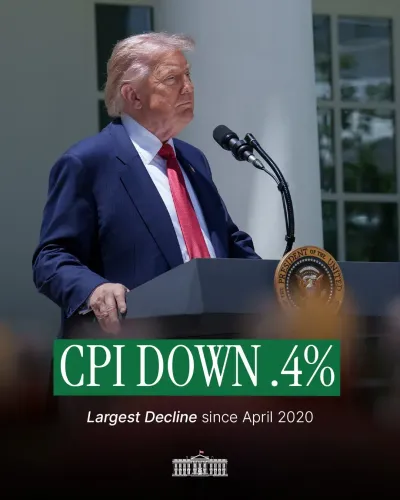
White House Flags Sharp Rise in US Consumer Confidence

Synopsis
The White House announced a sharp rise in U.S. consumer confidence for October 2026. As consumer spending drives ~70% of U.S. GDP, the reading is a key forward signal for retail demand, Federal Reserve policy deliberations, and global trade flows heading into the holiday season.
Key Takeaways
The White House reported a sharp rise in U.S. consumer confidence in October 2026 .
Consumer spending accounts for roughly 70 percent of U.S.
GDP , making confidence data a critical leading economic indicator.
A strong October print is closely watched by retailers ahead of the November–December holiday season .
The Federal Reserve monitors confidence indices alongside personal consumption expenditure data when making interest-rate decisions.
Analysts will look to the November consumer confidence release to confirm whether October's gain signals a durable trend.
American households are feeling measurably better about the economy. The White House flagged on Tuesday, 27 October 2026 that U.S. consumer confidence rose sharply in October — a headline that lands at the intersection of household sentiment, Federal Reserve deliberations, and the broader narrative of where the world's largest economy is headed.
Why a confidence number can move markets and policy
Consumer confidence indices are compiled monthly by private research organisations and function as leading indicators — a window into whether Americans plan to spend, save, or pull back. Because consumer spending drives roughly 70 percent of U.S. GDP, a sharp monthly uptick is more than a mood reading. It is a forward signal for retail sales, personal consumption expenditure figures, and, crucially, the Federal Reserve's read on demand conditions as it calibrates interest-rate decisions.
Administrations across party lines have routinely amplified strong confidence prints as evidence of economic momentum. A 'sharp' rise — the qualifier used in the White House post — carries particular weight because it suggests a directional shift, not a marginal drift.
What the October reading means for U.S. households and businesses
For ordinary Americans, a confidence rebound signals that more households feel secure enough in their jobs and finances to consider big-ticket purchases — cars, appliances, home improvements. For retail businesses heading into the all-important November–December holiday season, an October confidence surge is precisely the pre-season data point they watch most closely.
The timing matters globally, too. As the U.S. economy goes, so go trade flows, commodity demand, and capital allocation across emerging markets — including India, whose export and investment cycles are closely tethered to American consumption.
The next test: November data and Fed signals
One strong month does not a trend make. Analysts will be watching whether the November consumer confidence release confirms or reverses October's jump, and whether personal consumption expenditure data — the Fed's preferred inflation and spending gauge — echoes the same upward tilt. A sustained confidence recovery would strengthen the case that the U.S. economy is building durable momentum, not merely bouncing from a soft patch.
The White House will be watching those numbers just as closely as Wall Street does — and so will every finance ministry that exports to American consumers.
Point of View
And administrations deploy it precisely because it translates immediately into a narrative of everyday economic wellbeing. Whether the October reading reflects a genuine structural improvement or a single-month rebound will determine how durable that narrative proves. For India and other emerging-market economies, sustained U.S. consumer optimism remains a bellwether for export demand and capital flows.
NationPress
28 Oct 2026
Frequently Asked Questions
What is the U.S. consumer confidence index?
The U.S. consumer confidence index is a monthly survey-based measure compiled by private research organisations that tracks how optimistic or pessimistic American households feel about current and future economic conditions, including jobs and income.
Why did the White House post about consumer confidence rising?
The White House highlighted the sharp October 2026 rise to signal positive economic momentum, as consumer spending drives about 70 percent of U.S. GDP and strong sentiment is a leading indicator of future household expenditure.
How does U.S. consumer confidence affect India?
Higher U.S. consumer confidence typically boosts American spending, which increases demand for imports — including goods and services from India — and can attract more capital investment into emerging markets like India.
What does a 'sharp rise' in consumer confidence mean?
A sharp rise indicates a significant month-on-month improvement in household sentiment, suggesting that a meaningful share of Americans feel more secure about their jobs and finances than they did the previous month — a stronger signal than a marginal uptick.
What data comes after consumer confidence that analysts will watch?
Analysts will focus on the November consumer confidence release and the personal consumption expenditure figures, which is the Federal Reserve's preferred measure of household spending and inflation.