CM Assam Highlights Women's Empowerment Drive Under Himanta
Synopsis
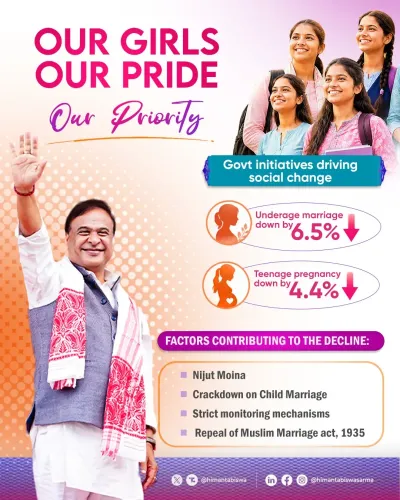
The Chief Minister's Office of Assam credited CM Dr. Himanta Biswa Sarma's government with advancing women's safety, education, healthcare, and livelihoods, framing women as the driving force behind the state's development push and highlighting progress on reducing child marriage.
Key Takeaways
The Chief Minister's Office of Assam posted on June 6, 2026 highlighting women's empowerment as central to the state's development agenda.
Himanta Biswa Sarma has led the BJP government in Assam since May 2021 , with women's welfare as a stated priority.
The state intensified enforcement of the Prohibition of Child Marriage Act and expanded girls' residential schooling under schemes including KGBV and Gunotsav .
The Orunodoi scheme provides monthly direct financial assistance to economically weaker women across Assam .
Key focus areas cited include women's safety, education, healthcare, and economic empowerment through livelihoods and skill development.
Independent verification of outcomes will depend on forthcoming NFHS or state health survey data and the 2026-27 Assam budget allocations.
The Chief Minister's Office of Assam on Saturday, June 6, 2026, highlighted the state government's multi-pronged push for women's empowerment, citing gains in safety, education, healthcare, and economic opportunity under the leadership of Chief Minister Dr. Himanta Biswa Sarma.
Context
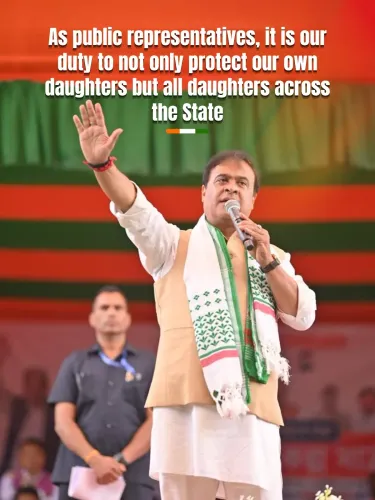
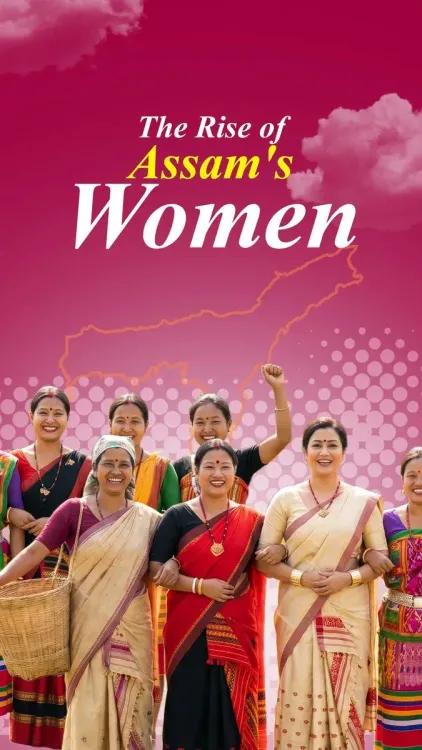
The official post from the Chief Minister's Office declared that 'women are powering the rise of a new Assam,' pointing to focused state initiatives as the engine of this transformation. The message specifically credited CM Dr. Himanta Biswa Sarma's administration for opening new opportunities for women across Assam through targeted policy action. The communication underscores a broader government effort to position women's welfare as central to the state's development story.
Policy Backdrop
Assam has historically recorded elevated rates of child marriage and significant gender gaps in education and workforce participation — challenges that successive governments have grappled with across the northeastern state. Since May 2021, when Dr. Himanta Biswa Sarma assumed office leading a BJP-led government, the administration intensified enforcement of the Prohibition of Child Marriage Act alongside community awareness drives aimed at adolescent girls and their families. State budgets in the years following 2021 also expanded scholarships and residential schooling for girls under schemes such as Gunotsav and the Kasturba Gandhi Balika Vidyalaya (KGBV) programme.
The flagship Orunodoi scheme — a monthly direct financial assistance programme for economically weaker women launched in 2020 — has continued under the current government as a key instrument of economic inclusion. Such direct-benefit transfers are designed to reduce household financial vulnerability and give women greater agency over spending decisions. The scheme is among the most visible symbols of the state's stated commitment to women-centric welfare delivery.
Stakeholders and Impact
The primary beneficiaries of these initiatives are the women and adolescent girls of Assam, spanning rural and semi-urban communities where barriers to education and livelihoods have historically been most acute. Reducing child marriage directly protects adolescent girls from early school dropout, health risks associated with early pregnancy, and long-term economic marginalisation. Expanded access to residential schooling and scholarships, meanwhile, targets first-generation learners in districts where girls' enrolment and retention rates have lagged.
On the economic empowerment front, schemes linking women to self-help groups, skill development programmes, and direct cash transfers are intended to raise female labour-force participation — a metric that remains a key indicator of inclusive growth in Assam and across India's northeastern region. The state government's framing of women as active agents of Assam's prosperity, rather than passive beneficiaries, reflects a wider shift in how Indian state governments communicate welfare policy.
What's Next
Analysts and civil society groups will look to the next round of national family health survey data or a dedicated state health survey to independently assess the measurable impact of Assam's child marriage crackdown and girls' education push. Any new budgetary allocations for women's livelihood schemes in the 2026-27 Assam budget session will be closely watched as a signal of the government's continued financial commitment to these priorities. The trajectory of female labour-force participation and school retention rates in the state will ultimately determine whether the 'new Assam' narrative translates into durable, ground-level change.
Point of View
Positioning the Himanta Biswa Sarma administration's social-sector record as a development achievement ahead of what is likely a period of heightened political attention. The emphasis on reducing child marriage and expanding girls' education taps into metrics that resonate both with national policy priorities and with international development benchmarks, giving the narrative a credibility anchor beyond partisan messaging. This mirrors a pattern across BJP-governed states of wrapping welfare delivery in an economic-growth frame — women not merely as beneficiaries but as agents of prosperity — which has proven effective in broadening the political appeal of social programmes. The real test of this narrative will come when independent survey data quantifies the actual change in child marriage prevalence, female school retention, and labour-force participation in Assam.
NationPress
19 Sept 2026
Frequently Asked Questions
What is the Assam government doing for women's empowerment in 2026?
The Assam government under CM Dr. Himanta Biswa Sarma is pursuing initiatives covering women's safety, education, healthcare, and economic empowerment, including enforcement of child marriage laws, expansion of girls' residential schooling, and direct financial assistance through the Orunodoi scheme.
What is the Orunodoi scheme in Assam?
Orunodoi is Assam's flagship monthly financial assistance programme for economically weaker women, launched in 2020 and continued under the current BJP-led government as a tool for economic inclusion.
Has Assam reduced child marriage?
The Assam government has intensified enforcement of the Prohibition of Child Marriage Act since 2021 and conducted community awareness drives, but independent verification of specific reduction figures will depend on forthcoming national family health survey or state health survey data.
Who is the Chief Minister of Assam?
Dr. Himanta Biswa Sarma has served as the Chief Minister of Assam since May 2021, leading a BJP-led state government.
What schemes support girls' education in Assam?
Assam has expanded scholarships and residential schooling for girls under schemes including Gunotsav and the Kasturba Gandhi Balika Vidyalaya (KGBV) programme, targeting first-generation learners in districts with lower girls' enrolment.