CM Pema Khandu hails Padma Shri for Ao Naga folk guardian
Synopsis
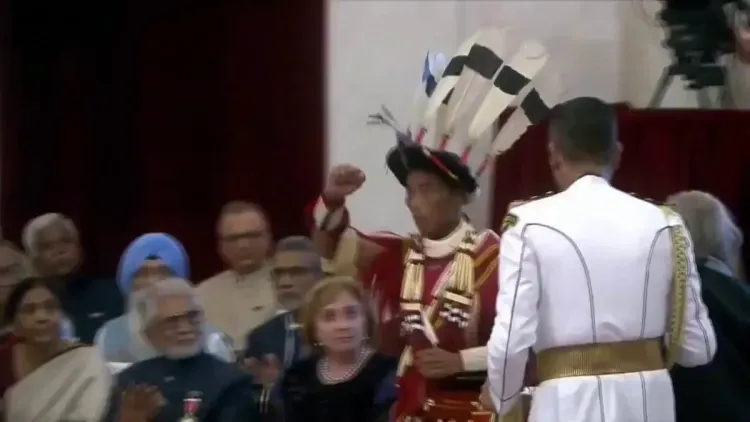
Arunachal Pradesh CM Pema Khandu lauded the Padma Shri awarded to Guru Sangyusang Pongener, who has trained over 2,000 artists in Ao Naga folk traditions, calling it a recognition of India's grassroots cultural custodians and crediting PM Modi's reforms to the Padma Awards process.
Key Takeaways
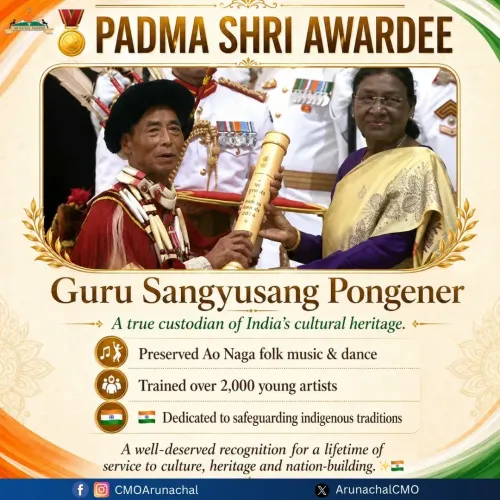
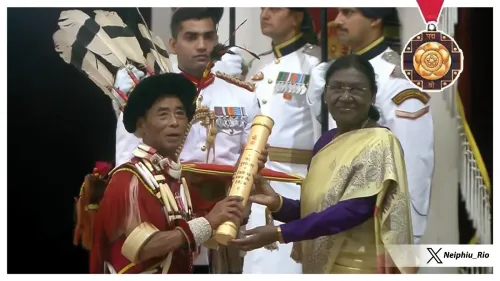
CM Pema Khandu publicly celebrated the Padma Shri conferred on Guru Sangyusang Pongener , an Ao Naga folk music and dance practitioner.
Pongener is credited with training over 2,000 young artists in Ao Naga folk music and dance .
Khandu linked the award to reforms by PM Narendra Modi after 2014 that opened Padma nominations to the public and prioritised unsung contributors.
Since 2014 , Padma lists have included a higher proportion of recipients from the Northeast and traditional performing arts.
The recognition is seen as symbolic validation for grassroots cultural custodians across India's tribal Northeast communities.
Observers will watch for follow-up state-level schemes to document and preserve Ao Naga and other Naga folk traditions.
Arunachal Pradesh Chief Minister Pema Khandu on Wednesday, 24 June 2026, publicly celebrated the Padma Shri conferred on Guru Sangyusang Pongener, an Ao Naga folk musician and dance trainer from the Northeast, calling the honour a recognition not just of one individual but of India's broader community of grassroots cultural custodians.
Context
In his post, CM Khandu described Guru Sangyusang Pongener as someone who has trained over 2,000 young artists and dedicated his life to preserving Ao Naga folk music and dance — a living tradition of the Ao community of Nagaland. Khandu wrote that Pongener 'has kept a priceless part of India's heritage alive,' framing the Padma Shri as a well-deserved tribute to 'countless grassroots custodians of India's civilizational heritage.'
The Ao Naga community is one of the major tribal groups of Nagaland in India's Northeast, with a rich oral and performative tradition that has historically received limited mainstream attention. Folk practitioners such as Pongener occupy a critical role in transmitting these traditions across generations.
Policy Backdrop
Khandu explicitly linked the recognition to reforms introduced under Prime Minister Narendra Modi after 2014, when the central government opened Padma Award nominations to the general public and began prioritising unsung contributors in arts, culture, and social service over established celebrities. 'One of the biggest changes under PM Modi has been that the Padma Awards now honour India's silent nation-builders, not just the famous,' Khandu stated.
Since 2014, successive Padma lists have featured a notably higher number of recipients from the Northeast and from traditional performing arts, consistent with the government's stated emphasis on India's intangible cultural heritage. The shift has been widely noted as a structural departure from earlier award cycles that tended to favour prominent public figures.
Stakeholders and Impact
For folk artists and indigenous cultural communities across the Northeast, national recognition of a practitioner like Guru Sangyusang Pongener carries symbolic weight beyond the individual. It signals institutional acknowledgement of oral and performative traditions that exist largely outside formal cultural infrastructure.
The tribute by a senior BJP leader and sitting Chief Minister also reflects the party's broader political messaging around cultural nationalism and the preservation of India's civilizational identity — themes that resonate strongly in states with rich tribal heritage such as Arunachal Pradesh and Nagaland. Community organisations working on documentation of Ao and other Naga folk forms stand to benefit from the increased visibility such recognition brings.
What's Next
Attention will now turn to whether state governments in the Northeast, including Arunachal Pradesh, follow up with dedicated schemes for documentation and archiving of folk traditions similar to those practised by Guru Sangyusang Pongener. The next annual Padma Awards cycle will also be watched to see whether the trend of honouring grassroots Northeast cultural figures continues to deepen.
For the Ao Naga community, the recognition is an opportunity to press for greater institutional support — from state arts councils to school curricula — that can sustain folk music and dance traditions beyond individual champions.
Point of View
Khandu reinforces the party's claim that it has democratised prestige — shifting recognition from urban elites to rural and tribal custodians. For the Northeast, where identity politics and cultural assertion are deeply intertwined with electoral dynamics, such signals carry weight beyond ceremony. The post fits a well-established pattern of BJP state leaders amplifying grassroots Padma recipients as proof of a more inclusive national recognition architecture.
NationPress
22 Sept 2026
Frequently Asked Questions
Who is Guru Sangyusang Pongener?
Guru Sangyusang Pongener is an Ao Naga folk musician and dance trainer from Nagaland credited with training over 2,000 young artists and preserving Ao Naga folk music and dance traditions. He was awarded the Padma Shri for his contributions to India's intangible cultural heritage.
Why did CM Pema Khandu praise the Padma Shri for Guru Sangyusang Pongener?
Arunachal Pradesh Chief Minister Pema Khandu praised the award on 24 June 2026, calling it a recognition of India's grassroots cultural custodians and linking it to PM Modi's post-2014 reforms that opened Padma nominations to ordinary citizens and unsung contributors.
How have Padma Awards changed under PM Modi?
After 2014, the central government opened Padma Award nominations to the general public and began prioritising grassroots workers in arts, culture, and social service, resulting in a higher proportion of recipients from the Northeast and traditional performing arts communities.
What is Ao Naga folk music and dance?
Ao Naga folk music and dance are traditional performative arts of the Ao community, one of the major tribal groups of Nagaland in India's Northeast. These traditions are transmitted orally and through community practice, and have historically received limited mainstream institutional support.
What is the significance of the Padma Shri for Northeast cultural artists?
For folk artists and indigenous communities in the Northeast, a Padma Shri carries symbolic weight as national institutional acknowledgement of oral and performative traditions that exist largely outside formal cultural infrastructure, and can increase visibility and support for preservation efforts.