CM Pema Khandu Marks Partition Horrors Remembrance Day
Synopsis
On Partition Horrors Remembrance Day, Arunachal Pradesh Chief Minister Pema Khandu paid solemn tribute to the millions who suffered displacement and death during the 1947 Partition of India, urging the nation to remember and never repeat those horrors.
Key Takeaways
Arunachal Pradesh CM Pema Khandu posted a tribute on Partition Horrors Remembrance Day, 14 August .
He honoured victims who lost their lives and survivors who rebuilt from nothing after the Partition of 1947 .
The Government of India declared 14 August as Partition Horrors Remembrance Day in 2021 .
The observance falls on the eve of Independence Day as a deliberate counterpoint to the celebrations of 15 August .
Khandu's message is part of an annual pattern of official commemorations from state and central government leaders across India.
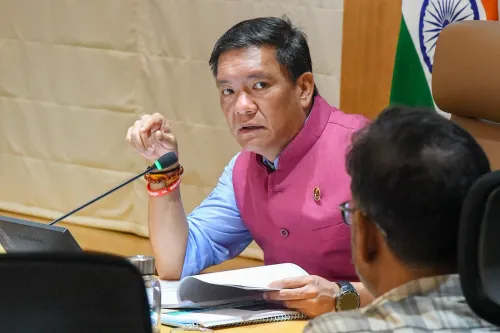
Seventy-nine years after one of history's most violent mass displacements, Arunachal Pradesh Chief Minister Pema Khandu joined the nation on 14 August in solemn remembrance of the millions who were uprooted, brutalised, and killed during the Partition of 1947 — a wound that still echoes in families across the subcontinent.
Posting on the occasion of Partition Horrors Remembrance Day, CM Khandu wrote: 'We remember the millions who endured unimaginable suffering, displacement and loss during the Partition of 1947. We pay tribute to those who lost their lives, honour the courage of those who rebuilt their lives from nothing, and remember the painful lessons of our history. May we never forget. May we never repeat.'
A Day Born from the Need to Never Look Away
The observance is not accidental. In 2021, the Government of India formally declared 14 August — the eve of Independence Day — as Partition Horrors Remembrance Day, specifically to ensure that the human cost of 1947 is not buried beneath the celebrations of freedom. The date is a deliberate counterweight: while 15 August marks the joy of independence, 14 August holds space for grief.
The Partition of British India into India and Pakistan triggered one of the largest forced migrations in recorded history. Millions were displaced across the newly drawn borders of Punjab and Bengal. Communities that had coexisted for generations were torn apart in weeks of communal violence that left hundreds of thousands dead.
State Leaders, a Shared Obligation
Chief Minister Khandu's message is part of a broader pattern of annual commemorations from state governments and the central leadership. Each year on this date, tributes flow from chief ministers and the Prime Minister alike — a coordinated act of national memory that the central government institutionalised to keep the lessons of 1947 in public consciousness.
The survivors who rebuilt their lives — arriving with nothing, in an unfamiliar land, in a newly born country — are the specific subjects of Khandu's tribute. Their resilience, he notes, is as much a part of the story as the horror itself.
History remembered with honesty is the only armour against its repetition — and that, above all, is what this day demands.
Point of View
Creating a coordinated national narrative around historical grief and unity. The day functions both as genuine commemoration and as a political signal — that the ruling dispensation claims custodianship of Partition memory. Whether that memory translates into concrete educational or archival programmes remains the more consequential question.
NationPress
29 Sept 2026
Frequently Asked Questions
What is Partition Horrors Remembrance Day?
Partition Horrors Remembrance Day is observed every year on 14 August to commemorate the victims and survivors of the 1947 Partition of India . The Government of India declared it in 2021 to ensure the human cost of Partition is remembered alongside the celebrations of Independence.
Why is Partition Remembrance Day on 14 August and not 15 August?
The date 14 August was chosen deliberately as the eve of Independence Day (15 August) , so that grief and remembrance are held alongside — not displaced by — the joy of freedom. It marks the day Pakistan was also created, making it a date of simultaneous birth and rupture.
What did Pema Khandu say on Partition Horrors Remembrance Day?
Arunachal Pradesh Chief Minister Pema Khandu paid tribute to those who lost their lives and honoured the courage of survivors who rebuilt from nothing. He called on the nation to remember the painful lessons of history and urged: 'May we never forget. May we never repeat.'
How many people were affected by the 1947 Partition of India?
The Partition of 1947 triggered one of the largest forced migrations in history, displacing millions across the borders of the newly created India and Pakistan , particularly in Punjab and Bengal , with hundreds of thousands killed in accompanying communal violence.
When did India declare 14 August as Partition Horrors Remembrance Day?
The Government of India declared 14 August as Partition Horrors Remembrance Day in 2021 , establishing it as an annual national observance to honour Partition victims and keep the lessons of 1947 in public memory.