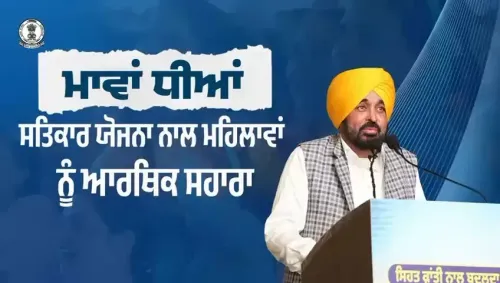
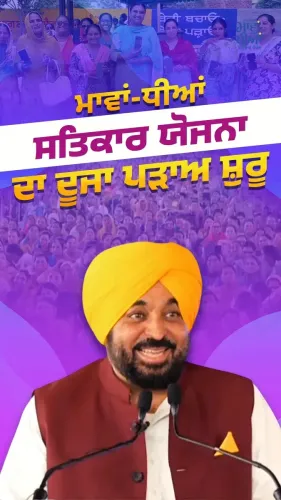
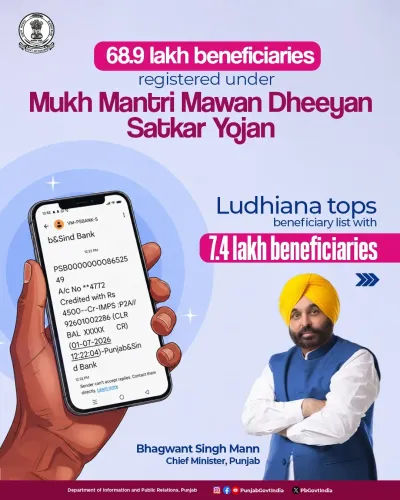
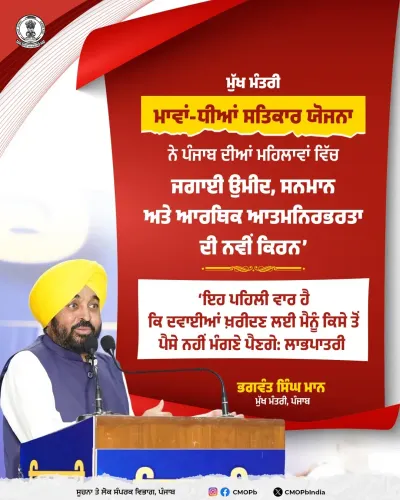
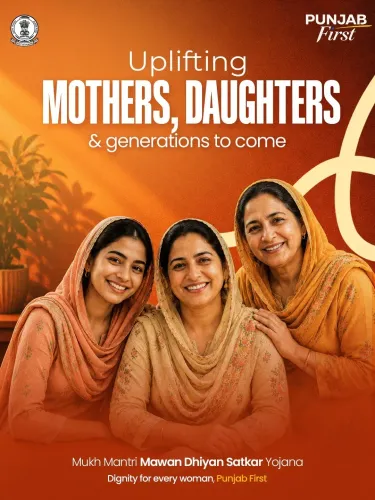
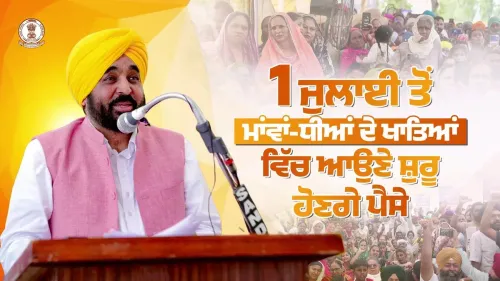
CM Bhagwant Mann to roll out Mawan Dheeyan Satkar Yojna from July 1
Synopsis
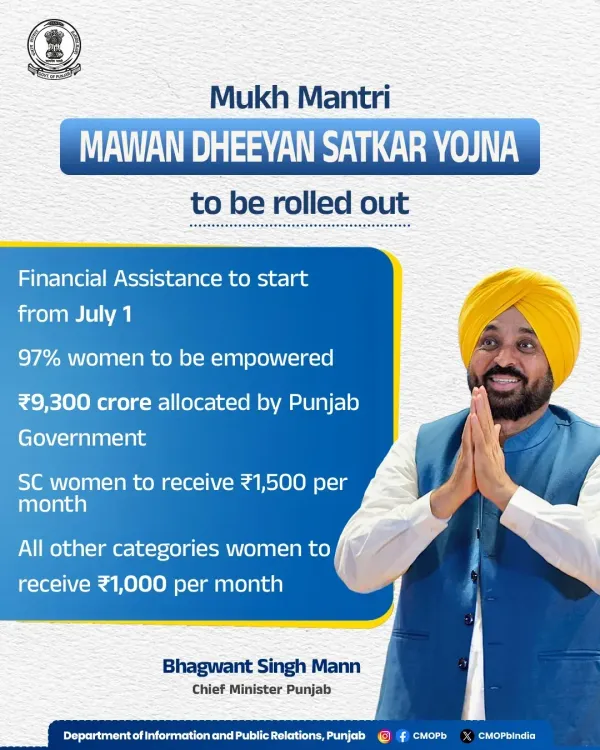
Punjab Chief Minister Bhagwant Singh Mann has announced that eligible women across the state will receive financial assistance under the Mukh Mantri Mawan Dheeyan Satkar Yojna from July 1, 2026, framing the scheme as a step toward women's financial independence and dignity.
Key Takeaways
The Chief Minister's Office of Punjab announced on June 6, 2026 that the Mukh Mantri Mawan Dheeyan Satkar Yojna will begin disbursements from July 1, 2026 .
CM Bhagwant Singh Mann reviewed the scheme's implementation before making the announcement.
The scheme is designed to provide financial assistance to eligible women across Punjab to promote financial independence and dignity.
Specific eligibility criteria and the benefit amount have not yet been officially detailed in public communications.
The initiative is part of the AAP government's broader social-sector welfare agenda in Punjab since March 2022 .
The rollout follows a wider national pattern of state governments using direct cash transfers targeted at women.
The Chief Minister's Office of Punjab announced on Saturday, June 6, 2026, that eligible women across the state will begin receiving financial assistance under the Mukh Mantri Mawan Dheeyan Satkar Yojna starting July 1, with Chief Minister Bhagwant Singh Mann reviewing the scheme's implementation and framing it as a step toward women's financial independence and dignity.
Context
CM Bhagwant Singh Mann stated that the initiative is 'aimed at strengthening women's financial independence and ensuring that they live with dignity and self-respect.' The announcement followed a review of the flagship scheme's implementation, signalling that the government considers the programme ready for statewide rollout. The July 1 date marks a firm administrative deadline for the first disbursements to reach eligible beneficiaries.
Policy Backdrop
The Mukh Mantri Mawan Dheeyan Satkar Yojna — whose name translates roughly to 'Chief Minister's Scheme for the Honour of Mothers and Daughters' — is among the Aam Aadmi Party government's flagship social-sector commitments in Punjab since it came to power in March 2022. Direct cash-transfer programmes targeting women have become a common instrument of state-level welfare policy across India, with governments of varying political persuasions using them to address economic vulnerability and improve household financial agency for women. Punjab's scheme follows this broader national pattern of expanding direct benefit transfers to female citizens.
The AAP administration in Punjab has positioned social-sector spending — spanning power subsidies, health, and education — as central to its governance model since taking office. The Mawan Dheeyan Satkar Yojna represents an extension of that approach into direct income support for women, a segment that welfare economists broadly identify as having high household-level multiplier effects when cash transfers are directed to female members.
Stakeholders and Impact
The primary beneficiaries are eligible women across Punjab, though specific eligibility criteria and the quantum of financial assistance have not yet been officially detailed in public communications. Once the July 1 rollout commences, the scale of impact will depend on how the government defines eligibility thresholds — factors such as income limits, age brackets, or household composition are typically used in comparable state schemes. Civil-society groups and women's organisations in the state have broadly welcomed direct-transfer schemes as tools for reducing financial dependence within households.
For the AAP government, a smooth launch carries political significance as well: welfare scheme delivery has been a key metric by which the party has sought to distinguish its governance record in Punjab.
What's Next
The government is expected to release detailed guidelines — covering eligibility norms, monthly benefit amounts, and the disbursement mechanism — ahead of the July 1 start date. Observers will also watch for any supplementary budget provisions or monitoring frameworks announced through subsequent government orders. The pace of enrolment and the share of eligible women who receive their first payment on or around July 1 will serve as early indicators of the scheme's administrative readiness and reach.
Point of View
Direct-benefit welfare deliverables. Setting a firm July 1 date publicly raises the administrative stakes: any delay in disbursements would invite scrutiny at a time when the party is keen to demonstrate execution capacity, not just policy ambition. The scheme also reflects a pan-India trend in which state governments — regardless of party — have increasingly turned to women-targeted cash transfers as a politically and socially resonant form of welfare. How the government defines eligibility and the scale of first-round coverage will determine whether the scheme is remembered as a meaningful income-support intervention or primarily as a political signalling exercise.
NationPress
21 Oct 2026
Frequently Asked Questions
What is the Mukh Mantri Mawan Dheeyan Satkar Yojna?
The Mukh Mantri Mawan Dheeyan Satkar Yojna is a Punjab government welfare scheme that provides financial assistance to eligible women in the state, aimed at promoting their financial independence and enabling them to live with dignity and self-respect.
When will women start receiving money under the Punjab scheme?
Eligible women across Punjab are set to start receiving financial assistance under the scheme from July 1, 2026 , as announced by CM Bhagwant Singh Mann on June 6, 2026.
Who is eligible for the Mukh Mantri Mawan Dheeyan Satkar Yojna?
The government has described the scheme as being for 'eligible women' across Punjab , but specific eligibility criteria — such as income thresholds, age limits, or household conditions — have not yet been officially detailed in public communications.
How much financial assistance will women get under the Punjab scheme?
The exact monthly benefit amount under the Mukh Mantri Mawan Dheeyan Satkar Yojna has not been officially confirmed in public communications as of the June 6, 2026 announcement; the government is expected to release detailed guidelines before the July 1 rollout.
Which party runs the Punjab government that launched this scheme?
The Aam Aadmi Party (AAP) , led by Chief Minister Bhagwant Singh Mann , has governed Punjab since March 2022 and is the government behind the Mukh Mantri Mawan Dheeyan Satkar Yojna.