Punjab CM Office: 68.9 Lakh Women Enrolled in Mawan Dheeyan Satkar Yojana
Synopsis
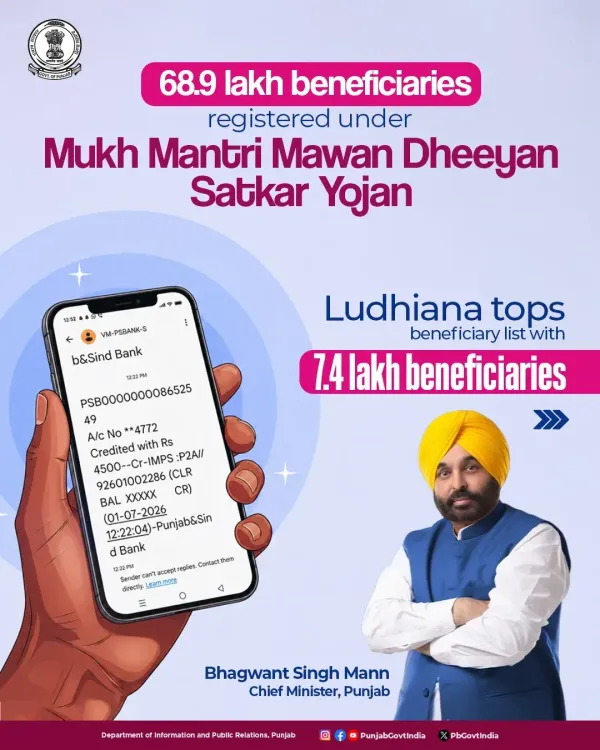
Punjab's Chief Minister's Office has announced that 68.9 lakh women are now registered under the Mukh Mantri Mawan Dheeyan Satkar Yojana, a monthly financial assistance scheme. Ludhiana leads all districts with 7.4 lakh enrolments, followed by Patiala, Amritsar, Jalandhar, Gurdaspur and Hoshiarpur.
Key Takeaways
The Punjab government has registered 68.9 lakh beneficiaries under the Mukh Mantri Mawan Dheeyan Satkar Yojana , a monthly cash-transfer scheme for eligible women.
Ludhiana leads all districts with 7.4 lakh enrolments , the highest in the state.
Other top-performing districts include Patiala , Amritsar , Jalandhar , Gurdaspur , and Hoshiarpur .
The scheme is a flagship welfare initiative of the Bhagwant Mann -led Aam Aadmi Party government, which took office in March 2022 .
The programme operates through direct benefit transfers linked to eligibility criteria including income and residency.
Future budget allocations and eligibility audits will determine the scheme's long-term sustainability.
The Chief Minister's Office of Punjab announced on Monday, 20 July 2026 that the state government has registered 68.9 lakh beneficiaries under the Mukh Mantri Mawan Dheeyan Satkar Yojana, a flagship social welfare scheme providing monthly financial assistance to eligible women across the state.
Context
The scheme, whose name translates from Punjabi as 'Mukh Mantri Mawan Dheeyan Satkar Yojana' ('Chief Minister's Respect for Mothers and Daughters Scheme'), was launched by the Bhagwant Mann-led Aam Aadmi Party government as part of its broader social welfare agenda. The programme delivers monthly cash assistance directly to women who meet the state's eligibility criteria, placing it within the growing family of direct benefit transfer initiatives that Punjab has rolled out since 2022. The official post from @CMOPbIndia described the scheme as a 'flagship social welfare scheme' designed to support women across every district of the state.
Policy Backdrop
The Aam Aadmi Party government in Punjab, which came to power in March 2022 under Chief Minister Bhagwant Mann, has made targeted welfare transfers a central pillar of its governance model. Monthly cash-transfer schemes for women have become a defining feature of several state governments across India, with administrations using district-level enrollment data to demonstrate outreach and administrative reach. Punjab's programme follows this broader national pattern, with eligibility typically anchored to income thresholds and residency requirements as set out in official notifications.
Direct benefit transfer architecture, which links payments to verified bank accounts, has been the preferred delivery mechanism for such schemes, reducing leakage and enabling real-time tracking of disbursements. The district-wise breakdown released by the CMO Punjab signals an active effort to publicise administrative performance and build public accountability around the scheme's rollout.
District-Level Impact
Ludhiana, Punjab's most populous district and a major industrial and agricultural centre, has emerged as the top-performing district with 7.4 lakh enrolments — the highest in the state. It is followed by Patiala, Amritsar, Jalandhar, Gurdaspur, and Hoshiarpur in terms of registered beneficiaries. The concentration of enrollments in these districts reflects both population density and the administrative capacity of local district offices to onboard eligible women at scale.
Across Punjab's 23 districts, the scheme's reach of 68.9 lakh women represents a substantial share of the state's female population, underscoring the programme's ambition as a mass-welfare intervention. District administrations have played a key operational role in identification, verification, and registration of beneficiaries.
What's Next
The sustainability of the Mukh Mantri Mawan Dheeyan Satkar Yojana will depend on state budget allocations in forthcoming fiscal cycles, as monthly cash transfers to nearly 69 lakh women represent a recurring and significant expenditure commitment. Analysts and civil society groups are likely to watch for official impact assessments and eligibility audits to evaluate whether disbursements are reaching intended beneficiaries without duplication or exclusion errors. The government's ability to maintain and expand enrollment while ensuring timely payments will be a key test of the scheme's long-term viability and political credibility ahead of future electoral cycles in Punjab.
Point of View
The scheme's scale rivals some of the largest state-run cash-transfer programmes in India, placing Punjab in a competitive position within the AAP's multi-state governance narrative. However, enrollment numbers alone do not confirm actual disbursement or beneficiary satisfaction, and the absence of independent impact data leaves room for scrutiny. The district-wise breakdown, led by industrially significant Ludhiana, also suggests the government is keen to demonstrate urban as well as rural reach ahead of future political cycles.
NationPress
20 Oct 2026
Frequently Asked Questions
What is the Mukh Mantri Mawan Dheeyan Satkar Yojana?
The Mukh Mantri Mawan Dheeyan Satkar Yojana is a Punjab state government scheme that provides monthly financial assistance to eligible women across the state, launched under Chief Minister Bhagwant Mann's Aam Aadmi Party government.
How many women have enrolled in the Mukh Mantri Mawan Dheeyan Satkar Yojana?
As of the announcement on 20 July 2026, a total of 68.9 lakh women have been registered as beneficiaries under the scheme across Punjab.
Which district has the most beneficiaries under the Punjab women's welfare scheme?
Ludhiana has the highest number of beneficiaries with 7.4 lakh enrolments, followed by Patiala, Amritsar, Jalandhar, Gurdaspur, and Hoshiarpur.
Who is eligible for the Mawan Dheeyan Satkar Yojana in Punjab?
The scheme targets eligible women in Punjab based on criteria such as income and residency, as specified in official government notifications. The exact eligibility rules are defined in the scheme's official guidelines.
How is the monthly financial assistance delivered under the Punjab women's scheme?
The assistance is delivered through direct benefit transfers linked to verified bank accounts, which is the standard mechanism used by Punjab and other state governments for such welfare programmes.