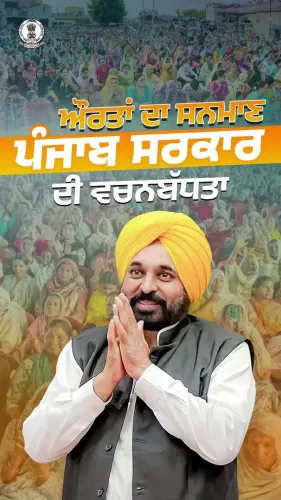
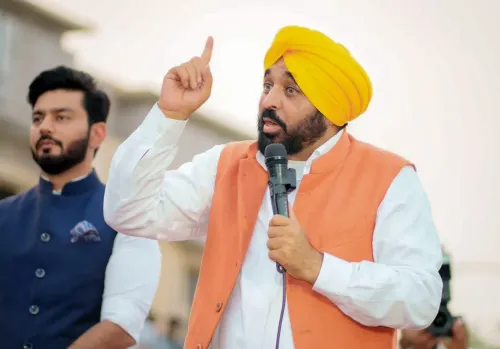
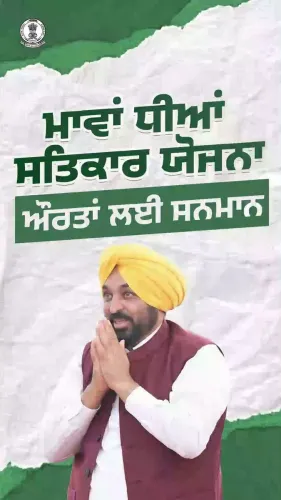
CM Mann urges Punjab women to register for Maavan Dhiyan Satkar Yojana
Synopsis
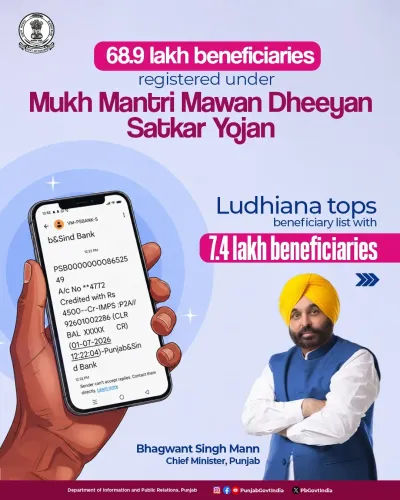
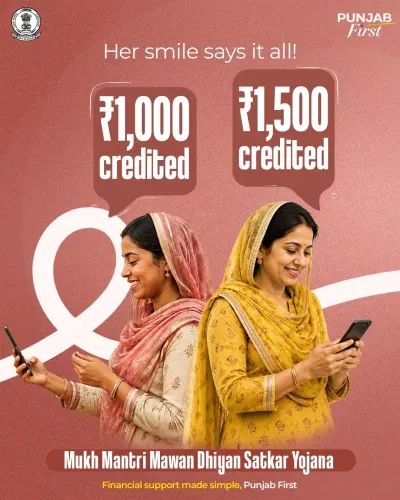
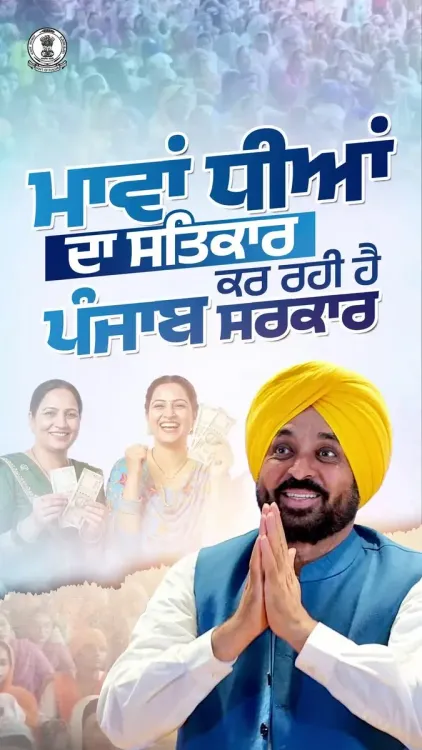
Chief Minister Bhagwant Mann has urged Punjab women to complete registration under the 'Maavan Dhiyan Satkar Yojana', which will provide Rs 1,000 per month to general category women and Rs 1,500 per month to Scheduled Caste women across the state as a monthly honour amount.
Key Takeaways
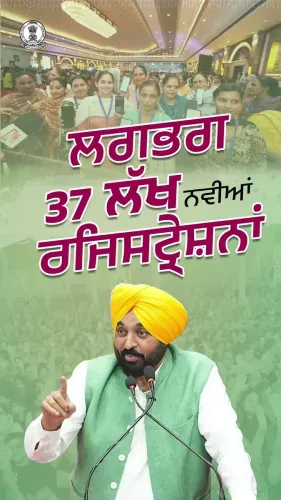
CM Bhagwant Mann publicly called on women across Punjab to complete registration under the Maavan Dhiyan Satkar Yojana and obtain their beneficiary cards.
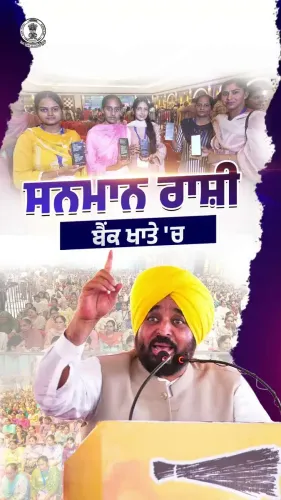
The scheme provides a monthly 'sanman rashi' (honour amount) of Rs 1,000 to eligible women statewide.
Women from Scheduled Caste communities will receive an enhanced amount of Rs 1,500 per month .
The announcement was made by the Chief Minister's Office of Punjab on 28 May 2026 .
Disbursements are contingent on beneficiaries completing the registration process and receiving their scheme cards.
The scheme aligns with AAP's broader 2022 election manifesto commitment to direct financial assistance for women in Punjab.
The Chief Minister's Office of Punjab announced on Thursday, 28 May 2026 that Chief Minister Bhagwant Mann has urged women across the state to complete their registration and obtain beneficiary cards under the 'Maavan Dhiyan Satkar Yojana' (Mothers-Daughters Respect Scheme), a monthly cash transfer programme promising Rs 1,000 per month to eligible women and Rs 1,500 per month to women from the Scheduled Caste (SC) community.
What the scheme offers
Addressing women across Punjab, CM Mann said — in Punjabi — 'ਮਾਵਾਂ ਧੀਆਂ ਸਤਿਕਾਰ ਯੋਜਨਾ' ('Maavan Dhiyan Satkar Yojana') will provide a monthly 'honour amount' (sanman rashi) to women statewide. General category beneficiaries will receive Rs 1,000 per month, while women belonging to Scheduled Caste communities will receive Rs 1,500 per month. The Chief Minister specifically called on women to ensure their registration process is completed and their beneficiary cards obtained without delay.
Context
The Aam Aadmi Party swept to power in Punjab in the March 2022 assembly elections, with a manifesto that prominently featured direct financial assistance to women and low-income households. The scheme's name — invoking mothers and daughters — reflects a pattern of gender-targeted welfare branding adopted by several Indian state governments in recent years. The differentiated payout for SC women signals an attempt to layer caste-based equity into the programme's design.
Policy backdrop
Since 2022, multiple Indian state governments have rolled out monthly cash transfer schemes aimed specifically at women, making such programmes a visible marker of competitive welfare politics. Punjab's AAP administration has consistently prioritised direct benefit transfers as a core delivery mechanism. Schemes of this kind typically require a structured registration drive and the issuance of physical or digital beneficiary cards before disbursements can begin — making CM Mann's public appeal for registration a critical operational step.
Stakeholders and impact
The primary beneficiaries are women across Punjab, with a specific enhanced benefit tier for SC community women — a demographic that has historically faced compounded economic disadvantage. The registration-and-card model means the scheme's reach will depend directly on outreach infrastructure at the district and block level. Civil society groups and panchayat bodies are likely to play a role in ensuring last-mile registration, particularly in rural areas.
What's next
The immediate priority, as signalled by CM Mann's public address, is driving up registration numbers before disbursements begin. Observers will watch Punjab's state budget allocations to assess whether sufficient funds have been earmarked for sustained monthly payouts across all eligible beneficiaries. The timeline for first payments and the geographic roll-out across Punjab's 23 districts will be key indicators of the scheme's operational credibility.
Point of View
The AAP government is attempting to address intersecting vulnerabilities of gender and caste, a design choice that could broaden the scheme's political coalition. This fits a wider pattern across Indian states where monthly cash transfers to women have become a primary arena of competitive welfare politics ahead of electoral cycles. The real test will be whether Punjab's administrative machinery can translate the registration drive into timely, sustained disbursements at scale.
NationPress
19 Sept 2026
Frequently Asked Questions
What is Maavan Dhiyan Satkar Yojana in Punjab?
The Maavan Dhiyan Satkar Yojana is a Punjab government scheme that provides a monthly financial assistance of Rs 1,000 to eligible women across the state and Rs 1,500 per month to women from Scheduled Caste communities, as announced by CM Bhagwant Mann.
How much money will Punjab women get under Bhagwant Mann's new scheme?
General category women will receive Rs 1,000 per month, while women belonging to Scheduled Caste communities will receive Rs 1,500 per month under the Maavan Dhiyan Satkar Yojana.
How do Punjab women register for Maavan Dhiyan Satkar Yojana?
CM Bhagwant Mann has urged women to complete their registration process and obtain their beneficiary cards; specific registration details and portal information are expected to be shared through official Punjab government channels.
Who is eligible for Punjab's Maavan Dhiyan Satkar Yojana?
Women across Punjab are eligible for the scheme, with Scheduled Caste women receiving a higher monthly amount of Rs 1,500 compared to Rs 1,000 for other eligible women.
What welfare schemes has AAP launched for women in Punjab?
The AAP government in Punjab has prioritised direct benefit transfers for women since coming to power in 2022, with the Maavan Dhiyan Satkar Yojana being the latest scheme offering monthly cash assistance to women statewide.