CM Mann Launches Mawan Dhiyan Satkar Yojna in Punjab
Synopsis
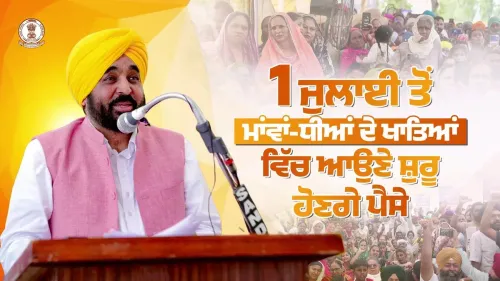
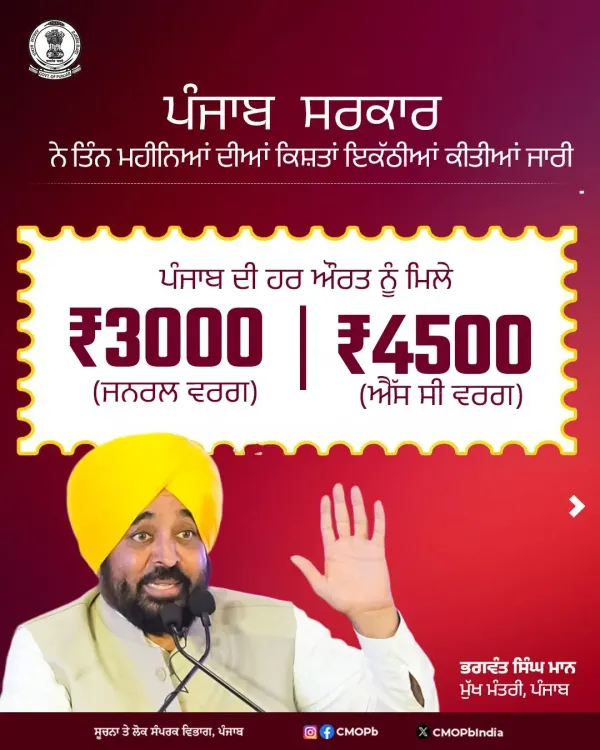
The Punjab government under CM Bhagwant Singh Mann launched the Mukh Mantri Mawan Dhiyan Satkar Yojna in Dhuri on 2 July 2026, directly transferring three months of cash support — ₹3,000 per woman and ₹4,500 for SC women — into bank accounts via DBT, with SMS confirmations arriving during the event itself.
Key Takeaways
Punjab's Mukh Mantri Mawan Dhiyan Satkar Yojna was officially launched by CM Bhagwant Singh Mann on 2 July 2026 in Dhuri , Sangrur district.
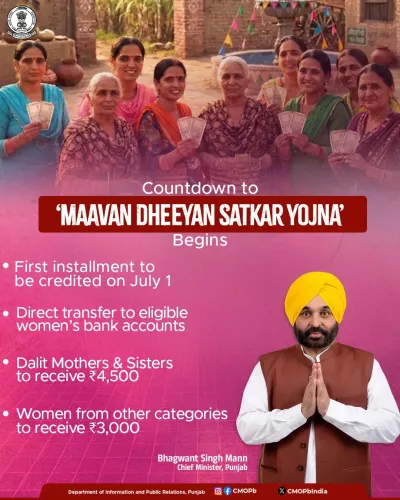
Every eligible woman receives ₹3,000 per quarter as satkar raashi ; women from Scheduled Caste categories receive ₹4,500 per quarter.
The first disbursement covered three months of the allowance, credited directly to beneficiaries' bank accounts via DBT .
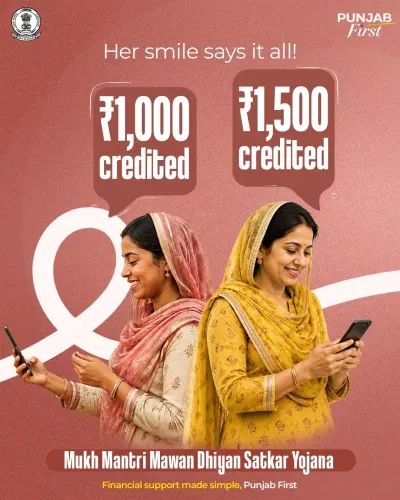
Payments began reaching beneficiaries during the launch event itself , with women receiving SMS confirmations on their mobile phones in real time.
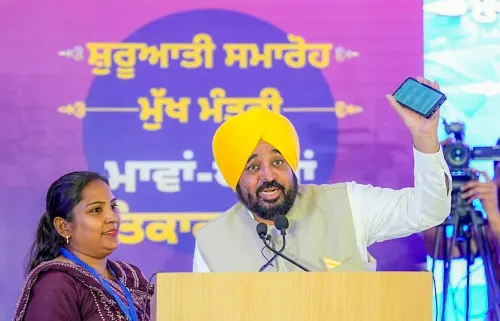
The scheme was activated through a dedicated web portal launched at the Dhuri event.
The initiative follows a national trend of state-level unconditional cash transfers for women, with Punjab adding a caste-differentiated payout structure .
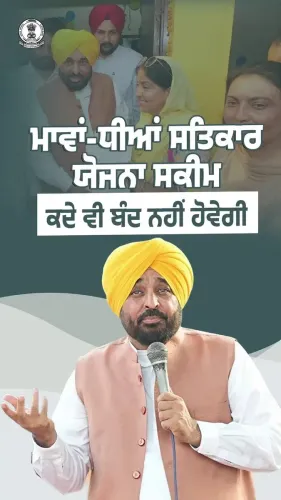
The Chief Minister's Office of Punjab announced on 2 July 2026 that the Bhagwant Singh Mann-led Punjab government has launched the 'Mukh Mantri Mawan Dhiyan Satkar Yojna', a direct cash-transfer scheme for women across the state, with payments beginning at the launch event itself in Dhuri, Sangrur district.
What the Scheme Offers
Under the scheme, every eligible woman beneficiary receives ₹3,000 as a quarterly satkar raashi (respect amount), while women from Scheduled Caste categories receive a higher payout of ₹4,500 per quarter. The differential amount for SC women reflects a deliberate policy choice to layer welfare support over existing social equity commitments. The first disbursement covered three months of the satkar amount, credited directly into beneficiaries' bank accounts via the Direct Benefit Transfer (DBT) mechanism.
The post states that women received SMS confirmations on their mobile phones as payments hit their accounts during the event itself — a real-time disbursement model that mirrors the digital infrastructure used in similar schemes across India. The scheme was activated through a dedicated web portal launched by CM Bhagwant Mann at the Dhuri venue.
Context: A State-Level Women's Cash-Transfer Wave
Punjab's Mawan Dhiyan Satkar Yojna is part of a broader national pattern in which state governments have introduced unconditional or semi-conditional cash transfers for adult women, framed as social respect or empowerment measures. Madhya Pradesh's Ladli Behna Yojana, launched in 2023, is widely credited with popularising this model and influencing policy design in other states. Punjab's version adopts the same Aadhaar-linked bank account and SMS-alert architecture for rapid, verifiable disbursement.
The Aam Aadmi Party (AAP) government in Punjab, which took office in March 2022, has consistently positioned direct benefit transfers as a core governance tool, building on national DBT infrastructure that has expanded significantly since 2014. The choice of Dhuri — a constituency with political significance in Sangrur district — as the launch venue underlines the scheme's public-facing rollout strategy.
Stakeholders and Impact
The scheme targets lakhs of women across Punjab, as described in the official post, with Scheduled Caste women receiving a 50 per cent higher quarterly amount. The dual-tier structure acknowledges intersecting vulnerabilities of gender and caste, a design feature that distinguishes Punjab's scheme from flat-rate counterparts in other states. Beneficiaries are identified through a dedicated web portal, suggesting a registration or eligibility-verification process, though precise eligibility criteria and the total number of enrolled beneficiaries have not been officially disclosed in the post.
The immediate SMS-based credit confirmation at the launch event served as a visible proof-of-concept, with women receiving real-time alerts — a detail the CMO highlighted to demonstrate the scheme's operational readiness and the government's commitment to seamless delivery.
What's Next
The government is expected to publish full eligibility guidelines, the total beneficiary count, and the annual budget outlay for the scheme in the coming weeks. Scrutiny will focus on the sustainability of the quarterly payout cycle and whether the portal-based registration process is accessible to women in rural and remote parts of Punjab. A possible expansion of the beneficiary base or revision of payout amounts after the initial three-month cycle will be a key indicator of the scheme's long-term fiscal and political trajectory.
Point of View
The AAP government is attempting to consolidate two politically significant constituencies — women and Dalits — ahead of future electoral cycles. The real-time SMS disbursement at the launch event was as much a media moment as an administrative milestone, designed to generate immediate, verifiable proof of delivery. The scheme's long-term credibility will hinge on the transparency of its eligibility process and the fiscal headroom Punjab's constrained finances allow for sustaining quarterly payouts at scale.
NationPress
2 Jul 2026
Frequently Asked Questions
What is the Mukh Mantri Mawan Dhiyan Satkar Yojna?
The Mukh Mantri Mawan Dhiyan Satkar Yojna is a Punjab government scheme that provides quarterly direct cash transfers to eligible women as a mark of respect, with general category women receiving ₹3,000 and Scheduled Caste women receiving ₹4,500 per quarter.
How much money will women get under Punjab's Satkar Yojna?
Eligible women receive ₹3,000 every quarter under the scheme, while women belonging to the Scheduled Caste category receive ₹4,500 per quarter, transferred directly to their bank accounts.
Where was the Mukh Mantri Mawan Dhiyan Satkar Yojna launched?
CM Bhagwant Singh Mann launched the scheme through a dedicated web portal at an event held in Dhuri, a town in Punjab's Sangrur district, on 2 July 2026.
Who is eligible for the Punjab Mawan Dhiyan Satkar Yojna?
The scheme targets women across Punjab, with Scheduled Caste women receiving a higher payout. Precise eligibility criteria are to be published through the scheme's dedicated web portal; the government has not yet released the full list of qualifying conditions.
How will payments be made under the Satkar Yojna?
Payments are made via Direct Benefit Transfer (DBT) directly into beneficiaries' Aadhaar-linked bank accounts, with SMS confirmations sent to their mobile phones as soon as the credit is processed.