CM Mohan Yadav: MP rolls out 25+ policies for investment and jobs
Synopsis
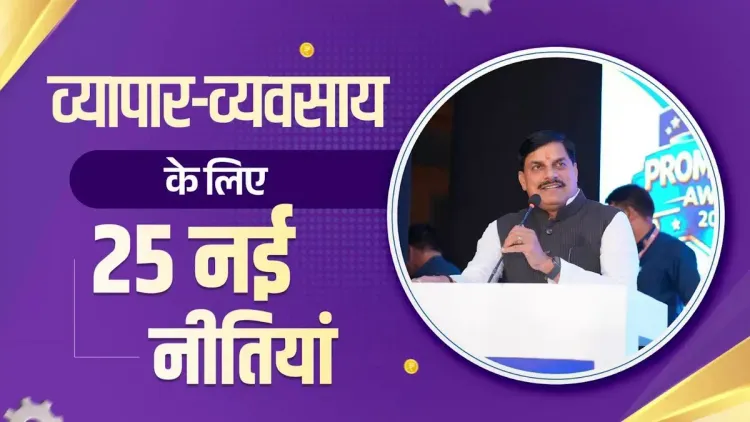
Chief Minister Dr. Mohan Yadav announced that Madhya Pradesh has introduced more than 25 new sector-specific policies spanning energy, mining, and small industries, targeting fresh investment inflows and employment generation across the state.
Key Takeaways
More than 25 new policies have been introduced by the Madhya Pradesh government across multiple economic sectors.
Policy coverage spans energy, mining and small-scale industries (MSMEs) — a deliberately broad cross-sector strategy.
The stated goals are expanding investment, industrial activity and employment in the state.
Mohan Yadav framed the moves as part of continuously strengthening the state's economic and financial framework.
The approach mirrors competitive federalism seen across Indian states vying for private capital and ease-of-doing-business rankings.
Actual outcomes will be tested against future investment data, job figures and state budget disclosures.
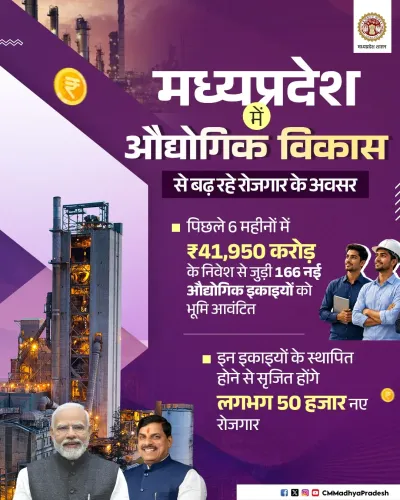
Madhya Pradesh is pushing its economic engine harder — Chief Minister Dr. Mohan Yadav declared on Saturday, September 26, 2026, that the state has introduced more than 25 new policies spanning sectors from energy and mining to small-scale industries, all aimed at unlocking investment, industrial growth, and fresh employment opportunities.
A policy blitz across energy, mining and MSMEs
Speaking publicly, CM Yadav stated: 'ऊर्जा और माइनिंग सेक्टर से लेकर लघु उद्योगों तक, सरकार 25 से अधिक नई नीतियां लेकर आई है' — ('From the energy and mining sector to small industries, the government has brought more than 25 new policies'). The breadth of the announcement is notable: rather than targeting one vertical, the state is laying a multi-sector policy grid designed to draw private capital and generate jobs simultaneously.
Madhya Pradesh, a resource-rich central Indian state with significant coal and mineral reserves, has historically struggled to translate its natural endowment into proportionate industrial output. A coordinated policy push across the energy-mining-MSME chain signals an attempt to close that gap — and to improve state finances through expanded industrial activity.
MP's bet in the competitive federalism race
What CM Yadav is describing fits a well-established pattern across Indian states: sector-specific reform packages designed to sharpen ease-of-doing-business rankings and outcompete neighbours for investment flows. States like Gujarat, Tamil Nadu and Telangana have long used targeted industrial policy as leverage in this race. Madhya Pradesh's multi-pronged approach — anchoring reforms simultaneously in heavy sectors like mining and energy alongside the more labour-intensive MSME tier — reflects a strategy to attract large capital while also building on the ground-level job creation that smaller enterprises deliver.
The emphasis on lagu udyog (small industries) is particularly pointed: MSMEs are the backbone of employment in the state's semi-urban and rural districts, and policy support here can have an outsized effect on household income and local demand.
What numbers will confirm the ambition
Announcements of this kind are measured ultimately by the data that follows: investment commitments signed at industrial summits, job-creation figures in state economic surveys, and revenue trends in successive state budgets. The government's next major accountability moment will come when Madhya Pradesh releases detailed policy documents and — more importantly — reports on actual capital deployed and employment generated under these frameworks.
For now, the signal from Bhopal is clear: the state intends to compete aggressively for post-2024 investment cycles, and it is betting that a dense, multi-sector policy architecture is the right instrument to do it.
Point of View
Where states increasingly use dense, sector-specific policy frameworks to attract private investment. The simultaneous targeting of capital-intensive sectors like energy and mining alongside labour-intensive MSMEs suggests a two-track strategy: fiscal revenue from large industry and ground-level job creation from smaller enterprises. However, the credibility of a '25-plus policies' claim rests entirely on implementation quality and verifiable outcomes — a benchmark the state's upcoming economic surveys will be expected to address. Bhopal's push reflects a broader BJP-governed-state template, but differentiation will come only through measurable delivery.
NationPress
26 Sept 2026
Frequently Asked Questions
How many new policies has the Madhya Pradesh government announced for economic growth?
Chief Minister Dr. Mohan Yadav stated that the government has introduced more than 25 new policies covering sectors including energy, mining and small industries to promote investment and employment.
Which sectors are covered under Madhya Pradesh's new economic policies?
The policies span the energy sector, the mining sector, and small-scale or micro, small and medium enterprises (MSMEs), aiming to create a broad base for industrial and economic growth.
What is the goal of Madhya Pradesh's new industrial policies in 2026?
The stated objectives are to boost investment inflows, accelerate industrial activity, and generate new employment opportunities across the state.
Who is the Chief Minister of Madhya Pradesh in 2026?
Dr. Mohan Yadav has been Chief Minister of Madhya Pradesh since late 2023 and is the leader driving the current round of economic and industrial policy reforms.
How does Madhya Pradesh compare with other states on industrial policy?
Madhya Pradesh's multi-sector policy push is consistent with competitive federalism across Indian states, where governments introduce targeted reforms to improve ease of doing business and attract private capital, similar to approaches seen in other states.