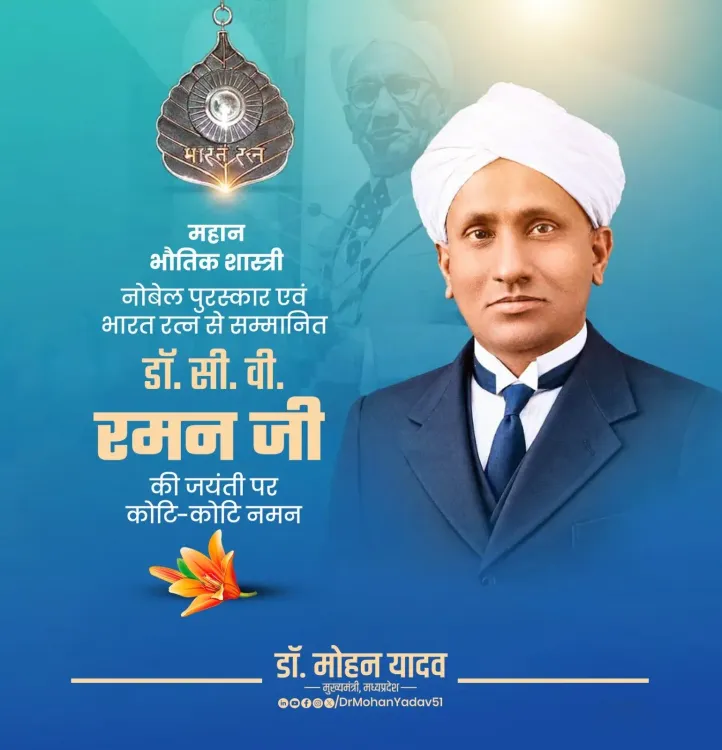
CM Mohan Yadav Pays Tribute to CV Raman on Birth Anniversary
Synopsis
Madhya Pradesh CM Dr. Mohan Yadav marked the birth anniversary of Nobel laureate Dr. C. V. Raman on 7 November 2026, honouring the physicist's discovery of the Raman Effect and his legacy as an enduring inspiration for India's youth in science and innovation.
Key Takeaways
Raman was born on 7 November 1888 and is celebrated annually on this date.
Raman won the Nobel Prize in Physics in 1930 for discovering the Raman Effect , becoming the first Indian and Asian Nobel science laureate.
He was awarded the Bharat Ratna in 1954 , India's highest civilian honour.
MP Chief Minister Dr.
Mohan Yadav paid tribute on 7 November 2026 , calling Raman's legacy an inspiration for the younger generation in science and innovation.
The tribute reflects a broader pattern of Indian political leaders publicly marking anniversaries of the country's scientific icons to promote scientific aspiration.
Ninety-six years after a Nobel committee in Stockholm recognised a discovery made in a Calcutta laboratory, Madhya Pradesh Chief Minister Dr. Mohan Yadav paused on 7 November 2026 to honour the man behind that breakthrough — physicist Dr. C. V. Raman — on his birth anniversary.
In a post on X, the Chief Minister offered his reverential tribute — 'koti-koti naman' (boundless salutations) — describing Raman as a world-renowned physicist whose 'scientific vision and incomparable research elevated the stature of Indian talent on the global stage.' He added that Raman's life and legacy 'will continue to inspire the younger generation to advance in the fields of knowledge, science and innovation.'
The discovery that put India on the physics map
Dr. Chandrasekhara Venkata Raman, born on 7 November 1888, changed the course of optical physics when he demonstrated in 1928 that light scatters with a shift in wavelength when it passes through a transparent material — a phenomenon now universally known as the Raman Effect. The discovery earned him the Nobel Prize in Physics in 1930, making him the first Indian — and first Asian — scientist to win a Nobel Prize.
That honour alone would have cemented his place in history. But Raman also became the founding director of the Indian Institute of Science in Bengaluru and established the Raman Research Institute, institutions that continue to shape Indian science decades after his passing in 1970. The government of India recognised his extraordinary contributions with the Bharat Ratna in 1954 — the country's highest civilian honour.
A pattern of leaders anchoring science identity in history
Chief Minister Yadav's tribute follows a consistent practice among Indian political leaders of publicly marking the birth anniversaries of the nation's scientific icons. Such gestures serve a dual purpose: they acknowledge a lineage of intellectual achievement and signal to students and researchers that the state takes scientific aspiration seriously.
Raman's anniversary carries particular resonance for a country that has long drawn on his story — a government employee who conducted Nobel-winning research with modest equipment — as proof that curiosity and rigour can outpace resource constraints. That narrative speaks directly to the millions of young students in states like Madhya Pradesh who pursue science against significant odds.
India's ambition to become a global science and technology power makes icons like Raman not museum-piece history but active inspiration. The Chief Minister's tribute, however brief, plants that flag again.
Point of View
CM Yadav subtly connects historical achievement to present-day ambition. The tribute also signals continuity in the BJP's broader cultural project of reclaiming and celebrating India's intellectual legacy. Whether such commemorations translate into tangible science-education policy at the state level is the question that gives these gestures their sharpest edge.
NationPress
7 Nov 2026
Frequently Asked Questions
Why is 7 November celebrated in relation to C. V. Raman?
7 November is the birth anniversary of Dr. C. V. Raman , born on this date in 1888 . Indian leaders and institutions mark the day to honour his contributions to physics.
What is the Raman Effect?
The Raman Effect is the phenomenon by which light changes wavelength when it scatters through a transparent material. Dr. C. V. Raman demonstrated this in 1928 , earning him the Nobel Prize in Physics in 1930 .
What awards did C. V. Raman receive?
Dr. C. V. Raman received the Nobel Prize in Physics in 1930 — the first Indian to win a science Nobel — and was awarded the Bharat Ratna in 1954 , India's highest civilian honour.
What did Madhya Pradesh CM Mohan Yadav say about C. V. Raman?
CM Dr. Mohan Yadav called Raman a world-renowned physicist whose scientific vision elevated Indian talent globally, and said his life will 'continue to inspire the younger generation in the fields of knowledge, science and innovation.'
Was C. V. Raman the first Indian Nobel laureate?
Yes. Dr. C. V. Raman was the first Indian — and first Asian — scientist to win a Nobel Prize, receiving the physics award in 1930 for his discovery of the Raman Effect.