CM Naidu Lauds Gudivada Donors for Amaravati, Bus Stand
Synopsis
During his Swachha Andhra–Swarna Andhra tour of Gudivada on 18 July 2026, CM N. Chandrababu Naidu received a Rs 3 crore donation for the town's bus stand and gold bangles plus piggy-bank savings for Amaravati, spotlighting the government's citizen-contribution model for infrastructure.
Key Takeaways
Chandrababu Naidu visited Gudivada on 18 July 2026 as part of the Swachha Andhra–Swarna Andhra programme.
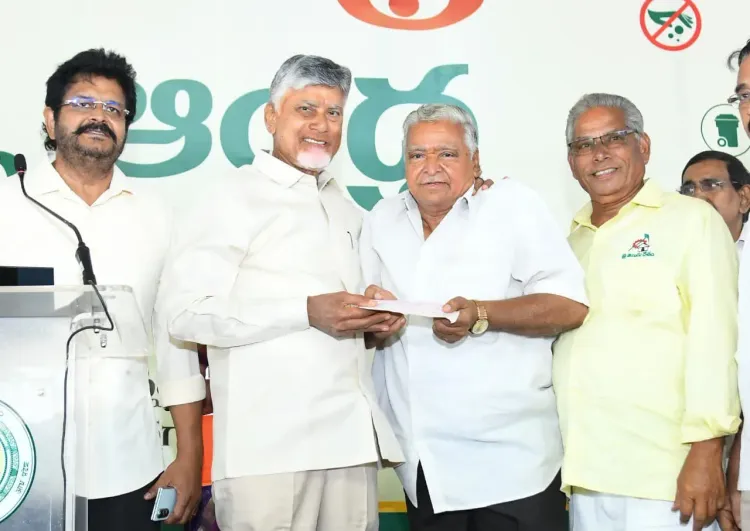
Couple Anne Narasimha Rao and Pushpaleelavathi donated Rs 3 crore for the Gudivada bus stand upgrade.
Homemaker Sai Shweta contributed her gold bangles toward Amaravati capital construction.
Her son Ganesh donated his piggy-bank savings to the Amaravati project.
The campaign revives a citizen-donation model first used during the original Amaravati land-pooling drive launched in 2015 .
The TDP-led government has accelerated Amaravati works since returning to power in 2024 .
Andhra Pradesh Chief Minister N. Chandrababu Naidu on Saturday, 18 July 2026, praised citizens who came forward with voluntary contributions during his visit to Gudivada as part of the Swachha Andhra–Swarna Andhra programme, calling their gesture deeply gratifying.
Context
During the Gudivada leg of the Swachha Andhra–Swarna Andhra tour, couple Anne Narasimha Rao and Pushpaleelavathi handed over a cheque of Rs 3 crore for the development of the Gudivada bus stand. In a separate gesture, homemaker Sai Shweta donated the gold bangles on her wrists toward the construction of the new state capital, Amaravati. Her son Ganesh contributed the savings from his piggy bank to the same cause.
Naidu expressed heartfelt congratulations to all three donors, writing: 'గొప్ప మనసుతో ముందుకు వచ్చి రాష్ట్రం కోసం విరాళం ఇచ్చిన వీరిని హృదయపూర్వకంగా అభినందిస్తున్నాను' ('I wholeheartedly congratulate those who came forward with a generous heart and donated for the state').
Policy Backdrop
The Swachha Andhra–Swarna Andhra initiative combines cleanliness drives with aspirational development goals, and explicitly encourages public participation in civic and capital-city projects. The approach mirrors a strategy Naidu's government first employed after the 2014 Andhra Pradesh reorganisation, when voluntary land pooling and donation campaigns were mobilised for the Amaravati capital project formally launched in 2015.
After the TDP-led coalition returned to power in 2024, the government revived momentum on Amaravati construction, which had stalled under the previous administration. Citizen contribution campaigns have been periodically renewed as a supplementary funding and public-engagement tool alongside state and central outlays.
Stakeholders and Impact
The Gudivada bus stand upgrade, now backed by a Rs 3 crore private donation, is expected to benefit commuters across Krishna district. The symbolic contributions — gold jewellery from a homemaker and piggy-bank savings from a child — are being highlighted by the government as evidence of grassroots buy-in for the Amaravati capital project.
For the state government, voluntary donations serve a dual purpose: they supplement public funds and generate visible community ownership of flagship infrastructure. Local philanthropists, NRI communities, and ordinary citizens have all been identified as potential contributors under this model.
What's Next
Progress on the Gudivada bus stand redevelopment will be a near-term indicator of how effectively private contributions are channelled into tangible civic upgrades. On the larger canvas, the pace of Amaravati construction and the regularity of organised donation campaigns will signal how central this citizen-participation model remains to the Naidu administration's infrastructure financing strategy going forward.
Point of View
The administration frames capital-city construction as a people's movement rather than a state-directed project. This narrative is particularly useful as the government seeks to rebuild momentum on Amaravati after years of stalled work, and to sustain public enthusiasm ahead of what will be a long and expensive construction horizon. Whether voluntary donations translate into meaningful fiscal supplementation, or remain largely symbolic, will shape how credible this participatory model appears over time.
NationPress
18 Jul 2026
Frequently Asked Questions
What is the Swachha Andhra–Swarna Andhra programme?
Swachha Andhra–Swarna Andhra is an Andhra Pradesh government initiative that combines cleanliness drives with aspirational development goals, encouraging citizens to contribute voluntarily to civic and infrastructure projects across the state.
Who donated Rs 3 crore for the Gudivada bus stand?
Couple Anne Narasimha Rao and Pushpaleelavathi donated Rs 3 crore for the development of the Gudivada bus stand, handing over the cheque to CM N. Chandrababu Naidu during his visit on 18 July 2026.
Why are citizens donating gold and money for Amaravati?
The Andhra Pradesh government has periodically encouraged voluntary public contributions — including gold, cash, and land — toward Amaravati's construction since the capital project was launched in 2015, framing it as a citizen-owned state-building effort.
What is the current status of Amaravati construction?
Amaravati construction was stalled under the previous state administration but has been revived after the TDP-led coalition returned to power in 2024, with the Naidu government prioritising the project and seeking fresh funding sources including citizen donations.
Where is Gudivada located?
Gudivada is a town in Krishna district, Andhra Pradesh, and has been a focus of recent state infrastructure development drives including the ongoing Swachha Andhra–Swarna Andhra programme.