CM Bhupendra Patel: 25 Crore Lifted from Poverty Under Modi
Synopsis
Gujarat Chief Minister Bhupendra Patel on 12 June 2026 credited PM Narendra Modi's 12-year welfare-scheme drive for lifting 25 crore people out of poverty, echoing BJP's development narrative as the party marks over a decade in power at the Centre.
Key Takeaways
Gujarat CM Bhupendra Patel posted on 12 June 2026 that 25 crore people have exited poverty under PM Modi 's leadership over 12 years .
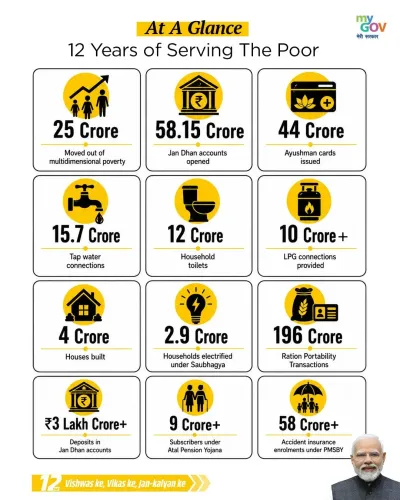
The claim covers welfare schemes including PMAY , Ujjwala Yojana , Jal Jeevan Mission , and Jan Dhan Yojana .
NITI Aayog's 2023 MPI report documented a reduction of approximately 13.5 crore people in multidimensional poverty between 2015-16 and 2019-21 .
The 25 crore figure cited by CM Patel extends beyond the last verified NITI Aayog data window and has not been independently confirmed.
The next NITI Aayog MPI update and any CAG scrutiny of scheme delivery will be key to assessing the broader poverty-reduction claim.
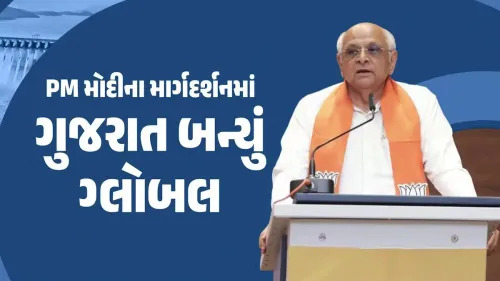
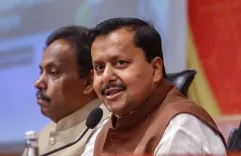
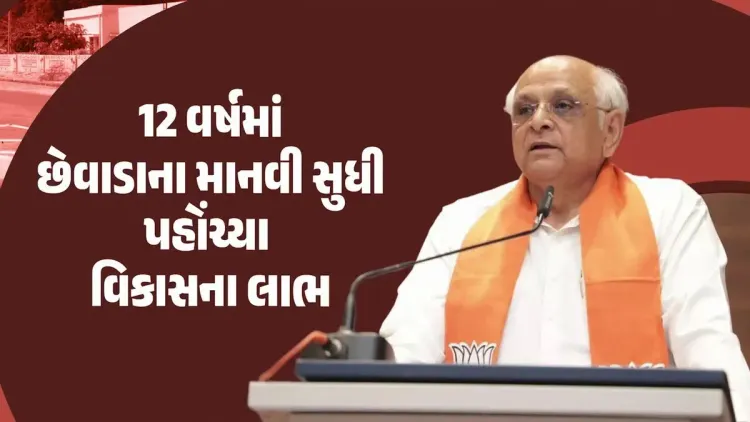
Gujarat Chief Minister Bhupendra Patel on Friday, 12 June 2026 credited Prime Minister Narendra Modi's welfare policies for lifting 25 crore people out of poverty over the past 12 years, sharing the claim in a post on X that tagged the Prime Minister directly.
Writing in Gujarati, CM Patel stated: 'ગત 12 વર્ષમાં માનનીય મોદીજીના નેતૃત્વમાં જનકલ્યાણકારી યોજનાઓના અસરકારક અમલીકરણ થકી દેશના 25 કરોડ લોકો ગરીબીમાંથી બહાર આવ્યા છે.' ['In the last 12 years, through the effective implementation of public welfare schemes under the respected Modi-ji's leadership, 25 crore people of the country have come out of poverty.']
Context
Bhupendra Patel, who has served as Chief Minister of Gujarat since September 2021, is a senior BJP leader who regularly amplifies the central government's development narrative. His post comes as the BJP marks over a decade of Narendra Modi's tenure as Prime Minister, which began in May 2014. The claim of 25 crore people exiting poverty is being circulated by party leaders as a headline achievement of the Modi era.
Policy Backdrop
The Union government's poverty-reduction strategy since 2014 has centred on saturation-mode delivery of direct-benefit-transfer-enabled schemes. Key programmes include Pradhan Mantri Awas Yojana (PMAY) for housing, Pradhan Mantri Ujjwala Yojana for cooking-fuel access, Jal Jeevan Mission for piped water, and financial inclusion drives under Jan Dhan Yojana. NITI Aayog's 2023 Multidimensional Poverty Index (MPI) report documented a reduction of approximately 13.5 crore people in multidimensional poverty between 2015-16 and 2019-21, citing improvements across health, education, and living-standard indicators. The figure of 25 crore cited by CM Patel covers a longer window through 2026 and has not been independently verified from available data.
Stakeholders and Impact
The primary beneficiaries of the schemes cited are rural poor households, particularly in states with high multidimensional poverty rates such as Bihar, Uttar Pradesh, Madhya Pradesh, and Rajasthan. Welfare economists and policy researchers have broadly acknowledged directional progress in reducing deprivation on indicators such as sanitation, cooking fuel, and bank-account access, while also flagging concerns about scheme targeting, leakages, and the distinction between multidimensional and income-based poverty metrics. BJP-governed state governments, including Gujarat, have used such national metrics to reinforce their alignment with the central government's development agenda.
What's Next
The next scheduled NITI Aayog MPI update is expected to provide fresh data that will either corroborate or contextualise the 25 crore figure. Parliamentary committees and the Comptroller and Auditor General (CAG) are also periodically scrutinising scheme targeting and fund utilisation, which could add further detail to the poverty-reduction picture. As the BJP approaches the anniversary of a decade-plus in government, welfare metrics are likely to remain central to the party's political communication, with state leaders such as CM Patel continuing to relay national achievements to regional audiences.
Point of View
Which means the claim will face scrutiny from opposition parties and independent researchers when the next data release arrives. The framing of poverty reduction as a direct outcome of named schemes reflects the BJP's deliberate shift from input-based to outcome-based political communication. Whether the numbers hold up under fresh audit will determine how durable this narrative proves in the run-up to future electoral cycles.
NationPress
20 Sept 2026
Frequently Asked Questions
How many people has India lifted out of poverty under PM Modi?
Gujarat CM Bhupendra Patel has claimed that 25 crore people have come out of poverty in the last 12 years under PM Modi's welfare schemes. The last independently verified figure from NITI Aayog's 2023 MPI report documented a reduction of approximately 13.5 crore people in multidimensional poverty between 2015-16 and 2019-21 .
What welfare schemes are credited for poverty reduction in India since 2014?
Key schemes credited include Pradhan Mantri Awas Yojana (PMAY) for affordable housing, Pradhan Mantri Ujjwala Yojana for cooking-gas access, Jal Jeevan Mission for piped drinking water, and Jan Dhan Yojana for financial inclusion.
What is the NITI Aayog Multidimensional Poverty Index?
The NITI Aayog Multidimensional Poverty Index (MPI) is a composite measure that tracks deprivation across health, education, and living standards. Its 2023 report showed roughly 13.5 crore people exiting multidimensional poverty between 2015-16 and 2019-21 .
Who is Bhupendra Patel and why did he post about poverty reduction?
Bhupendra Patel is the Chief Minister of Gujarat and a senior BJP leader who has held the post since September 2021 . He regularly amplifies central government welfare achievements as part of the BJP's broader political communication strategy.
Is the 25 crore poverty reduction claim verified?
The 25 crore figure has not been independently verified from available published data. The most recent NITI Aayog MPI report covers up to 2019-21 and documents a smaller reduction; updated figures are expected in the next scheduled MPI release.