CM Pema Khandu Hails Sushruta Statue at Edinburgh Surgeons College
Synopsis
Arunachal Pradesh Chief Minister Pema Khandu welcomed the unveiling of a bronze statue of Rishi Sushruta at the Royal College of Surgeons of Edinburgh, calling it a fitting tribute to India's ancient medical contributions and expressing hope that more of Bharat's sages receive global recognition.
Key Takeaways
Arunachal Pradesh Chief Minister Pema Khandu publicly welcomed the installation of a Rishi Sushruta bronze statue at the Royal College of Surgeons of Edinburgh .
Rishi Sushruta , believed to have lived around the 6th century BCE , is credited as the Father of Surgery and author of the Sushruta Samhita .
The Royal College of Surgeons of Edinburgh , founded in 1505 , is one of the world's oldest and most prestigious surgical institutions.
CM Khandu described the recognition as 'long overdue,' framing it as acknowledgment of Bharat's immense contribution to medical science .
The event aligns with India's broader cultural diplomacy efforts to secure global recognition for its ancient scientific heritage.
Khandu expressed hope that more ancient Indian sages receive similar international acknowledgment in the future.
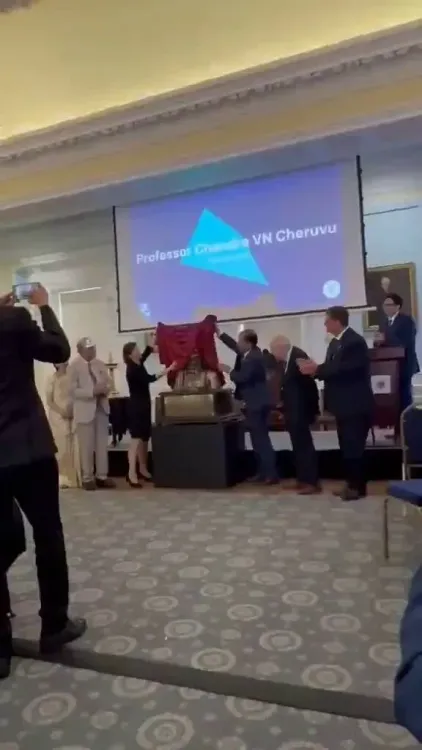
Arunachal Pradesh Chief Minister Pema Khandu on Wednesday, 24 June 2026, welcomed the unveiling of a bronze statue of Rishi Sushruta — widely revered as the Father of Surgery — at the Royal College of Surgeons of Edinburgh, calling it a fitting tribute to ancient Indian medical wisdom and 'a recognition long overdue.'
Context
In his post, CM Khandu wrote: 'More than 2,600 years later, the world is finally recognizing Rishi Sushruta. The unveiling of his bronze statue at the Royal College of Surgeons of Edinburgh is a fitting tribute to the timeless wisdom of our Sanatani Rishis and Bharat's immense contribution to medical science.'
The statue marks a rare institutional acknowledgment by one of the world's oldest surgical bodies of a non-Western pioneer. The Royal College of Surgeons of Edinburgh, founded in 1505, is among the most prestigious surgical institutions globally, making the installation symbolically significant for advocates of India's ancient knowledge traditions.
Policy Backdrop
Rishi Sushruta, believed to have lived around the 6th century BCE, authored the Sushruta Samhita — a comprehensive Sanskrit treatise detailing surgical techniques, instruments, and procedures including early forms of plastic surgery. The text is considered one of the foundational documents of world medicine and has been studied by historians of science across continents.
India has, over the past decade, actively pursued greater global visibility for its ancient scientific and medical heritage as part of a broader cultural diplomacy and soft-power strategy. Initiatives ranging from the international promotion of yoga to the inclusion of traditional knowledge in academic curricula reflect this pattern. The Edinburgh statue fits squarely within that arc.
Stakeholders and Impact
The recognition carries weight for Ayurveda practitioners, medical historians, and scholars of ancient Indian science who have long argued that Sushruta's contributions to surgery predate and parallel developments in Greek and Arab medical traditions. For the Indian diaspora in the United Kingdom and across Europe, the installation at a landmark Scottish institution offers a point of cultural pride.
Domestically, the event is likely to energise ongoing efforts to integrate traditional Indian medical knowledge into mainstream academic and policy frameworks, including proposals for greater recognition of AYUSH systems alongside modern medicine.
What's Next
Advocates and policymakers are expected to push for follow-on collaborations — including joint academic programmes between Indian medical heritage bodies and British or European surgical colleges — building on the momentum of the Edinburgh installation. CM Khandu concluded his post with a broader aspiration: 'May many more of Bharat's great sages receive the global acknowledgment they deserve,' signalling that this statue is seen not as an endpoint but as a precedent for wider international recognition of India's ancient intellectual legacy.
Point of View
Using a prestigious Western surgical institution's gesture to validate the country's ancient knowledge systems on the global stage. The Edinburgh installation hands Indian policymakers a concrete, internationally credible data point in their long-running effort to mainstream traditional medicine and cultural heritage alongside modern science. For the BJP, such moments serve a dual purpose: reinforcing civilisational pride domestically while demonstrating diplomatic traction abroad. The broader pattern suggests that similar installations or academic partnerships could follow, particularly as India's cultural diplomacy infrastructure grows more organised and better funded.
NationPress
24 Jun 2026
Frequently Asked Questions
Who is Rishi Sushruta and why is he called the Father of Surgery?
Rishi Sushruta was an ancient Indian physician who lived around the 6th century BCE. He is called the Father of Surgery because his treatise, the Sushruta Samhita, documented detailed surgical procedures, instruments, and techniques — including early plastic surgery — making it one of the oldest and most comprehensive surgical texts in the world.
Where was the Rishi Sushruta statue unveiled?
The bronze statue of Rishi Sushruta was unveiled at the Royal College of Surgeons of Edinburgh, one of the world's oldest surgical institutions, founded in 1505 in Scotland.
What did Arunachal Pradesh CM Pema Khandu say about the Sushruta statue?
CM Pema Khandu called the unveiling 'a fitting tribute to the timeless wisdom of our Sanatani Rishis,' describing the recognition as 'long overdue' and expressing hope that more of Bharat's great sages receive global acknowledgment.
What is the Sushruta Samhita?
The Sushruta Samhita is an ancient Sanskrit medical treatise authored by Rishi Sushruta. It covers surgical techniques, medical instruments, and procedures including rhinoplasty, and is regarded as a foundational text of both Indian Ayurvedic medicine and world surgical history.
Why is India promoting ancient Indian scientists and sages globally?
India has made the global recognition of its ancient scientific and cultural heritage a key part of its cultural diplomacy and soft-power strategy, seeking to highlight pre-modern contributions in fields such as surgery, mathematics, and yoga through institutional acknowledgments abroad.