CM Fadnavis to Act Against Atrocities, Conversions in Corporate Sector
Synopsis
The Chief Minister's Office of Maharashtra announced on 24 June 2026 that CM Devendra Fadnavis will take strict measures to prevent atrocities against women and religious conversions in the corporate sector, signalling a major extension of state social-policy oversight into private workplaces.
Key Takeaways
The Chief Minister's Office of Maharashtra announced on 24 June 2026 that strict steps will be taken against atrocities on women and religious conversions in the corporate sector.
CM Devendra Fadnavis is the driving force behind the initiative, per the official CMO post tagging his handle.
Maharashtra is India's most industrialised state, making a corporate-sector social-policy push unusually far-reaching in scope.
Existing law — the POSH Act, 2013 — already covers workplace sexual harassment; the new measures appear set to go beyond its current provisions.
Both women employees and corporate firms will be key stakeholders, with new compliance obligations likely on the horizon.
Specific legislative or executive action is expected in an upcoming session of the Maharashtra Legislative Assembly .
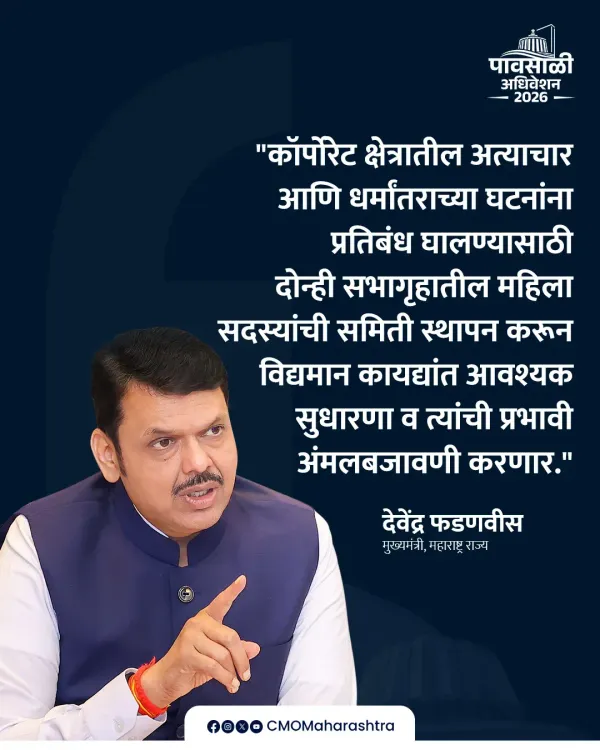
The Chief Minister's Office of Maharashtra announced on Wednesday, 24 June 2026 that the state government, under Chief Minister Devendra Fadnavis, will take strict measures to prevent atrocities against women and religious conversions in the corporate sector. The post, shared on the official CMO handle, signals a significant extension of Maharashtra's social-policy oversight into private workplaces.
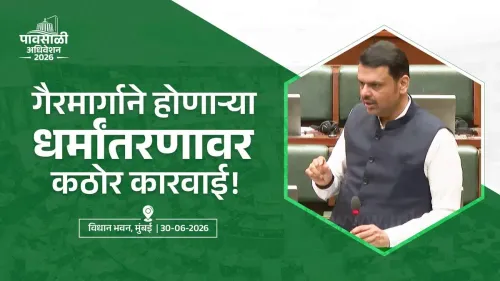
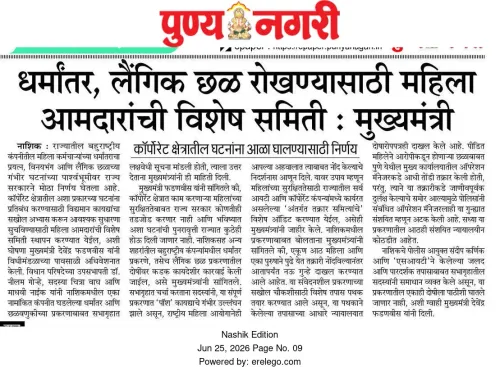
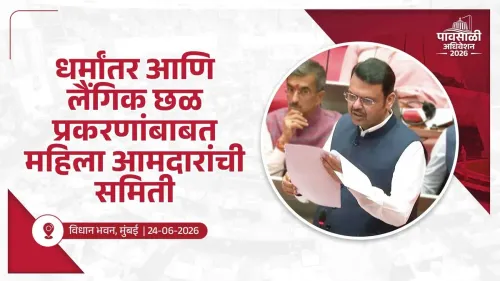
The post, written in Marathi, states: 'कॉर्पोरेट क्षेत्रात महिलांवरील अत्याचार आणि धर्मांतर घटनांना प्रतिबंध करण्यासाठी कठोर पावले उचलणार!' — translated as: 'Strict steps will be taken to prevent atrocities against women and incidents of religious conversion in the corporate sector!'
Context
Maharashtra is India's most industrialised state, home to major corporate hubs including Mumbai, Pune, and Nagpur, hosting thousands of private-sector firms and millions of women employees. The announcement directly targets the corporate workplace environment, an arena that has historically received limited attention under state-level social-regulation frameworks. The dual focus — women's safety alongside conversion prevention — marks a notable broadening of the state's policy scope.
Policy Backdrop
India's Sexual Harassment of Women at Workplace (Prevention, Prohibition and Redressal) Act, 2013 — commonly known as the POSH Act — already mandates Internal Complaints Committees in organisations with ten or more employees. Maharashtra had issued stricter enforcement guidelines for POSH compliance in the private sector around 2019–2020 following high-profile workplace harassment cases. The current announcement suggests the Fadnavis government intends to go further, potentially adding new compliance obligations or legislative amendments targeting HR practices in large companies.
BJP-governed states have periodically combined women's-safety measures with religious-conversion regulation, framing both as protection of vulnerable groups. Extending this dual framework explicitly to the corporate sector is, however, uncommon and represents a new policy frontier for Maharashtra.
Stakeholders and Impact
Women employees in Maharashtra's vast corporate workforce stand to be the primary beneficiaries if the announced measures translate into enforceable protections against harassment and coercion. Corporate firms, particularly large employers in financial services, manufacturing, and technology sectors concentrated in Mumbai and Pune, may face new compliance requirements. Industry bodies are likely to seek clarity on the scope and implementation timeline of any forthcoming rules.
Civil society groups working on women's rights have long demanded stronger enforcement of existing POSH provisions, while religious organisations and legal experts are expected to scrutinise the conversion-related provisions closely, given the constitutional sensitivities around freedom of religion.
What's Next
The announcement is expected to be followed by concrete legislative or executive action, possibly in the next session of the Maharashtra Legislative Assembly. Observers will watch for the introduction of a bill or government resolution detailing the specific prohibitions, penalties, and the regulatory body responsible for enforcement in the corporate sector. The Fadnavis government's framing of this as a law-and-order priority suggests the measures could be fast-tracked through the legislative calendar.
Point of View
The administration is aligning with a broader BJP-ruled-state pattern of bundling social-protection and religious-regulation agendas. The corporate focus is the genuine policy novelty here: if implemented, it would mark one of the first state-level attempts to impose conversion-related restrictions on private employers, inviting both legal scrutiny and political debate. How the government defines 'conversion incidents' in a workplace context will be the critical test of whether this remains a political signal or becomes enforceable law.
NationPress
22 Sept 2026
Frequently Asked Questions
What did the Maharashtra CMO announce about the corporate sector?
The Chief Minister's Office of Maharashtra announced on 24 June 2026 that CM Devendra Fadnavis will take strict steps to prevent atrocities against women and incidents of religious conversion in the corporate sector.
What is the POSH Act and does it already cover corporate workplaces?
The Sexual Harassment of Women at Workplace (Prevention, Prohibition and Redressal) Act, 2013 — the POSH Act — already requires companies with ten or more employees to have an Internal Complaints Committee. Maharashtra's new measures are expected to go beyond existing POSH provisions.
Which companies or industries will be affected by Fadnavis's new corporate rules?
The announcement targets the corporate sector broadly, which in Maharashtra includes large employers in financial services, manufacturing, and technology concentrated in Mumbai and Pune. Specific sectors and thresholds will likely be clarified in forthcoming legislation or government resolutions.
Has any Indian state previously banned religious conversions in corporate workplaces?
No Indian state has previously enacted explicit corporate-sector conversion-prevention rules, making Maharashtra's proposed step an uncommon policy frontier, though BJP-governed states have combined women's safety and conversion regulation in other contexts.
When will Maharashtra introduce the new law or rules for the corporate sector?
No specific date has been announced yet. Observers expect the Fadnavis government to introduce a bill or government resolution in the next session of the Maharashtra Legislative Assembly.