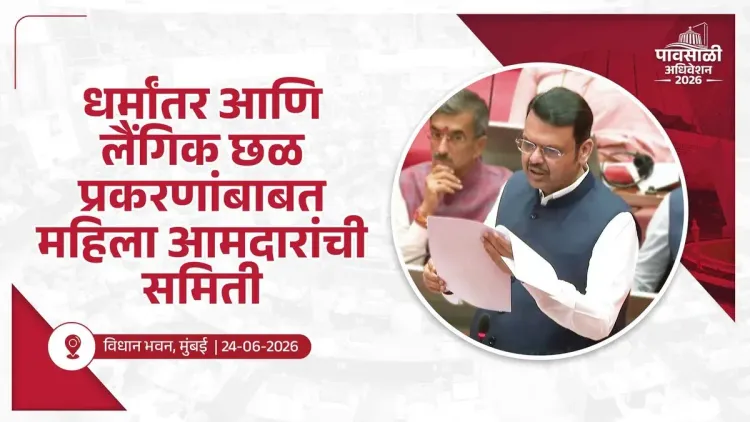
CM Fadnavis to Form Women MLAs Panel on Conversion, Harassment Laws
Synopsis
Maharashtra CM Devendra Fadnavis announced at the Vidhan Parishad during Monsoon Session 2026 that a special committee of women MLAs will review existing laws on religious conversion and sexual harassment in private companies and recommend necessary reforms.
Key Takeaways
CM Devendra Fadnavis announced the committee at the Maharashtra Vidhan Parishad on 24 June 2026 during the Monsoon Session 2026 .
The panel will consist exclusively of women MLAs and will review the existing legal framework on two issues: religious conversion and sexual harassment in private companies .
The committee's mandate is to study current laws in depth and recommend necessary reforms — its formal constitution order and terms of reference are yet to be issued.
India's central POSH Act (2013) already covers workplace sexual harassment, but enforcement in the private sector has been widely flagged as inadequate.
Several states — including Uttar Pradesh and Madhya Pradesh — have enacted anti-conversion laws; Maharashtra does not currently have a standalone such statute.
The committee's recommendations could influence new Maharashtra legislation or amendments to state rules, with implications for women employees across the state's large private sector.
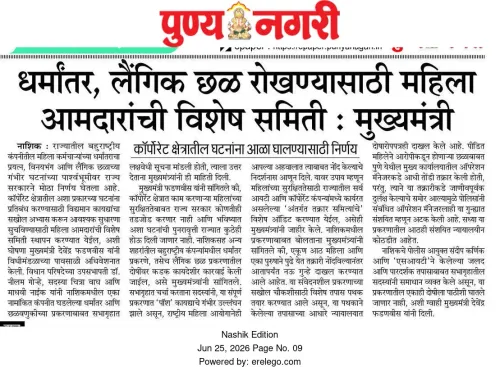
Maharashtra Chief Minister Devendra Fadnavis announced on Wednesday, 24 June 2026, at the Maharashtra Vidhan Parishad in Mumbai, that a special committee of women legislators will be constituted to conduct a comprehensive review of existing laws and recommend reforms addressing religious conversion and sexual harassment in private companies.
Context
Speaking during the Monsoon Session 2026 of the Maharashtra legislature, CM Fadnavis announced the panel in response to growing concerns over cases of alleged religious conversion and sexual harassment reported from within private sector workplaces. The announcement was made in the upper house, the Vidhan Parishad, signalling a legislative rather than purely executive response to the issue.
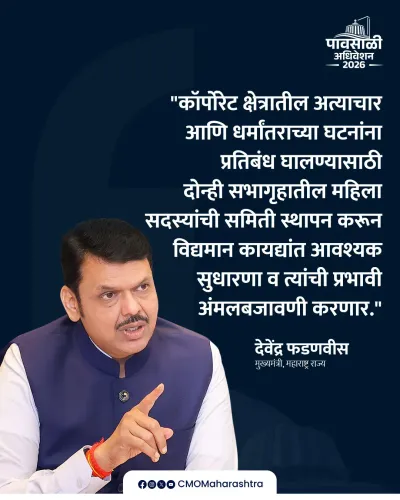
In his post, Fadnavis stated: 'A special committee of women MLAs will be constituted to undertake a comprehensive review of the existing legal framework and recommend necessary reforms in light of cases involving religious conversion and sexual harassment in private companies.' The original Marathi text reads: 'खासगी कंपन्यांमधील धर्मांतर आणि लैंगिक छळाच्या प्रकरणांच्या पार्श्वभूमीवर विद्यमान कायद्यांचा सखोल अभ्यास करून आवश्यक सुधारणा सुचविण्यासाठी महिला आमदारांची विशेष समिती स्थापन करण्यात येईल.' (Translation: 'A special committee of women MLAs will be formed to conduct a thorough study of existing laws and suggest necessary reforms in the backdrop of cases of religious conversion and sexual harassment in private companies.')
Policy Backdrop
India's central framework on workplace sexual harassment — the Sexual Harassment of Women at Workplace (Prevention, Prohibition and Redressal) Act, 2013, commonly known as the POSH Act — mandates that all organisations above a prescribed size constitute Internal Complaints Committees. Critics and women's rights groups have long argued that compliance and enforcement in the private sector remain uneven, particularly in smaller companies.
On religious conversion, several states including Uttar Pradesh (2020) and Madhya Pradesh have enacted anti-conversion statutes addressing allegations of forced or fraudulent religious change. Maharashtra has not yet enacted a standalone anti-conversion law, making the committee's mandate to review the legal framework a potentially consequential exercise. Indian state governments have periodically revisited personal and criminal laws linked to conversion amid competing claims of individual freedom and allegations of social coercion.
Stakeholders and Impact
The committee's primary focus will be women employees in private companies, a constituency that straddles both the POSH enforcement gap and concerns about workplace coercion. By specifically constituting the panel from women MLAs across the house, the government signals an intent to give the review a cross-party legislative character, though the final composition and terms of reference are yet to be announced.
Industry bodies and private employers in Maharashtra — home to India's largest concentration of corporate headquarters and private-sector workers — will be closely watching the committee's scope. Civil society organisations working on women's rights and minority rights are also expected to engage with the panel's consultations once it is formally constituted.
What's Next
The immediate next steps include the formal constitution order for the committee, the notification of its terms of reference, and a timeline for submitting reform proposals, likely within the current or the next assembly session. The committee's recommendations could lay the groundwork for new Maharashtra-specific legislation or amendments to existing state rules under the POSH Act framework.
Whether the panel's mandate will extend to proposing a state-level anti-conversion statute — similar to those in Uttar Pradesh and Madhya Pradesh — or will focus on administrative and enforcement reforms within existing law will be a key question as the session progresses.
Point of View
Women-led parliamentary process rather than executive ordinance, lending it cross-party legitimacy. By tying both issues to a single committee, the government frames workplace coercion and conversion as a connected women's-safety concern, a framing that aligns with the BJP's broader social policy narrative in Maharashtra. The committee mechanism also allows the administration to defer immediate legislative commitment while demonstrating responsiveness to its constituency. The panel's eventual terms of reference will be the real test of whether this is substantive law reform or a procedural holding measure ahead of future electoral cycles.
NationPress
22 Sept 2026
Frequently Asked Questions
What is the special women MLA committee announced by CM Fadnavis?
It is a legislative committee composed of women MLAs from the Maharashtra legislature, announced by CM Devendra Fadnavis on 24 June 2026 at the Vidhan Parishad. Its mandate is to review existing laws on religious conversion and sexual harassment in private companies and recommend reforms.
Why is Maharashtra forming a committee on religious conversion and sexual harassment?
The committee was announced in the backdrop of reported cases involving religious conversion and sexual harassment within private companies in Maharashtra. The government has stated it wants a thorough legal review before proposing reforms.
Does Maharashtra already have a law against forced religious conversion?
As of the time of this announcement, Maharashtra does not have a standalone anti-conversion statute. States such as Uttar Pradesh and Madhya Pradesh have enacted such laws, and the new committee may examine whether Maharashtra needs similar legislation.
What is the POSH Act and how does it relate to this committee?
The Sexual Harassment of Women at Workplace (Prevention, Prohibition and Redressal) Act, 2013 — known as the POSH Act — is the central law governing workplace sexual harassment in India. The committee will review whether existing provisions under this and related laws are adequate for private-sector workers in Maharashtra.
When will the Maharashtra women MLA committee submit its recommendations?
No specific deadline has been announced. The formal constitution order and terms of reference are yet to be issued; recommendations are expected within the current or a subsequent assembly session.