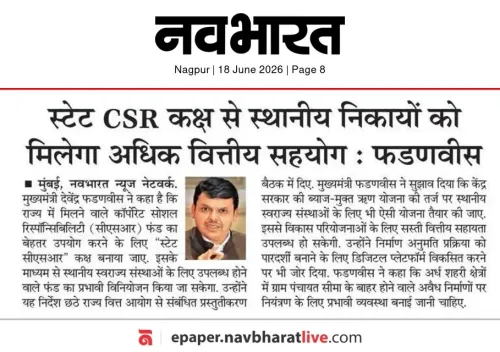
Maharashtra CMO Announces CSR Cell for Finance Commission

Synopsis
The Chief Minister's Office of Maharashtra announced a dedicated cell for CSR fund deployment on 18 June 2026, tagging CM Devendra Fadnavis and referencing the Finance Commission — signalling a formal state mechanism to align corporate social responsibility spending with development priorities.
Key Takeaways
The Chief Minister's Office of Maharashtra announced a dedicated cell for CSR deployment on 18 June 2026 .
The post tagged Chief Minister Devendra Fadnavis and carried the hashtag #FinanceCommission , indicating a policy linkage.
Section 135 of the Companies Act, 2013 mandates eligible companies to spend 2 per cent of average net profits on CSR activities.
Maharashtra is India's most industrialised state, generating substantial annual CSR outlays from its large corporate base.
A dedicated cell could help align CSR funds with state priorities and supplement Finance Commission grants to local bodies.
Operational guidelines, integration with district planning committees, and the cell's formal mandate are yet to be detailed publicly.
The Chief Minister's Office of Maharashtra announced on Thursday, 18 June 2026 the establishment of a dedicated cell for the deployment of Corporate Social Responsibility (CSR) funds, tagging Chief Minister Devendra Fadnavis in a post that also referenced the Finance Commission. The announcement signals a formal institutional mechanism to channel and monitor CSR spending in line with state development priorities.
Context
The post, shared by the official Chief Minister's Office of Maharashtra account, reads 'सीएसआर' विनियोगासाठी कक्ष — translating from Marathi as 'A cell for CSR deployment.' The brief but pointed announcement, addressed to CM Devendra Fadnavis and hashtagged #FinanceCommission, points to a structured effort to bring order and purpose to how corporate social responsibility funds are utilised across the state.
Maharashtra is India's most industrialised state and hosts a disproportionately large share of companies that are statutorily required to spend on CSR activities. The scale of potential funding makes coordination between corporations and government departments both valuable and complex.
Policy Backdrop
Corporate Social Responsibility obligations in India were codified under Section 135 of the Companies Act, 2013, which mandates that eligible companies — those meeting specified thresholds of turnover, net worth, or net profit — spend 2 per cent of their average net profits over the preceding three years on approved social development activities. The law transformed what was once voluntary philanthropy into a regulated, reportable obligation.
Several Indian states have since created dedicated mechanisms to align CSR flows with state planning priorities, recognising that uncoordinated spending can lead to duplication in some districts and near-total absence in others. Maharashtra has historically generated substantial CSR outlays given its large industrial base, prompting repeated efforts to improve coordination between companies and government departments.
The reference to the Finance Commission in the post is significant. The Finance Commission, constituted under Article 280 of the Constitution, recommends the sharing of tax revenues between the Union and states for five-year periods, including grants to local bodies. Linking a CSR deployment cell to the Finance Commission framework could indicate an intent to use private funds to supplement or complement devolution-linked spending at the local level.
Stakeholders and Impact
The primary stakeholders are corporates operating in Maharashtra, local bodies, district planning committees, and development agencies that currently receive or seek CSR funding. A dedicated cell could reduce the friction companies face when identifying credible, government-aligned projects, potentially increasing the effective utilisation rate of CSR funds.
For local bodies — which often lack the capacity to attract or process CSR partnerships — a state-level cell acting as a facilitator could meaningfully supplement Finance Commission grants. Citizens in industrially adjacent but under-served districts stand to benefit most if the cell succeeds in redirecting funds away from already-well-resourced urban pockets.
What's Next
Attention will now turn to the operational guidelines for the proposed cell, including its mandate, staffing, and reporting structure. Key questions include whether it will integrate with district planning committees and how it will interface with the Ministry of Corporate Affairs' national CSR portal.
Any formal linkage between the cell's priorities and the eventual recommendations of the 16th Finance Commission — particularly on local body grants — will be closely watched by policy observers and corporate affairs departments alike. CM Devendra Fadnavis, who has a track record of institutionalising governance mechanisms, is expected to elaborate on the cell's scope in the coming weeks.
Point of View
The Fadnavis administration appears to be positioning CSR flows as a complement to constitutionally mandated devolution — a nuanced fiscal strategy that could attract scrutiny from both corporate affairs regulators and opposition benches. Maharashtra's industrial dominance means even marginal improvements in CSR utilisation efficiency could translate into hundreds of crores redirected toward underserved districts. The move also signals that Fadnavis, heading into a period of active fiscal consolidation, is looking beyond the state budget to fund social infrastructure.
NationPress
17 Sept 2026
Frequently Asked Questions
What is the CSR cell announced by the Maharashtra CMO?
The Chief Minister's Office of Maharashtra announced a dedicated cell for the deployment of Corporate Social Responsibility funds, aimed at channelling CSR spending toward state development priorities in a coordinated manner.
What does 'सीएसआर विनियोगासाठी कक्ष' mean?
The Marathi phrase translates to 'a cell for CSR deployment' — referring to a formal government unit that will oversee how corporate social responsibility funds are directed and utilised across Maharashtra.
Why is the Finance Commission mentioned alongside the CSR cell?
The hashtag #FinanceCommission in the post suggests the state intends to link CSR fund deployment with the broader framework of Finance Commission-mandated grants, potentially using corporate funds to supplement devolution to local bodies.
Who is responsible for CSR spending under Indian law?
Under Section 135 of the Companies Act, 2013, companies that meet specified thresholds of net worth, turnover, or net profit are required to spend 2 per cent of their average net profits over the preceding three years on approved CSR activities.
How does this affect companies operating in Maharashtra?
Companies with CSR obligations in Maharashtra may find it easier to identify and execute government-aligned projects through the new cell, potentially improving compliance quality and reducing duplication of effort across districts.