CM Fadnavis Chairs Sixth SFC Meet, Orders State CSR Cell
Synopsis
CM Devendra Fadnavis on 17 June 2026 chaired a meeting on Maharashtra's Sixth State Finance Commission, directing creation of a State CSR Cell to channel corporate funds to local bodies, an interest-free loan scheme for local governments, and digital property mapping under an expanded SVAMITVA framework.
Key Takeaways
42 recommendations of the Sixth State Finance Commission were discussed across six thematic categories at a meeting chaired by CM Devendra Fadnavis on 17 June 2026 .
A State CSR Cell is to be created to route Maharashtra's — India's highest — CSR inflows toward local self-government institutions.
An interest-free loan scheme for local bodies, modelled on a Central Government programme, is to be explored for financing development works.
A digital platform will be built to manage building permissions for constructions adjacent to but outside gram panchayat gaothan limits, with safeguards against misuse.
The SVAMITVA Scheme is to be extended beyond existing village settlement boundaries for comprehensive property mapping.
Ashish Jaiswal and senior officials attended the meeting at Varsha , Mumbai.
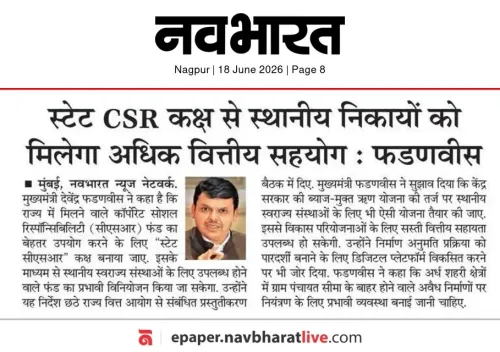
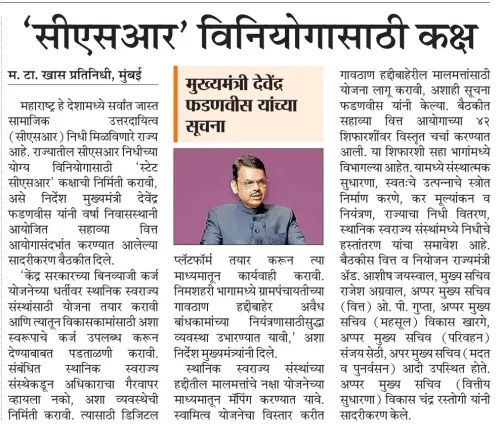
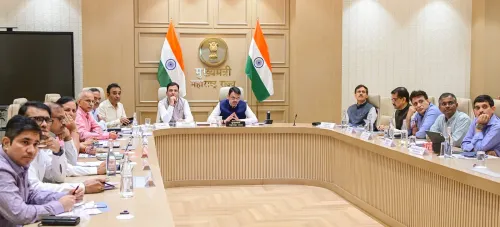
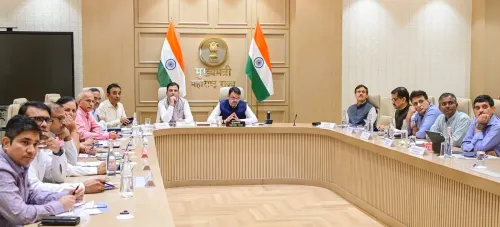
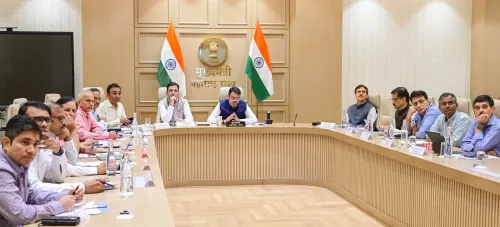
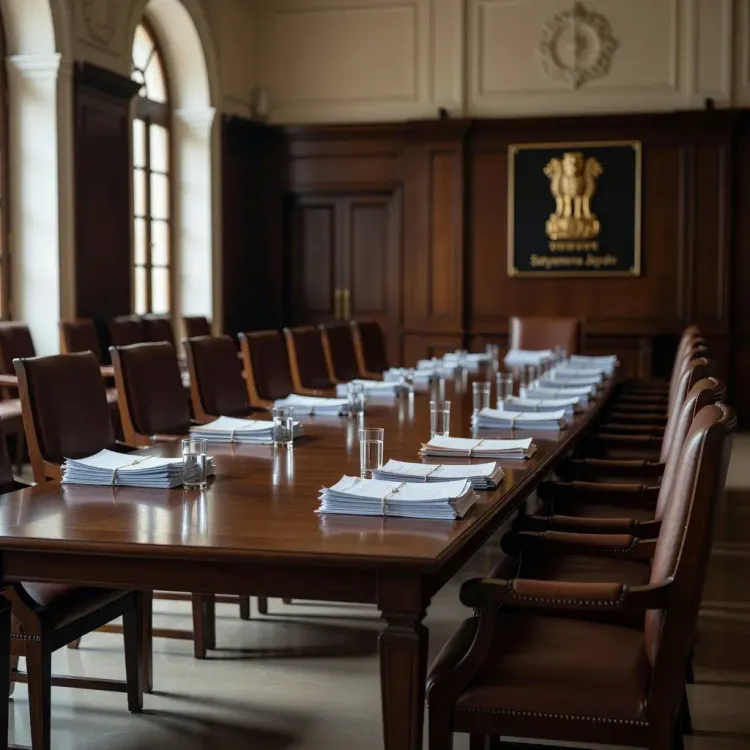
Chief Minister Devendra Fadnavis chaired a high-level meeting at Varsha, his official residence in Mumbai, on 17 June 2026 to review the recommendations of Maharashtra's Sixth State Finance Commission, directing the creation of a dedicated 'State CSR Cell' to channel corporate social responsibility funds toward local self-government bodies.
Context
The meeting deliberated on all 42 recommendations of the Sixth State Finance Commission, which are grouped into six broad categories: institutional reforms, creation of own revenue sources, tax assessment and control, state fund distribution, fund transfer to local self-government bodies, and strengthening of the Finance Commission itself.
State Minister Adv. Ashish Jaiswal and senior officials were present at the meeting. The CMO's post noted that the discussion was extensive, covering each of the six thematic clusters in detail.
Policy Backdrop
Maharashtra receives the highest CSR funding of any state in India. Recognising this, CM Fadnavis directed that a 'State CSR Cell' (स्टेट सीएसआर कक्ष) be constituted to ensure proper utilisation of these funds, specifically routing eligible amounts toward local self-government institutions such as gram panchayats and municipal bodies.
The Chief Minister also directed that an interest-free loan scheme for local bodies be explored on the lines of the Central Government's existing interest-free loan programme, with such credit to be made available for development works. This mirrors a broader national pattern of states using State Finance Commission cycles — mandated every five years under the 73rd and 74th Constitutional Amendments of 1992 — to address fiscal gaps between state and local tiers of government. Maharashtra's Fifth State Finance Commission had submitted its report in 2019-20 on similar themes.
Key Directives and Stakeholder Impact
On construction regulation, Fadnavis directed that a specific mechanism be put in place to allow local self-government bodies to grant building permissions for constructions adjacent to but outside their gaothan (village settlement) boundaries, while simultaneously ensuring that no misuse of authority occurs. A digital platform is to be developed for this purpose.
For peri-urban areas, the Chief Minister called for a system to control unauthorised construction outside gram panchayat gaothan limits. He further directed that properties within local body jurisdictions be mapped using a map-based scheme, and that the SVAMITVA Scheme — the Central Government's drone-based property-mapping initiative — be extended to cover properties beyond existing gaothan boundaries. These steps are aimed directly at gram panchayats and urban local bodies, which stand to gain both regulatory authority and improved revenue streams.
What's Next
The immediate watch points are a formal government order constituting the State CSR Cell and an action-taken report on the 42 recommendations being placed before the state legislature. The interest-free loan scheme for local bodies will require a feasibility review before notification.
If implemented, the combined effect of CSR fund channelling, interest-free credit, and digital property mapping could significantly strengthen the fiscal autonomy of Maharashtra's roughly 28,000 gram panchayats and hundreds of urban local bodies — a long-standing goal of decentralisation policy in India.
Point of View
Self-sustaining revenue architecture for local bodies — using CSR funds and interest-free credit as levers. The push for a digital platform for building permissions and the SVAMITVA extension together suggest a governance-through-technology approach to a perennial problem: unauthorised construction in peri-urban Maharashtra. Politically, delivering tangible fiscal empowerment to gram panchayats and municipalities strengthens the ruling coalition's grassroots credibility ahead of local body elections. The real test will be whether a formal government order and a legislative action-taken report follow within the current budget cycle.
NationPress
16 Sept 2026
Frequently Asked Questions
What is the State CSR Cell announced by CM Fadnavis?
The State CSR Cell is a proposed government unit in Maharashtra that will coordinate and channel corporate social responsibility funds — the highest received by any Indian state — specifically toward projects and needs of local self-government bodies such as gram panchayats and municipalities.
What did the Sixth State Finance Commission meeting discuss on 17 June 2026?
The meeting chaired by CM Devendra Fadnavis at Varsha reviewed all 42 recommendations of the Sixth State Finance Commission, covering institutional reforms, own revenue sources, tax assessment, state fund distribution, fund transfers to local bodies, and strengthening the Finance Commission itself.
What is the SVAMITVA scheme and how does Maharashtra plan to expand it?
SVAMITVA is a Central Government scheme that uses drones to map properties and create ownership records in rural areas. CM Fadnavis directed that it be extended beyond existing gaothan (village settlement) boundaries to cover properties in adjacent areas, improving local body revenue and land records.
How will Maharashtra control illegal construction near village limits?
CM Fadnavis directed that a digital platform be developed to manage building permissions for constructions just outside gram panchayat gaothan limits, with built-in checks to prevent misuse of authority by local bodies, particularly in peri-urban areas.
What is an interest-free loan scheme for local bodies in Maharashtra?
CM Fadnavis asked officials to explore an interest-free loan scheme for local self-government institutions modelled on a similar Central Government programme, with the aim of providing credit for development and infrastructure works without the burden of interest payments.