CM Pema Khandu's Independence Day Address to Arunachal
Synopsis
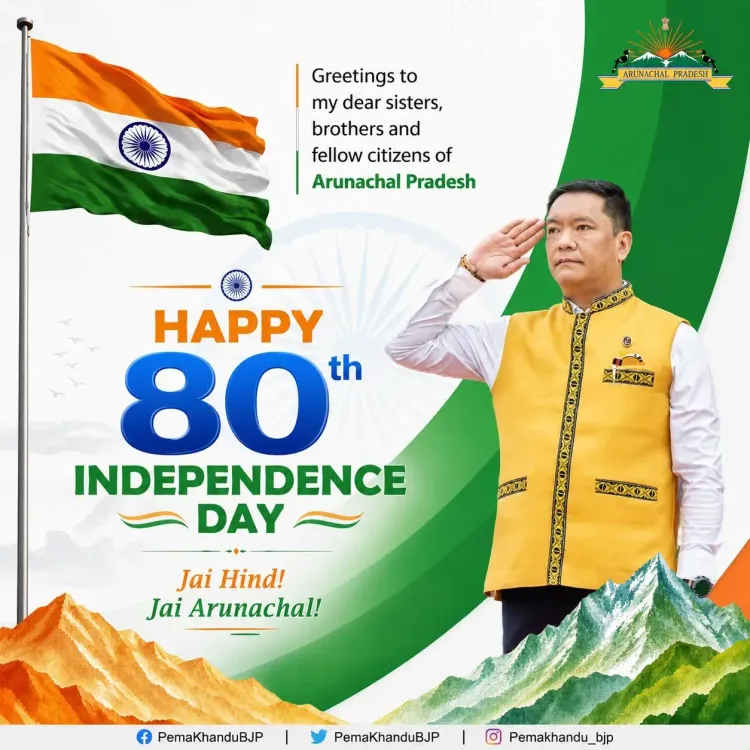
On India's 80th Independence Day, Arunachal Pradesh CM Pema Khandu saluted unsung freedom fighters, credited 'Team Arunachal' for state progress under PM Modi's central support, and warned youth that in the AI era, information travels faster than truth — urging them to pause, verify, and think before sharing online.
Key Takeaways
CM Pema Khandu addressed citizens of Arunachal Pradesh on India's 80th Independence Day, 15 August 2026 .
He paid tribute to both celebrated and unsung freedom fighters, a pointed gesture in a state with rich but under-documented tribal resistance histories.
Khandu credited PM Narendra Modi and the Government of India for development support, while asserting that progress belongs to 'Team Arunachal' — all citizens collectively.
He issued a direct warning to youth about misinformation in the age of artificial intelligence: 'information can travel faster than truth — pause, verify and think.' He defined peace as 'the foundation on which development is built,' signalling its centrality to governance in the sensitive border state.
The address invoked the 'Reform, Perform and Transform' framework as the guiding philosophy of the state government's journey with its citizens.
On India's 80th Independence Day, Saturday, 15 August 2026, Arunachal Pradesh Chief Minister Pema Khandu delivered a sweeping address to his state — honouring the freedom fighters who built the nation, while issuing a pointed call to the younger generation to think before they share in an age where, as he put it, 'information can travel faster than truth.'
Saluting the unsung alongside the celebrated
Khandu opened on a note of inclusive remembrance. He paid tribute not only to the 'known heroes whose names are written in history' but insisted the state must equally honour 'the many unsung heroes whose stories may not have reached the pages of our history books.' It is a distinction that carries particular weight in Arunachal Pradesh, a state of extraordinary tribal diversity where local resistance to colonial rule has rarely received national-level recognition.
He framed that diversity — across communities, languages, and aspirations — as the state's 'greatest strength,' while acknowledging honestly that 'meeting these diverse aspirations is not always easy.' That candour, rare in ceremonial addresses, set the tone for what followed.
Team Arunachal — crediting the centre, claiming the journey
Khandu credited Prime Minister Narendra Modi and the Government of India for standing 'firmly with Arunachal Pradesh,' pointing to governance reforms, connectivity, education, healthcare, sports, youth development, women's empowerment and employment as areas of visible change. The acknowledgement aligns with the sustained push under the Act East Policy — upgraded in 2014 — which has channelled road, air and digital infrastructure investment into the Northeast.
But Khandu was equally deliberate in asserting state ownership of the story. 'The progress of Arunachal Pradesh belongs to Team Arunachal,' he said — naming farmers, entrepreneurs, sportspersons, students, government employees and every citizen as co-authors of the transformation. The framing is politically significant: it roots development pride locally while maintaining the central partnership that defines BJP governance in the Northeast.
A direct message to Arunachal's youth on AI and digital responsibility
The sharpest passage of the address was aimed squarely at young people. Khandu told them they are 'more connected, more informed and more ambitious than any generation before' — and then issued a clear warning: 'In this age of artificial intelligence, information can travel faster than truth. So, pause, verify and think before you believe, create or share something online.'
He framed technology as a tool that 'should empower us, not manipulate us' — a message that resonates in a border state where misinformation can carry social and security consequences beyond the ordinary. The government, he pledged, would keep creating opportunities for young people 'to learn, innovate, compete, work and build a future here in Arunachal.'
Peace as the foundation, not the absence of conflict
Khandu closed on a philosophical note that doubled as a political signal. 'Peace is not merely the absence of conflict,' he said. 'Peace is the foundation on which development is built.' In a state that shares a sensitive international border and is home to dozens of tribal communities with distinct identities, that line is more than rhetoric — it is a governing principle. His call to 'protect the peace of our State' echoed the consistent emphasis from New Delhi on stability in the Northeast as a prerequisite for the Act East agenda.
He concluded with the twin salute — Jai Hind! Jai Arunachal! [Long live India! Long live Arunachal!] — binding national pride to state identity in a single breath.
Arunachal's next assembly session or state budget will be the real test of whether the youth employment and digital literacy commitments Khandu outlined today translate into policy with a price tag.
Point of View
So neither the party's national narrative nor the state's distinct identity is subordinated. The AI-and-misinformation passage is the most forward-looking element — it signals that the state government sees digital manipulation, not just physical unrest, as a threat to border-state stability. The 'peace as foundation' framing is also a quiet but deliberate reminder that Arunachal's development story is inseparable from its geopolitical sensitivity, particularly relevant given ongoing China boundary tensions. Whether the youth-focused commitments survive contact with the next budget will determine if this was vision or valediction.
NationPress
15 Aug 2026
Frequently Asked Questions
What did Pema Khandu say on Independence Day 2026?
Arunachal Pradesh CM Pema Khandu delivered an Independence Day address on 15 August 2026 honouring freedom fighters, crediting 'Team Arunachal' for state progress, and warning youth to verify information before sharing in the age of artificial intelligence.
What did Pema Khandu say about AI and social media?
Khandu warned that 'in this age of artificial intelligence, information can travel faster than truth,' urging young people to 'pause, verify and think' before believing or sharing content online, and saying technology should empower, not manipulate.
What is 'Team Arunachal' that Pema Khandu mentioned?
Khandu used 'Team Arunachal' to describe the collective of all citizens — youth, farmers, entrepreneurs, sportspersons, students, women and government employees — whom he credited as the true drivers of the state's development progress.
What is the Act East Policy and how does it affect Arunachal Pradesh?
India's Act East Policy, upgraded in 2014, prioritises road, air and digital connectivity across the Northeast, including Arunachal Pradesh, and has channelled significant central investment into infrastructure, education and healthcare in the state.
Why did Pema Khandu emphasise peace in his Independence Day speech?
Khandu described peace as 'the foundation on which development is built,' a particularly significant statement for Arunachal Pradesh, a sensitive border state with diverse tribal communities where social stability is seen as a prerequisite for continued growth.