CM Manik Saha pays tribute to Rebel Poet Nazrul Islam
Synopsis
Tripura Chief Minister Dr. Manik Saha marked Nazrul Jayanti by paying tribute to Rebel Poet Kazi Nazrul Islam, honouring his legacy of equality, humanity, and courage against injustice through literature and song.
Key Takeaways
Manik Saha , Chief Minister of Tripura, paid tribute to Kazi Nazrul Islam on his birth anniversary on 26 May 2026 .
Saha described Nazrul as a pioneer of the ideals of equality, humanity, and fraternity .
Kazi Nazrul Islam , born in 1899 , is revered as the 'Rebel Poet' and is the national poet of Bangladesh .
The Government of India awarded Nazrul the Padma Bhushan in 1960 for his literary contributions.
Tripura has a large Bengali-speaking population with strong cultural ties to Nazrul's literary tradition.
Annual Nazrul Jayanti observances are a consistent feature of cultural life across West Bengal , Tripura , and the broader Bengali-speaking world.
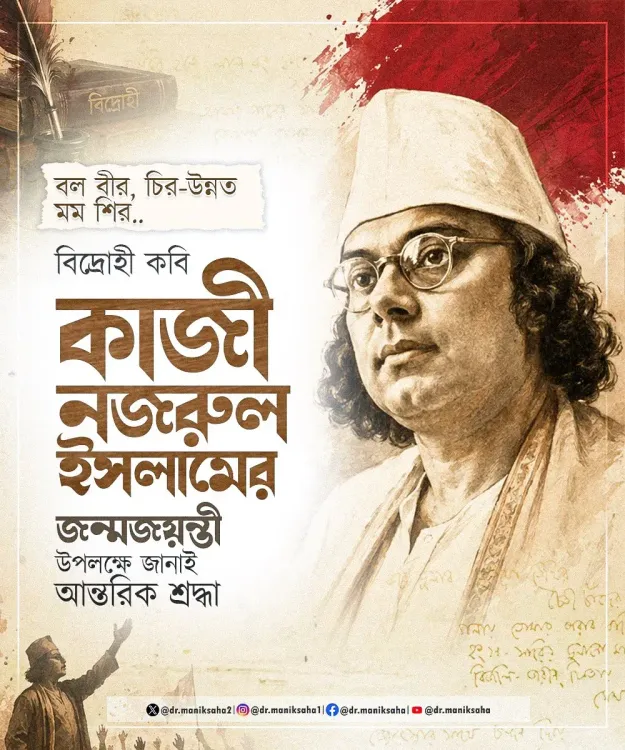
Tripura Chief Minister Dr. Manik Saha on Tuesday, 26 May 2026, paid tribute to the rebel poet Kazi Nazrul Islam on his birth anniversary, hailing the poet as a timeless source of inspiration for humanity through his literature, songs, and poetry.
Writing in Bengali on X, Dr. Saha offered his 'humble homage' on the occasion of Nazrul Jayanti. He described Nazrul as a pioneer of the ideals of equality, humanity, and brotherhood — 'সাম্য, মানবতা ও সৌভাতৃত্বের চেতনার অগ্রদূত' [a pioneer of the consciousness of equality, humanity, and fraternity] — and said the poet's immortal creations would continue to give people the courage to march forward against injustice and oppression.
Context
Kazi Nazrul Islam, born in 1899, is one of the most celebrated literary figures in the Bengali-speaking world. Known as the 'Rebel Poet' for his fiery verse challenging colonial rule, social hierarchy, and religious bigotry, he wrote prolifically across poetry, songs, novels, and essays. His work remains a living cultural touchstone across West Bengal, Tripura, and Bangladesh, where he holds the distinction of being the national poet.
Nazrul Jayanti is observed annually and draws tributes from political leaders, cultural organisations, and literary bodies across the subcontinent. In 1960, the Government of India recognised his contributions with the Padma Bhushan, one of the country's highest civilian honours.
Policy Backdrop
Tripura has a large Bengali-speaking population with deep historical and cultural ties to the broader Bengali literary tradition. State governments in the northeast have consistently observed Nazrul Jayanti as part of efforts to promote composite culture and shared heritage. Dr. Saha's tribute fits within this established pattern of annual observance.
The promotion of secular literary icons such as Nazrul also carries broader symbolic weight, underscoring shared cultural bonds between India and Bangladesh at a time when people-to-people ties between the two neighbours remain an important dimension of bilateral relations.
Stakeholders and Impact
The tribute resonates most immediately with Tripura's Bengali-speaking community, which forms a significant majority of the state's population. Literary associations, cultural bodies, and educational institutions across the state typically mark the occasion with readings, performances, and seminars centred on Nazrul's work.
More broadly, the message speaks to a pan-Bengali cultural identity that transcends national borders. Nazrul's themes of equality and resistance to injustice continue to find relevance among diverse audiences, making his birth anniversary an occasion that unites rather than divides.
What's Next
Similar tributes from other state governments and central cultural bodies are expected during the Nazrul Jayanti period. In Tripura, state-level literary and cultural programmes may be organised to mark the anniversary, with schools and cultural institutions likely to host events celebrating the poet's legacy.
As annual observances of Nazrul Jayanti grow in institutional scale, they also serve as a reminder of the enduring role that shared literary heritage plays in shaping regional identity and cross-border cultural diplomacy in South Asia.
Point of View
Saha signals cultural continuity with a poet whose secular and humanist credentials are universally accepted across political lines. The tribute also reinforces Tripura's identity as a state deeply embedded in Bengali literary heritage, a useful political signal in a region where cultural affinity shapes electoral sentiment. Nationally, such observances by BJP chief ministers reflect the party's ongoing effort to claim ownership of composite cultural icons beyond its core ideological register.
NationPress
21 Oct 2026
Frequently Asked Questions
Who is Kazi Nazrul Islam and why is he called the Rebel Poet?
Kazi Nazrul Islam, born in 1899, is called the Rebel Poet for his fiery literature that challenged colonial rule, social inequality, and religious bigotry. He is the national poet of Bangladesh and a beloved literary figure across the Bengali-speaking world.
When is Nazrul Jayanti observed?
Nazrul Jayanti marks the birth anniversary of Kazi Nazrul Islam and is observed annually in late May, drawing tributes from political leaders, cultural organisations, and literary bodies across India and Bangladesh.
What did Tripura CM Manik Saha say about Nazrul Islam?
Dr. Manik Saha described Kazi Nazrul Islam as a pioneer of equality, humanity, and fraternity, saying the poet's immortal creations would continue to inspire courage against injustice and oppression.
Did India honour Kazi Nazrul Islam with any award?
Yes, the Government of India awarded Kazi Nazrul Islam the Padma Bhushan in 1960 in recognition of his outstanding contributions to literature.
Why does Tripura observe Nazrul Jayanti?
Tripura has a large Bengali-speaking population with deep cultural ties to Bengali literary traditions. Observing Nazrul Jayanti reflects the state's shared heritage with the broader Bengali-speaking world and promotes composite cultural values.