CM Sai invokes Nalanda, Takshashila at Chhattisgarh school fest

Synopsis
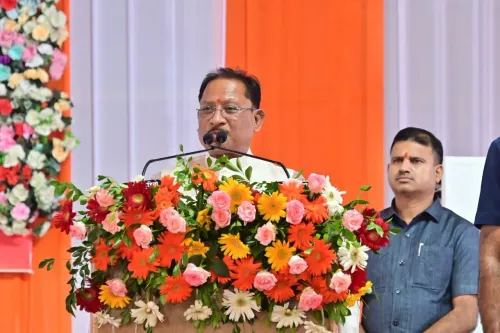
Chief Minister Vishnu Deo Sai addressed Chhattisgarh's Shala Praveshotsav 2026-27 at a Swami Atmanand school in Durg on 20 July, invoking Nalanda and Takshashila to position the annual school admission drive within India's ancient tradition of knowledge and the NEP 2020 framework.
Key Takeaways
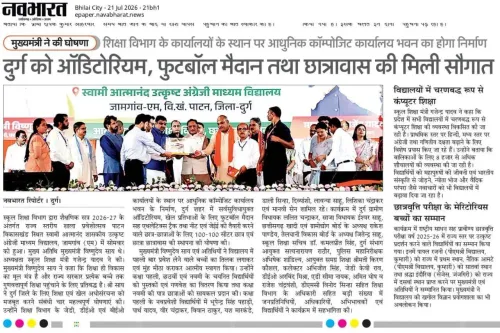
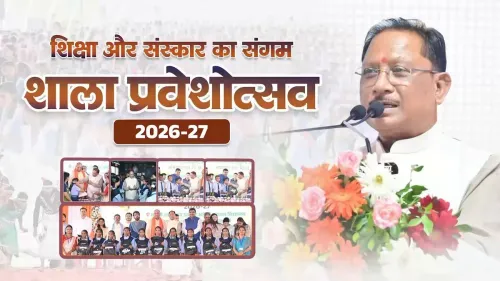
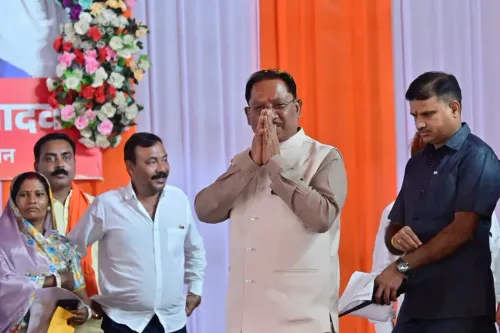
CM Vishnu Deo Sai addressed the state-level Shala Praveshotsav 2026-27 on 20 July 2026 at Swami Atmanand Utkrisht English Medium Vidyalaya, Jamgaon-M, Durg .
He cited Nalanda and Takshashila as evidence that India has been a global centre of learning for centuries.
The remarks align with the National Education Policy 2020 , which mandates integration of Indian Knowledge Systems into curricula.
The Swami Atmanand school scheme, launched in 2020-21 , provides free English-medium government schooling modelled on central schools.
The event is part of a broader Viksit Bharat 2047 -aligned push by BJP-governed states to link modern education drives to ancient Indian intellectual heritage.
The Chief Minister's Office of Chhattisgarh, on behalf of Chief Minister Vishnu Deo Sai, shared remarks delivered at the state-level Shala Praveshotsav 2026-27 programme on Monday, 20 July 2026, held at Swami Atmanand Utkrisht English Medium Vidyalaya, Jamgaon-M, Durg. The Chief Minister invoked the legacy of ancient Indian universities to frame the occasion as part of a civilisational continuum in education.
Context
Speaking at the annual school admission festival, CM Sai stated: 'Bharat ki pehchaan keval sanskriti se nahin, balki apni samridh gyaan parampara se bhi rahi hai' — 'India's identity is defined not only by its culture but also by its rich tradition of knowledge.' He cited Nalanda and Takshashila as proof that India has been a Vishwaguru (world teacher) in education for centuries.
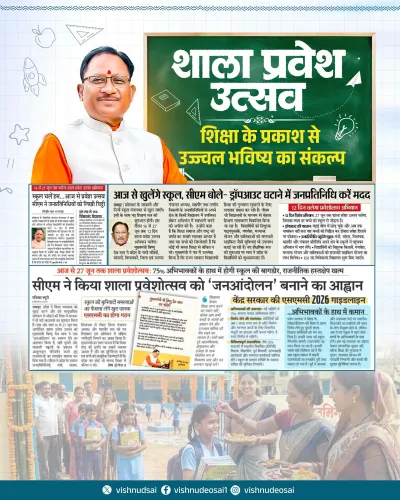
The Shala Praveshotsav is an annual state-government initiative to mark and encourage fresh enrolments at the start of the academic year, lending a celebratory character to what is otherwise a routine administrative exercise. The choice of a Swami Atmanand school as the venue underscores the state's flagship push for free, high-quality English-medium government schooling.
Policy Backdrop
The Swami Atmanand Utkrisht English Medium Vidyalaya scheme was launched by Chhattisgarh in 2020-21 to give students in government schools access to English-medium instruction modelled on central schools, addressing a long-standing gap between private and public schooling quality in the state.
CM Sai's references to Nalanda and Takshashila align closely with the National Education Policy 2020, approved by the Union Cabinet in July 2020, which explicitly mandates the integration of Indian Knowledge Systems into school and higher education curricula. The NEP is India's first comprehensive overhaul of its education framework in over three decades. Several BJP-governed states have organised similar admission festivals and curriculum workshops that highlight India's historical role as a knowledge centre alongside NEP implementation.
Nalanda, located in present-day Bihar, was a celebrated Buddhist university that drew scholars from across Asia before its destruction in the 12th century. Takshashila, in present-day Pakistan, was renowned from roughly the 6th century BCE for instruction in medicine, statecraft, and the arts. Both institutions are frequently cited in contemporary Indian education policy discourse as anchors of the Vishwaguru narrative.
Stakeholders and Impact
The primary beneficiaries of the Shala Praveshotsav drive are students, parents, and teachers across Chhattisgarh, particularly in districts such as Durg where Swami Atmanand schools have expanded access to English-medium instruction for families who cannot afford private schooling.
The ideological framing — linking the 2026-27 admissions cycle to the heritage of Nalanda and Takshashila — is aimed at building cultural confidence among young learners while reinforcing the state's alignment with the Viksit Bharat 2047 agenda, the central government's long-term development vision. Teachers and school administrators are expected to translate this narrative into classroom practice through NEP-aligned Indian Knowledge Systems modules.
What's Next
Attention will now turn to enrolment figures for the 2026-27 academic year and whether Chhattisgarh rolls out dedicated state-level curriculum modules on Indian Knowledge Systems as part of its NEP implementation roadmap. The Swami Atmanand school network's expansion trajectory will also be closely watched as a measure of the government's commitment to bridging the public-private education quality gap.
If the state follows the pattern set by comparable BJP-governed states, structured workshops and supplementary reading materials on ancient Indian learning traditions could be introduced in government schools before the end of the current academic year, giving the CM's Shala Praveshotsav address a concrete policy follow-through.
Point of View
Embedding the NEP 2020 narrative of Indian Knowledge Systems into grassroots school administration. It signals that Chhattisgarh intends to use the Shala Praveshotsav not merely as an enrolment drive but as a platform for cultural messaging aligned with the Viksit Bharat 2047 agenda. The choice of a Swami Atmanand English-medium school as the venue is also telling: it lets the government simultaneously project modernity and civilisational pride. The pattern mirrors similar events in other BJP-governed states, suggesting coordinated messaging rather than a standalone state initiative.
NationPress
19 Oct 2026
Frequently Asked Questions
What is Shala Praveshotsav in Chhattisgarh?
Shala Praveshotsav is an annual school admission festival organised by the Chhattisgarh government to celebrate and encourage fresh student enrolments at the start of the academic year. The 2026-27 edition was held on 20 July 2026 at a Swami Atmanand school in Durg.
What are Swami Atmanand English Medium Schools?
Swami Atmanand Utkrisht English Medium Vidyalayas are a Chhattisgarh government initiative launched in 2020-21 to provide free, high-quality English-medium education in government schools, modelled on the standards of central schools.
Why did CM Vishnu Deo Sai mention Nalanda and Takshashila?
CM Sai cited Nalanda and Takshashila to argue that India has been a global centre of learning for centuries, framing the 2026-27 school admissions drive within the National Education Policy 2020's emphasis on Indian Knowledge Systems and the broader Viksit Bharat 2047 vision.
What is the National Education Policy 2020 and how does it relate to this event?
The National Education Policy 2020 is India's first major education framework revision in over three decades, approved in July 2020. It explicitly calls for integrating Indian Knowledge Systems — including references to ancient institutions like Nalanda — into school and higher education curricula, which CM Sai's address directly echoes.
Who is Vishnu Deo Sai?
Vishnu Deo Sai is the Chief Minister of Chhattisgarh, serving since December 2023 following the BJP's electoral victory in the state. He has been associated with education and development programmes including the Shala Praveshotsav initiative.