CM Sai Announces Key Appointments Across CG Boards
Synopsis
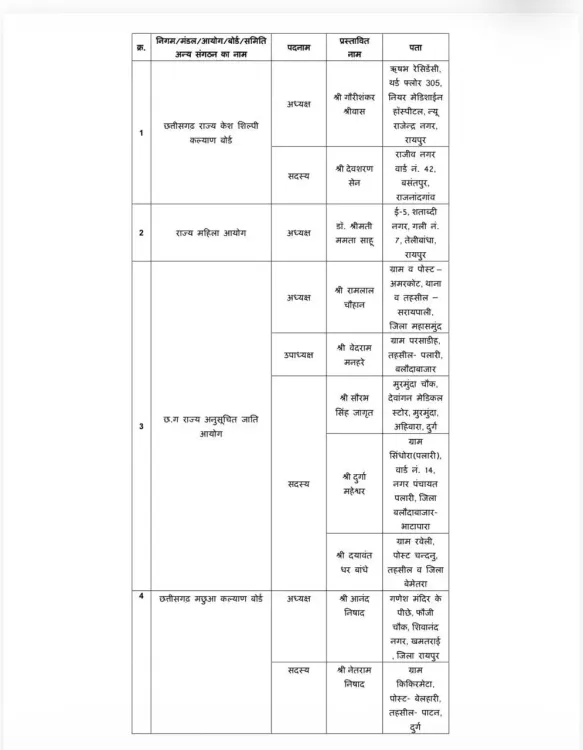
Chhattisgarh Chief Minister Vishnu Deo Sai on 7 July 2026 announced appointments of chairpersons, vice-chairpersons, and members across more than a dozen state corporations, boards, and commissions — from the Women's Commission and SC/ST Commissions to welfare boards for fisherfolk, hairdressers, and labourers.
Key Takeaways
Dr Mamta Sahu appointed chairperson of the Chhattisgarh State Women's Commission .
Ramlal Chauhan named chairperson of the Chhattisgarh State Scheduled Castes Commission , with Vedram Manhare as vice-chairperson and three members.
Mangal Das Thakur appointed vice-chairperson of the Chhattisgarh State Scheduled Tribes Commission .
Sudhir Gautam named chairperson of the Chhattisgarh State Education Commission ; Dr J.P.
Sharma appointed vice-chairperson of the Raipur Development Authority .
Anand Nishad appointed chairperson of the Chhattisgarh Fishermen Welfare Board and Gaurishankar Srivastava chairperson of the Hairdressers Welfare Board .
CM Sai expressed confidence that all appointees will work toward 'Viksit Chhattisgarh' with dedication to public service and good governance.
Chhattisgarh Chief Minister Vishnu Deo Sai on Tuesday, 7 July 2026, announced a sweeping round of appointments to chairperson, vice-chairperson, and member positions across multiple state corporations, boards, commissions, and committees, signalling a broad administrative consolidation of the BJP-led state government's institutional framework.
Context
The Chief Minister's post listed appointments spanning more than a dozen bodies. In his words, 'प्रदेश के विभिन्न निगम, मंडल, आयोग, बोर्ड, समिति एवं अन्य संस्थाओं में अध्यक्ष, उपाध्यक्ष एवं सदस्यों की नियुक्ति के आदेश जारी किए गए हैं' ('Orders have been issued for the appointment of chairpersons, vice-chairpersons, and members in various corporations, boards, commissions, committees, and other institutions of the state'). CM Sai extended congratulations to all newly appointed officials and expressed confidence that they would serve the public with full dedication toward the goal of a 'Viksit Chhattisgarh' (Developed Chhattisgarh).
Among the most prominent appointments: Dr Mamta Sahu has been entrusted with the chairpersonship of the Chhattisgarh State Women's Commission, while Ramlal Chauhan has been named chairperson of the Chhattisgarh State Scheduled Castes Commission, with Vedram Manhare as vice-chairperson and Saurabh Singh Jagrit, Durga Maheshwar, and Dayavant Dhar Bandhe as members.
Policy Backdrop
Following the BJP's victory in the November 2023 Chhattisgarh assembly elections, the new government under CM Sai began filling vacancies in state-level statutory bodies to operationalise welfare mandates aligned with its electoral priorities. This latest round extends that consolidation into 2026, covering bodies ranging from tribal welfare to urban development.
State governments in India routinely reconstitute such bodies after elections, ensuring that institutional leadership reflects the ruling party's policy direction on social justice, development, and targeted welfare. The appointments cover a wide spectrum: the Chhattisgarh State Scheduled Tribes Commission sees Mangal Das Thakur appointed as vice-chairperson; the Raipur Development Authority gets Dr J.P. Sharma as vice-chairperson; and the Chhattisgarh Labour Welfare Board appoints Kishore Mahanand as vice-chairperson.
Other key appointments include Gaurishankar Srivastava as chairperson of the Chhattisgarh State Hairdressers Welfare Board (Kesh Shilpi Kalyan Board), Anand Nishad as chairperson of the Chhattisgarh Fishermen Welfare Board (Machhua Kalyan Board), Rajesh Kumar Rajput as chairperson of the Chhattisgarh Sanskrit Vidya Mandal, Raipur, Rajendra Nayak as chairperson of the Shakambhari Board, and Sudhir Gautam as chairperson of the Chhattisgarh State Education Commission. Anand Kumar Tiwari (also known as Rajiv Lochan Das Maharaj) has been appointed vice-chairperson of the Gau Seva Aayog (Cow Service Commission).
Stakeholders and Impact
The appointments directly affect communities whose welfare these bodies are mandated to serve: Scheduled Caste and Scheduled Tribe communities, women, fisherfolk, hairdressers, labourers, Sanskrit scholars, and urban residents of Raipur. Statutory commissions such as the Women's Commission and the SC/ST Commissions carry legal powers to investigate complaints, recommend policy measures, and monitor implementation of constitutional safeguards.
The inclusion of occupational welfare boards — for fisherfolk and hairdressers — alongside cultural bodies like the Sanskrit Vidya Mandal and the Shakambhari Board (which serves the farming and horticulture community) reflects the government's attempt to signal outreach across caste, occupational, and cultural constituencies ahead of future electoral cycles.
What's Next
Attention will now turn to whether the newly constituted commissions and boards convene promptly and begin substantive work, including filing annual reports, taking up grievances, and recommending budgetary allocations in the next state assembly session. The pace at which these bodies become operational will be a key indicator of whether the appointments translate into on-ground welfare delivery for the communities they are designed to serve.
Point of View
Allowing the BJP government to embed its loyalists and priority constituencies into the state's statutory architecture more than two years into its term. By simultaneously appointing to SC, ST, and Women's Commissions alongside occupational boards for fisherfolk and hairdressers, CM Sai is signalling broad-based outreach that maps closely onto the party's social coalition in Chhattisgarh. The real test will be whether these bodies move beyond ceremonial reconstitution to deliver measurable outcomes — annual reports, grievance redressal, and policy recommendations — that can be cited ahead of the next assembly election. The 'Viksit Chhattisgarh' framing ties these appointments to the national 'Viksit Bharat' narrative, reinforcing the state government's alignment with the central BJP leadership's messaging.
NationPress
6 Oct 2026
Frequently Asked Questions
Who has been appointed as chairperson of the Chhattisgarh State Women's Commission?
Dr Mamta Sahu has been appointed as chairperson of the Chhattisgarh State Women's Commission, as announced by Chief Minister Vishnu Deo Sai on 7 July 2026 .
Who is the new chairman of the Chhattisgarh State Scheduled Castes Commission?
Ramlal Chauhan has been appointed chairperson of the Chhattisgarh State Scheduled Castes Commission, with Vedram Manhare as vice-chairperson.
What appointments did CM Vishnu Deo Sai announce on 7 July 2026?
CM Sai announced appointments to chairperson, vice-chairperson, and member positions across more than a dozen state bodies, including the Women's Commission, SC and ST Commissions, the Fishermen Welfare Board, the Hairdressers Welfare Board, the Raipur Development Authority, and the State Education Commission, among others.
Who has been appointed vice-chairperson of the Raipur Development Authority?
Dr J.P. Sharma has been appointed vice-chairperson of the Raipur Development Authority as part of the 7 July 2026 appointment orders.
What is the Chhattisgarh Gau Seva Aayog and who is its new vice-chairperson?
The Gau Seva Aayog is the state's Cow Service Commission. Anand Kumar Tiwari , also known as Rajiv Lochan Das Maharaj , has been appointed its vice-chairperson in the latest round of appointments.