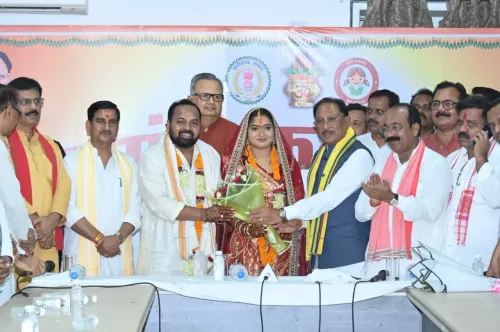
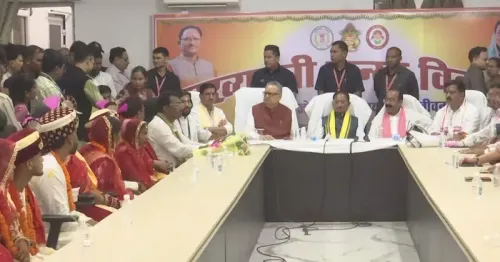
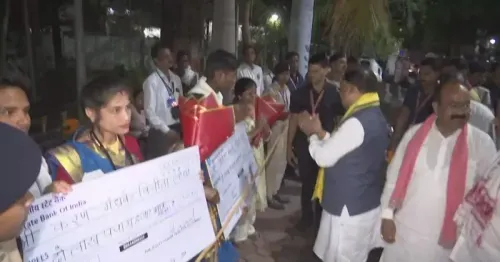
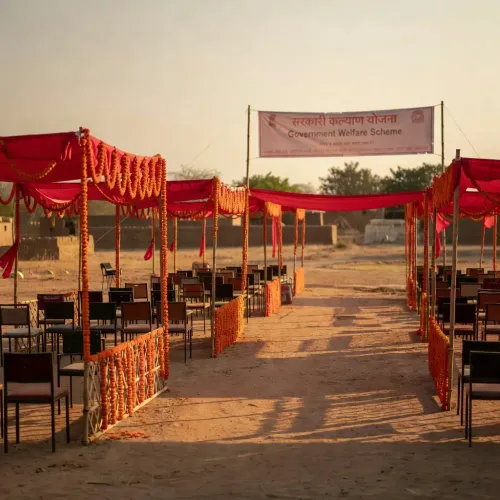
CM Sai's Govt Marks 2 Years of Kanya Vivah Yojana in Chhattisgarh
Synopsis
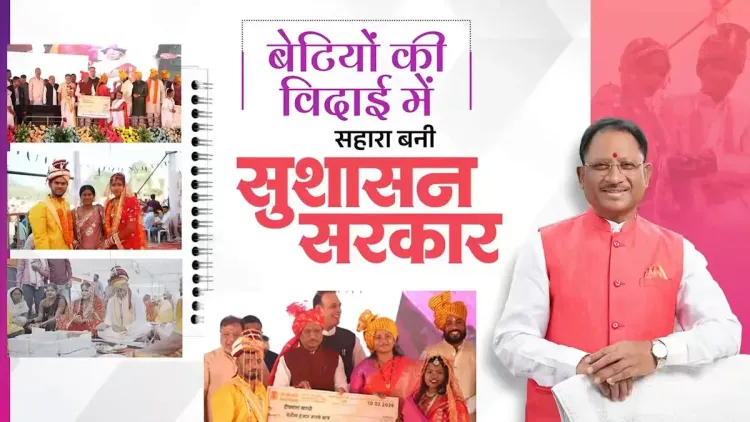
The Chief Minister's Office of Chhattisgarh has highlighted the Mukhyamantri Kanya Vivah Yojana on Navratri 2026, stating that thousands of economically weaker families have received marriage support for their daughters over the past two years under CM Vishnu Dev Sai's government.
Key Takeaways
The Chhattisgarh CMO posted on 13 October 2026 , during Navratri, highlighting the Mukhyamantri Kanya Vivah Yojana .
The scheme provides financial assistance for weddings of daughters from economically weaker sections and BPL households.
CM Vishnu Dev Sai , in office since December 2023 , has continued this multi-government welfare programme.
The government describes the scheme as a 'responsibility', not merely a policy, using the sushasan (good governance) framing.
Exact beneficiary counts and per-family assistance amounts for the two-year period have not been officially disclosed in this post.
Chhattisgarh's approach mirrors similar marriage-assistance schemes active across multiple Indian states.
Thousands of families in Chhattisgarh have crossed one of life's most financially daunting milestones with state support — a daughter's wedding — and the government of Chief Minister Vishnu Dev Sai is marking that milestone on Tuesday, 13 October 2026, as part of its Navratri outreach.
The Chief Minister's Office of Chhattisgarh posted on X, describing the Mukhyamantri Kanya Vivah Yojana not merely as a scheme but as a responsibility: 'बेटियों की खुशियों में सहभागी सुशासन सरकार' — 'A good-governance government that shares in the happiness of daughters.' The post states that over the past two years, thousands of weddings have been facilitated, easing the financial anxiety of families in need.
What the Mukhyamantri Kanya Vivah Yojana does
The scheme provides direct financial assistance for the marriages of daughters from economically weaker sections, targeting households below the poverty line. It is designed to reduce the burden that wedding costs place on low-income families — a burden that in many cases drives debt or deferred marriages.
Chhattisgarh has run variants of marriage-assistance programmes for girls across successive governments, making this a durable plank of the state's social welfare architecture rather than a single administration's initiative. The BJP government that took office in December 2023 under CM Sai has continued and amplified the scheme as part of its broader women-focused outreach portfolio.
Navratri timing and the 'Shakti Vandana' frame
The post carries the hashtag #ShaktiVandana alongside #CGNavratri2026, situating the announcement within the nine-day festival that celebrates feminine power. The timing is deliberate: Navratri gives state governments a culturally resonant window to highlight women-welfare outcomes, and the Chhattisgarh CMO has used it to underscore the 'good governance' (sushasan) narrative the Sai administration has built its brand around.
Across India, similar state-level schemes — in Madhya Pradesh, Uttar Pradesh, West Bengal, and others — reflect a shared policy logic: reducing distress around marriage costs helps keep girls in school longer, discourages early marriage, and prevents families from spiralling into debt. Chhattisgarh's version sits within that national pattern.
What the numbers don't yet tell us
The CMO's post references 'thousands of daughters' married over two years but does not specify the exact beneficiary count, the quantum of financial assistance per family, or the total budget deployed. Those figures, once officially published, will be the clearest measure of the scheme's reach under the current administration. The next state budget will be watched for allocation trends.
For now, the government's message on Navratri is unambiguous: the state sees itself not as a passive administrator of a welfare line item, but as an active partner in a family's most consequential day. Whether the numbers ultimately bear that out is the accountability question that follows every such pledge.
Point of View
Reinforcing the BJP's 'sushasan' brand in a state it recaptured in late 2023. Marriage-assistance schemes occupy an interesting space in Indian welfare policy: they enjoy cross-party consensus and longevity, yet rarely produce the headline beneficiary data that would allow rigorous evaluation. CM Sai's administration has an opportunity to differentiate itself by publishing audited numbers; without them, the 'thousands of daughters' claim remains inspirational rhetoric rather than verifiable governance. The broader pattern — multiple states maintaining such schemes — suggests this is now a floor expectation for state governments, making implementation quality, not mere existence of the scheme, the real political differentiator.
NationPress
13 Oct 2026
Frequently Asked Questions
What is the Mukhyamantri Kanya Vivah Yojana in Chhattisgarh?
The Mukhyamantri Kanya Vivah Yojana is a Chhattisgarh state scheme that provides financial assistance to economically weaker and BPL families to help cover the costs of their daughters' weddings, reducing financial distress.
Who is the current Chief Minister of Chhattisgarh?
Vishnu Dev Sai has been the Chief Minister of Chhattisgarh since December 2023, heading the BJP-led state government.
How many beneficiaries has the Kanya Vivah Yojana helped in the last two years?
The Chhattisgarh CMO states that thousands of daughters have been married under the scheme over the past two years, though exact certified figures have not been disclosed in the official post.
Why was the Kanya Vivah Yojana announcement made during Navratri 2026?
The government timed the announcement to coincide with Navratri, a festival celebrating feminine power, framing the welfare scheme as part of its 'Shakti Vandana' — an act of honouring women — during the nine-day celebration.
Do other Indian states have similar marriage assistance schemes for girls?
Yes, several Indian states including Madhya Pradesh, Uttar Pradesh, and West Bengal operate comparable marriage-assistance programmes for daughters from low-income families, reflecting a widely shared welfare policy approach across the country.