CM Sai Highlights Good Governance Driving Chhattisgarh Growth
Synopsis
Chhattisgarh Chief Minister Vishnu Deo Sai on 27 May 2026 posted a message on X declaring that 'public-welfare decisions are accelerating development,' reaffirming his BJP government's good governance agenda nearly two and a half years after taking office in December 2023.
Key Takeaways
CM Vishnu Deo Sai posted on 27 May 2026 reaffirming his government's 'good governance' ('su-shasan') commitment.
The post stated that janahitaishi nirnay (public-welfare decisions) are driving development pace in Chhattisgarh .
The BJP government has held office in Chhattisgarh since December 2023 , following victory in the state assembly elections.
Chhattisgarh is a mineral-rich, predominantly tribal state where welfare delivery and Naxal-affected district development remain central governance challenges.
The messaging continues a consistent BJP state-level theme of positioning current administration as an improvement over the 2018–2023 Congress tenure under Bhupesh Baghel .
Future budget and scheme implementation reports will be watched for measurable progress in rural and tribal belts.
Chhattisgarh Chief Minister Vishnu Deo Sai on Wednesday, 27 May 2026, reaffirmed his government's commitment to public-welfare-led development, posting a message on X that described his administration as a 'good governance government dedicated to the progress of the state.'
Context
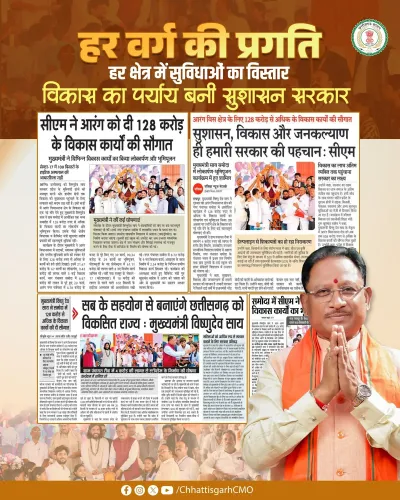
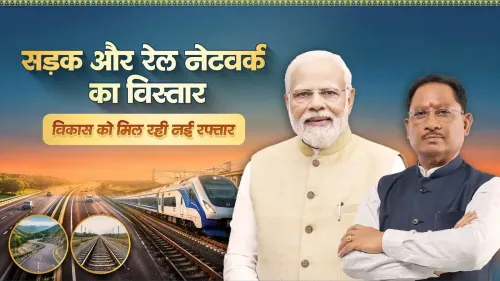
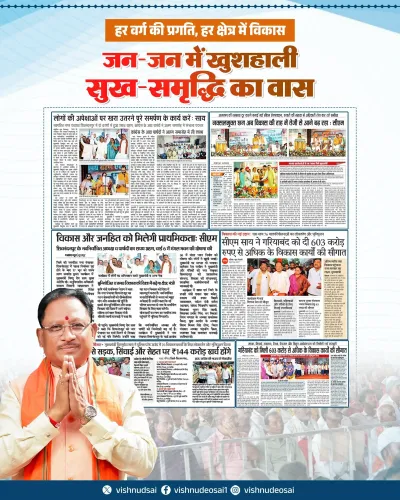
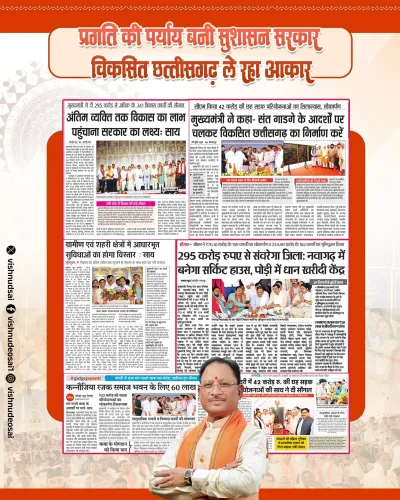
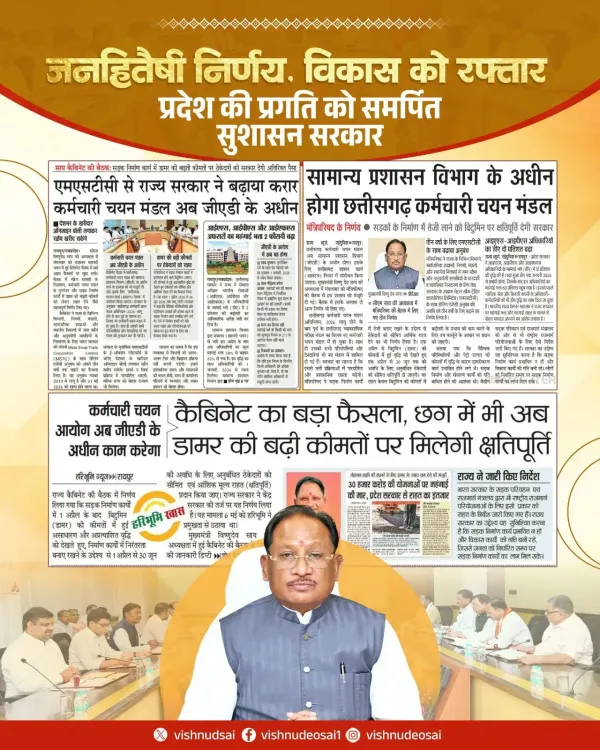
The Chief Minister's post read: 'जनहितैषी निर्णयों से विकास को मिलती रफ्तार / प्रदेश की प्रगति को समर्पित सुशासन सरकार!!' — translated as 'Development gains pace through public-welfare decisions / A good governance government dedicated to the progress of the state.' The message, accompanied by an image, encapsulates the BJP-led government's central governing theme since it assumed office in December 2023.
The framing of suशासन ('su-shasan', or good governance) has been a consistent rhetorical anchor for the Bharatiya Janata Party in Chhattisgarh, positioning the current dispensation as a course correction after the 2018–2023 Congress government led by Bhupesh Baghel.
Policy Backdrop
Chhattisgarh is a mineral-rich state in central India with a large tribal population and a history of left-wing extremism that has complicated welfare delivery and infrastructure development for decades. The BJP returned to power after the 2023 assembly elections on a platform of accelerated development, reduced corruption, and stronger administrative efficiency.
Chief Minister Sai, a tribal leader and former Union Minister, has since steered the government's messaging toward public-welfare decisions — referred to as janahitaishi nirnay — as the engine of growth. This fits a broader national pattern of BJP-governed states emphasising administrative delivery and welfare schemes to consolidate gains in resource-rich but underdeveloped regions.
Stakeholders and Impact
The primary beneficiaries of welfare-oriented governance in Chhattisgarh are the state's rural households, tribal communities, and residents of districts historically affected by Naxal activity. Effective scheme implementation in these areas carries both developmental and security implications, as improved welfare delivery has long been seen as a counter to left-wing extremist influence.
Central-state coordination on mining revenues, infrastructure spending, and rehabilitation programmes in Naxal-affected districts remains a key variable in how swiftly the government's stated development agenda translates into measurable outcomes on the ground.
What's Next
Observers will look to forthcoming state budget presentations and scheme implementation reports for concrete metrics on infrastructure and welfare delivery. The government's ability to demonstrate tangible progress in tribal and rural belts will be critical ahead of future electoral cycles and will test whether the 'good governance' narrative is matched by outcomes in areas such as road connectivity, health access, and agricultural support.
Point of View
More efficient administration. By invoking 'public-welfare decisions' as the driver of development, the messaging subtly keeps alive the contrast with the Baghel-era Congress government without naming it directly. This fits a wider BJP playbook across multiple states where post-election consolidation relies on visible welfare delivery rather than ideological messaging alone. The real test, however, lies in scheme implementation data from tribal and Naxal-affected districts, where the gap between political narrative and ground reality tends to be most visible.
NationPress
16 Sept 2026
Frequently Asked Questions
Who is Vishnu Deo Sai and what is his role in Chhattisgarh?
Vishnu Deo Sai is the Chief Minister of Chhattisgarh , a BJP leader who assumed office in December 2023 following the party's victory in the state assembly elections. He is a tribal leader and former Union Minister.
What did Chhattisgarh CM Vishnu Deo Sai post on X on 27 May 2026?
CM Sai posted that 'development gains pace through public-welfare decisions' and described his administration as a 'good governance government dedicated to the progress of the state,' in a Hindi-language message accompanied by an image.
What is 'su-shasan' and why does the BJP use it in Chhattisgarh?
'Su-shasan' means good governance in Hindi. The BJP uses it as a central theme in Chhattisgarh to position its administration as more efficient and welfare-oriented compared to the previous Congress government that held power from 2018 to 2023 .
What are the main governance challenges in Chhattisgarh?
Chhattisgarh faces challenges including welfare delivery to a large tribal population, infrastructure development, and security concerns in districts affected by left-wing extremism, alongside managing revenues from its significant mineral resources.
How does Chhattisgarh's governance model fit the broader BJP pattern?
The BJP 's emphasis on welfare-driven development and administrative efficiency in Chhattisgarh mirrors its approach across multiple states where it won elections in 2023 , using public scheme delivery to consolidate electoral gains in resource-rich but underdeveloped regions.