CM Saini Calls for People's Role in Building Viksit Haryana
Synopsis
Haryana Chief Minister Nayab Singh Saini has called for citizen participation — Jan Bhagidari — as the driving force behind a developed Haryana, aligning the state's governance vision with the national Viksit Bharat @2047 agenda and signalling a shift toward community co-creation in policy delivery.
Key Takeaways
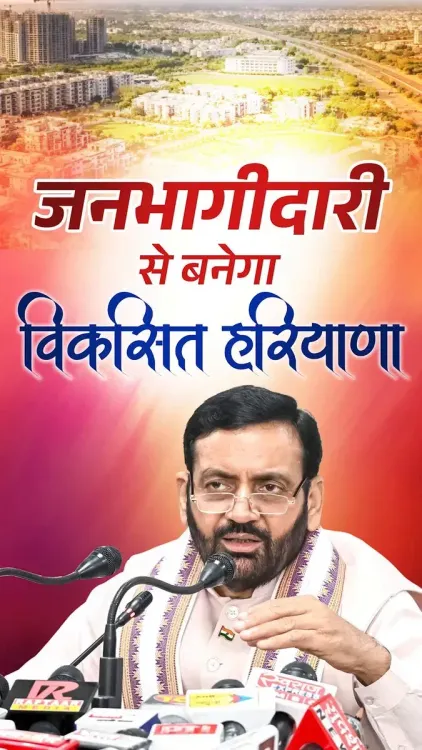
CM Nayab Singh Saini posted on 23 June 2026 that a developed Haryana will be built through people's participation ( जनभागीदारी ).
The message aligns with the national Viksit Bharat @2047 vision promoted by Prime Minister Narendra Modi .
Saini has stressed Jan Bhagidari as a core governance principle since taking office in March 2024 .
Haryana previously ran the Viksit Bharat Sankalp Yatra in 2023-24 to promote citizen enrolment in welfare schemes.
Similar participatory-governance messaging has appeared in BJP -ruled states including Gujarat and Madhya Pradesh .
Analysts will watch the 2026-27 budget and gram sabha guidelines for concrete implementation steps.
Haryana Chief Minister Nayab Singh Saini on Tuesday, 23 June 2026, invoked the principle of Jan Bhagidari — citizen participation — as the cornerstone of the state's development vision, declaring that a developed Haryana will be built through the collective effort of its people.
Context
In a post on X, CM Saini wrote: 'जनभागीदारी से बनेगा विकसित हरियाणा' — 'A developed Haryana will be built through people's participation.' The message, though brief, carries significant political and administrative weight, signalling that the BJP-led state government intends to anchor its governance model on citizen co-creation rather than top-down delivery of schemes.
The slogan echoes language Saini has used since he assumed office as Chief Minister in March 2024, succeeding Manohar Lal Khattar. In his first address as CM, he had stressed inclusive growth and Jan Bhagidari as guiding principles of his administration.
Policy Backdrop
The post aligns closely with the Viksit Bharat @2047 vision articulated by Prime Minister Narendra Modi, which calls on states to become developed economies by 2047 — the centenary of Indian independence. Haryana has previously run parallel campaigns to operationalise this vision at the grassroots level, most notably the Viksit Bharat Sankalp Yatra of 2023-24, which toured the state to enrol citizens in central welfare schemes and build awareness of government programmes.
The emphasis on participatory governance also draws on Haryana's earlier 'Mera Parivar, Mera Desh' initiative, which between 2015 and 2020 experimented with community involvement in local development planning. The current messaging represents a more explicit ideological framing of that approach — positioning citizens not merely as beneficiaries but as active co-builders of the state's future.
Across BJP-ruled states such as Gujarat and Madhya Pradesh, similar language has accompanied periods of heightened political mobilisation, including ahead of assembly or local-body elections. The pattern reflects a post-2014 administrative philosophy that seeks to increase public ownership of schemes, improve implementation efficiency, and reduce leakages in welfare delivery.
Stakeholders and Impact
Haryana's roughly 2.9 crore residents stand as the primary audience for this call to action. The state's population spans diverse constituencies — farmers in the agrarian belt, industrial workers in Gurugram and Faridabad, and fast-growing urban communities — all of whom are implicitly invited into the government's development framework under the Jan Bhagidari model.
For local communities and gram sabhas, the message could presage greater formal roles in planning and resource allocation, depending on how the administration chooses to operationalise the principle. Civil society groups and panchayati raj institutions in the state will be watching for concrete policy announcements that translate the slogan into institutional mechanisms.
What's Next
Observers will look to Haryana's 2026-27 budget cycle and any new guidelines for gram sabha or ward-level planning committees as indicators of whether this Jan Bhagidari messaging translates into structural reform. The possible launch of district-level 'Viksit Haryana' action plans — potentially assigning measurable development targets to local bodies — would mark the next concrete step in this governance direction.
If the Saini government moves to institutionalise citizen participation through formal frameworks, it could set a template for other BJP-governed states seeking to align state-level delivery with the broader Viksit Bharat national agenda ahead of future electoral cycles.
Point of View
A distinction that carries electoral as well as administrative value. The message fits squarely within the BJP's national template of tethering state-level governance to the Viksit Bharat @2047 brand, creating a coherent top-down-to-grassroots narrative. For Saini personally, it reinforces his positioning as a people-centric leader distinct from the more technocratic image of his predecessor. The real test will be whether Jan Bhagidari produces structural reforms — in gram sabha empowerment or participatory budgeting — or remains a mobilisation slogan ahead of future electoral contests.
NationPress
22 Sept 2026
Frequently Asked Questions
What does 'जनभागीदारी से बनेगा विकसित हरियाणा' mean?
It translates to 'A developed Haryana will be built through people's participation,' expressing CM Nayab Singh Saini's vision of citizen-driven development in the state.
Who is Nayab Singh Saini and when did he become Haryana CM?
Nayab Singh Saini is a BJP leader who became Chief Minister of Haryana in March 2024, succeeding Manohar Lal Khattar, with a focus on inclusive growth and administrative reform.
What is Viksit Haryana and how does it relate to Viksit Bharat?
Viksit Haryana is Haryana's state-level development vision modelled on the national Viksit Bharat @2047 agenda, which aims to make India a developed nation by the centenary of independence.
What is Jan Bhagidari in the context of Haryana governance?
Jan Bhagidari means citizen participation; in Haryana's governance context it refers to involving residents actively in planning and implementing development schemes rather than treating them only as beneficiaries.
What should we watch for next from the Haryana government on this agenda?
Key indicators include new guidelines for gram sabha or ward-level planning committees, district-level Viksit Haryana action plans, and announcements in the 2026-27 state budget.