CM Saini Pays Tribute to Dadabhai Naoroji on Death Anniversary
Synopsis
Haryana Chief Minister Nayab Singh Saini honoured Dadabhai Naoroji — economist, freedom fighter and 'Grand Old Man of India' — on his death anniversary on 30 June 2026, calling his contributions to patriotism, Swadeshi thought and public welfare eternally memorable.
Key Takeaways
Haryana CM Nayab Singh Saini paid tribute to Dadabhai Naoroji on his death anniversary, 30 June 2026 .
Naoroji is remembered as the 'Grand Old Man of India' , a pioneering economist and leading freedom fighter.
CM Saini highlighted Naoroji's contributions to patriotism, Swadeshi thought, and public welfare .
Naoroji ( 1825–1917 ) was a three-time president of the Indian National Congress and architect of the 'Drain of Wealth' theory.
He was the first person of Indian origin elected to the British House of Commons , in 1892 .
The tribute reflects ongoing political engagement with India's freedom movement legacy ahead of the 2047 independence centenary.
Haryana Chief Minister Nayab Singh Saini on Tuesday, 30 June 2026, paid homage to Dadabhai Naoroji, the pioneering Indian economist and freedom fighter widely known as the 'Grand Old Man of India', on his death anniversary.
Context
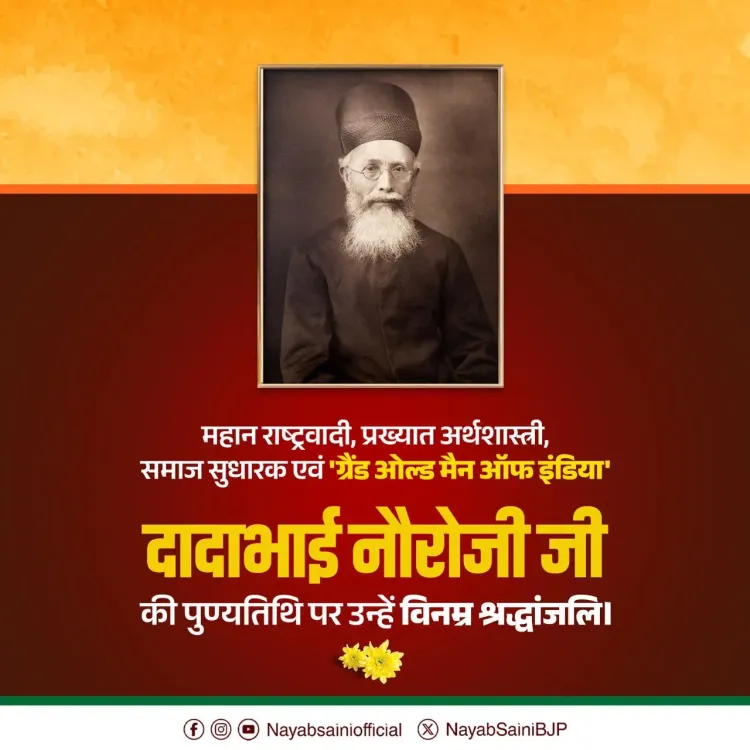
In his post, CM Saini described Dadabhai Naoroji as 'भारतीय राष्ट्रीय चेतना के अग्रदूत' (the harbinger of Indian national consciousness) and honoured him as a 'महान अर्थशास्त्री' (great economist) and a leading fighter of the independence movement. The tribute was shared in Hindi and accompanied by an image, reflecting the significance of the occasion.
Saini wrote that Naoroji's contributions to 'राष्ट्रभक्ति, स्वदेशी विचार और जनकल्याण' — patriotism, the Swadeshi spirit, and public welfare — 'will always be remembered.' The post carried a tone of reverence consistent with tributes offered by leaders across the political spectrum on this date each year.
Policy Backdrop
Dadabhai Naoroji (4 September 1825 – 30 June 1917) was one of the founding figures of the Indian National Congress and served as its president three times. He is best remembered for his 'Drain of Wealth' theory, which systematically documented how British colonial rule extracted economic resources from India, laying the intellectual groundwork for the economic critique of colonialism.
Naoroji was also the first person of Indian origin to be elected to the British House of Commons, representing Finsbury Central in London in 1892. His dual legacy — as an economic thinker and a democratic pioneer — makes him a figure invoked across ideological lines in contemporary Indian politics.
Stakeholders and Impact
Tributes to Dadabhai Naoroji on his death anniversary (30 June) are observed nationally, with political leaders, academics, and civil society groups honouring his memory. For BJP leaders such as CM Saini, invoking Naoroji's Swadeshi ideology carries particular resonance, given the party's consistent emphasis on economic self-reliance and the 'Atmanirbhar Bharat' (self-reliant India) framework.
The tribute also underscores a broader political effort to claim shared ownership of India's freedom movement legacy, a recurring theme in national discourse ahead of the country's centenary of independence in 2047.
What's Next
As India approaches the centenary of its independence, the ideas of foundational figures like Dadabhai Naoroji — particularly his economic nationalism and advocacy for self-governance — are likely to feature prominently in policy narratives and public commemorations. CM Saini's tribute signals continued political engagement with this intellectual heritage at the state level in Haryana.
Point of View
Broadening the ideological tent. The move also reflects a wider BJP strategy of claiming shared stewardship of India's pre-independence intellectual heritage, a narrative space traditionally associated with the Congress. As India counts down to its 2047 independence centenary, such tributes are likely to grow in frequency and political weight. For a sitting state chief minister, participating in national memory-making of this kind reinforces both patriotic credentials and policy continuity.
NationPress
29 Sept 2026
Frequently Asked Questions
Who was Dadabhai Naoroji and why is he called the Grand Old Man of India?
Dadabhai Naoroji (1825–1917) was a pioneering Indian economist, statesman, and freedom fighter. He earned the title 'Grand Old Man of India' for his lifelong service to the Indian independence cause, his foundational role in the Indian National Congress, and his internationally recognised intellectual contributions, most notably the 'Drain of Wealth' theory exposing British economic exploitation of India.
When did Dadabhai Naoroji die?
Dadabhai Naoroji passed away on 30 June 1917 . His death anniversary is observed each year on this date by political leaders, academics, and civil society across India.
What is Dadabhai Naoroji's Drain of Wealth theory?
The 'Drain of Wealth' theory, articulated by Dadabhai Naoroji in the late 19th century, argued that British colonial rule systematically transferred economic resources — revenues, profits, and goods — out of India to Britain without equivalent return, impoverishing the country. It became a foundational critique of colonialism and influenced later nationalist economic thought.
Why did Haryana CM Nayab Singh Saini pay tribute to Dadabhai Naoroji?
CM Nayab Singh Saini paid tribute on 30 June 2026 to mark Dadabhai Naoroji's death anniversary. In his post, Saini honoured Naoroji's contributions to patriotism, Swadeshi thought, and public welfare, describing him as a harbinger of Indian national consciousness.
Was Dadabhai Naoroji a member of the British Parliament?
Yes. Dadabhai Naoroji was elected to the British House of Commons in 1892, representing Finsbury Central in London. He was the first person of Indian origin to serve as a Member of Parliament in Britain.