CM Saini: Sweden firms agree ₹4,000 cr Haryana investment
Synopsis
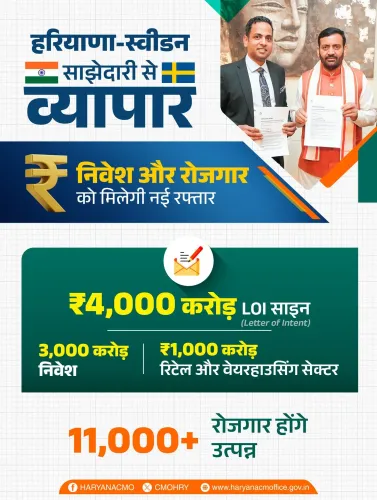
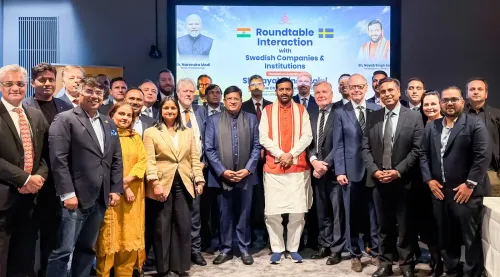
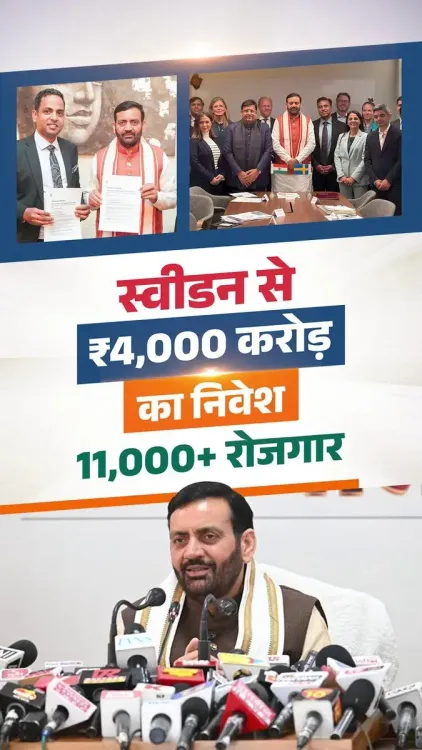
Haryana CM Nayab Singh Saini announced on 17 October 2026 that Swedish companies have agreed to invest ₹4,000 crore in the state, with projections of over 11,000 new employment opportunities — a significant European FDI commitment under India's Make in India push.
Key Takeaways
₹4,000 crore investment agreement reached with Swedish companies for Haryana , announced on 17 October 2026 .
The deal is projected to create more than 11,000 new jobs in the state.
CM Nayab Singh Saini made the announcement via his official X account, with a video accompanying the post.
Specific Swedish companies, sectors, and implementation timelines have not yet been publicly disclosed.
The agreement aligns with India's Make in India initiative and Haryana's established role as a manufacturing hub near Delhi .
The deal reflects India's broader strategy of diversifying foreign direct investment sources toward European partners .
A ₹4,000 crore commitment from Swedish companies is set to plant more than 11,000 new jobs in Haryana — and Haryana Chief Minister Nayab Singh Saini announced the deal on Saturday, 17 October 2026, signalling a significant European vote of confidence in the state's industrial ambitions.
In his post, Saini stated: 'स्वीडन की कंपनियों के साथ ₹4,000 करोड़ के निवेश पर सहमति बनी है, जिससे हरियाणा में 11,000 से अधिक नए रोजगार के अवसर सृजित होंगे।' — 'Agreement has been reached with Swedish companies on an investment of ₹4,000 crore, which will create more than 11,000 new employment opportunities in Haryana.'
Sweden steps into Haryana's manufacturing corridor
Haryana sits at the industrial gateway to Delhi, hosting auto-component clusters, electronics parks, and logistics hubs that have long drawn domestic and foreign capital. Swedish industry has historically leaned into India through technology, automotive, and precision manufacturing — sectors that align neatly with what the state already offers. An agreement of this scale deepens that fit and adds a European anchor to a supply chain that Haryana has been building for years.
The announcement also slots into India's Make in India framework, the national policy launched in 2014 that tasks states with hunting down foreign direct investment for domestic manufacturing. State-level outreach — investor roadshows, bilateral delegations, chief ministerial visits — has become the preferred instrument, and this Sweden deal appears to be exactly that machinery producing results.
What ₹4,000 crore actually means for Haryana workers
Translate the headline number into ground-level impact: ₹4,000 crore is roughly $480 million at current exchange rates — serious capital for a state-level manufacturing push. More telling is the 11,000-plus jobs figure, which points toward labour-intensive production rather than capital-heavy, low-employment automation plays. For a state where youth unemployment and agrarian-to-industrial transition are live political concerns, that distinction matters enormously.
The specific Swedish companies, the sectors they will enter, and the implementation timeline have not yet been disclosed. Official confirmation through investor summit documentation or government gazette notifications will be the next test of whether intent hardens into ground-breaking.
India's European FDI pivot gathers momentum
This agreement fits a visible broader pattern: India is actively diversifying its foreign investment base toward European partners, deliberately reducing over-dependence on any single supply chain or geography. Sweden, home to globally competitive multinationals in telecom, heavy engineering, and clean technology, is a natural partner in that pivot. For CM Saini, landing a marquee European commitment reinforces Haryana's pitch as the preferred northern manufacturing address — not just for domestic investors but for boardrooms in Stockholm as well.
The numbers are on the table. Now comes the harder work: turning a bilateral handshake into factory floors and pay cheques.
Point of View
000 crore Sweden deal is more than a headline investment figure — it is a calibrated signal from a BJP-led state government that it can deliver European capital, not just domestic industrial policy rhetoric. For CM Saini, who took office in March 2024, landing a marquee foreign commitment strengthens his economic credentials ahead of any future electoral cycle. The emphasis on 11,000-plus jobs — rather than just rupee value — reflects a deliberate political calculation: in a state navigating agrarian stress, employment optics matter as much as investment quantum. The absence of named companies, however, means the announcement sits in that familiar grey zone between diplomatic intent and confirmed deal — a distinction Haryana's opposition will almost certainly press on.
NationPress
17 Oct 2026
Frequently Asked Questions
What is the Haryana-Sweden investment deal announced by CM Nayab Singh Saini?
Haryana Chief Minister Nayab Singh Saini announced on 17 October 2026 that Swedish companies have agreed to invest ₹4,000 crore in Haryana, with the deal expected to generate more than 11,000 new jobs in the state.
Which Swedish companies are investing in Haryana?
The specific Swedish companies involved have not been publicly named in the announcement. Official government releases or investor summit documentation are expected to provide further details.
How many jobs will the Sweden-Haryana investment create?
According to CM Nayab Singh Saini's announcement, the ₹4,000 crore investment from Swedish companies is projected to create more than 11,000 new employment opportunities in Haryana.
How does this deal fit into India's Make in India programme?
Make in India, launched in 2014, encourages Indian states to attract foreign direct investment for domestic manufacturing. Haryana's agreement with Swedish firms is a state-level outcome of that national policy framework.
Why is Sweden investing in Haryana specifically?
Haryana is positioned as a key manufacturing hub near Delhi with existing auto-component, electronics, and logistics clusters. Sweden has historically maintained technology and industrial ties with India, making Haryana an attractive destination for European manufacturing investment.