CM Samrat Choudhary hails India-Australia ties under PM Modi
Synopsis
Bihar Chief Minister Samrat Choudhary on 12 July 2026 praised the India-Australia Comprehensive Strategic Partnership under PM Modi, highlighting cooperation in clean energy, critical minerals, infrastructure and economic development as markers of India's rising global stature and the Viksit Bharat vision.
Key Takeaways
Bihar CM Samrat Choudhary endorsed the India-Australia bilateral partnership on 12 July 2026 , crediting PM Narendra Modi's leadership.
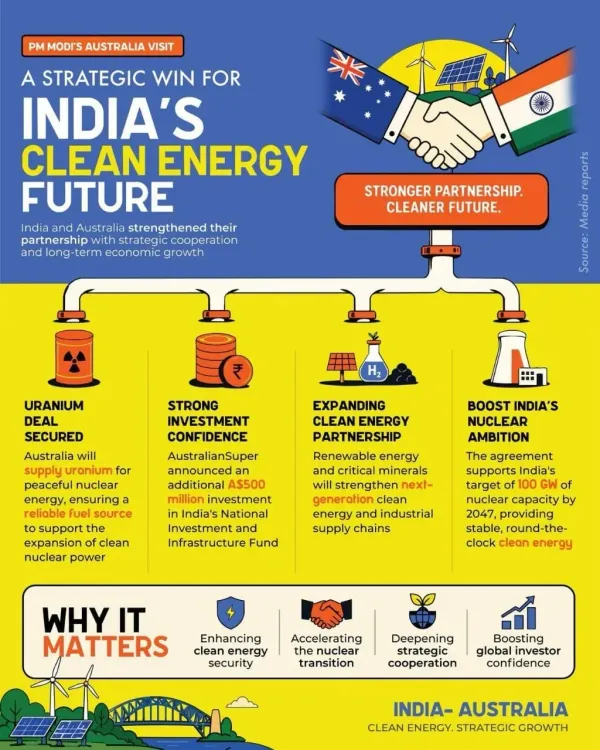
He cited cooperation in clean energy, critical minerals, infrastructure and economic development as key pillars of the relationship.
India and Australia upgraded ties to a Comprehensive Strategic Partnership in 2020 and signed the ECTA trade agreement in 2022 .
The partnership is central to India's strategy of diversifying critical mineral supply chains away from single-source dependence.
The statement links bilateral diplomacy to the Viksit Bharat 2047 vision of a self-reliant, developed India.
Progress on joint critical minerals projects and the next India-Australia annual summit will be key milestones to watch.
Bihar Chief Minister Samrat Choudhary on Sunday, 12 July 2026, lauded the deepening partnership between India and Australia, attributing the momentum to the leadership of Prime Minister Narendra Modi and framing it as a pillar of the Viksit Bharat (Developed India) vision.
Posting on X, Choudhary wrote: 'माननीय प्रधानमंत्री श्री @narendramodi जी के नेतृत्व में भारत-ऑस्ट्रेलिया संबंध नई ऊंचाइयों पर पहुंच रहे हैं' — 'Under the leadership of honourable Prime Minister Shri Narendra Modi, India-Australia relations are reaching new heights.' He specifically cited cooperation in clean energy, critical minerals, infrastructure, and economic development as evidence of India's rising global stature and its commitment to realising the Viksit Bharat goal.
Context
The post comes against a backdrop of sustained diplomatic engagement between New Delhi and Canberra. The two nations upgraded their bilateral relationship to a Comprehensive Strategic Partnership in 2020, signalling a shift from a transactional relationship to one with strategic depth. That upgrade has since been reinforced through joint participation in the Quad grouping alongside the United States and Japan.
In 2022, the two countries signed the India-Australia Economic Cooperation and Trade Agreement (ECTA), which expanded market access across goods and services and laid the groundwork for deeper supply-chain integration. Choudhary's remarks reflect the ruling BJP's consistent effort to project these diplomatic gains as outcomes of Prime Minister Modi's personal diplomacy.
Policy Backdrop
Critical minerals sit at the heart of the evolving India-Australia partnership. Australia holds some of the world's largest reserves of lithium, cobalt, and rare earth elements — inputs that are essential for electric vehicles, battery storage, and advanced electronics manufacturing. India has been actively diversifying its supply chains to reduce dependence on any single source country for these materials.
On clean energy, the partnership aligns with India's stated net-zero commitments and its push to scale up domestic renewable capacity. Cooperation on infrastructure and technology transfer has also been positioned as a support mechanism for India's production-linked incentive schemes, which aim to build domestic manufacturing capability across strategic sectors.
Stakeholders and Impact
The sectors highlighted by Choudhary — clean energy and critical minerals — directly affect Indian renewable energy firms, battery manufacturers, and infrastructure developers who stand to benefit from preferential access to Australian resources and technology. For Australian mining and resources companies, India's scale and growth trajectory represent a significant export market.
At a broader level, the partnership feeds into India's ambition to position itself as a reliable node in global supply chains, an objective that carries weight for both foreign investors and domestic industry. Bihar, as a state with infrastructure development needs, also has an indirect stake in the national push for capital and technology inflows that such bilateral ties can catalyse.
What's Next
Analysts and industry stakeholders will watch for concrete progress on joint critical minerals projects that have been announced under the bilateral framework, and for any new commitments that may emerge at the next India-Australia annual summit. The pace at which announced cooperation translates into operational agreements will be a key test of the partnership's depth.
Choudhary's statement, while a political endorsement rather than a policy announcement, underscores how the BJP is weaving foreign policy achievements into its domestic narrative ahead of ongoing electoral cycles — positioning global partnerships as proof of the Viksit Bharat roadmap gaining tangible shape.
Point of View
Amplifying central government foreign policy also serves to demonstrate alignment with the national leadership at a moment when the BJP's coalition management remains in focus. The broader pattern here is clear — India's resource-security diplomacy with like-minded democracies is increasingly being packaged as a unified national project, with regional leaders acting as a chorus to the central government's solo.
NationPress
10 Oct 2026
Frequently Asked Questions
What did Bihar CM Samrat Choudhary say about India-Australia relations?
Samrat Choudhary said that under PM Modi's leadership, India-Australia relations are reaching new heights, with strong cooperation in clean energy, critical minerals, infrastructure and economic development reflecting India's growing global stature.
What is the India-Australia Comprehensive Strategic Partnership?
India and Australia upgraded their bilateral relationship to a Comprehensive Strategic Partnership in 2020, deepening defence, trade and technology cooperation and anchoring their ties within the broader Quad framework.
What is the India-Australia ECTA trade agreement?
The India-Australia Economic Cooperation and Trade Agreement, signed in 2022, expanded market access in goods and services between the two countries and laid the foundation for deeper supply-chain integration, particularly in critical minerals and clean energy.
Why are critical minerals important to India-Australia ties?
Australia holds large reserves of lithium, cobalt and rare earth elements essential for electric vehicles and battery storage. India is diversifying its supply chains to reduce dependence on single-source countries, making Australia a strategic partner for securing these inputs.
What is Viksit Bharat and how does it relate to foreign policy?
Viksit Bharat is India's official vision for becoming a developed nation by 2047, encompassing self-reliance in energy, minerals and infrastructure. Bilateral partnerships like the one with Australia are positioned as enablers of this goal by securing resource access and technology transfer.