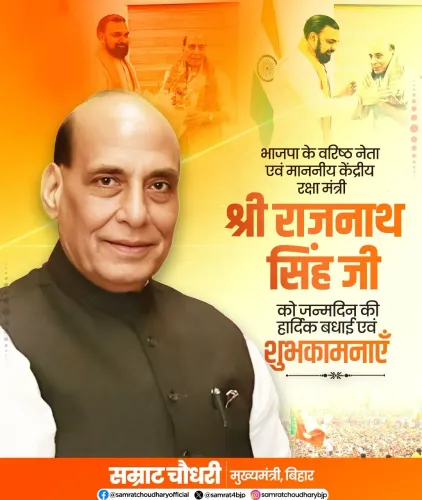
CM Samrat Choudhary backs Rajnath Singh's article on misinformation
Synopsis
Bihar CM Samrat Choudhary endorsed a Union Defence Minister Rajnath Singh opinion piece on October 19, 2026, arguing that fabricated narratives and misinformation are being used to make baseless attacks on India's core democratic institutions.
Key Takeaways
Bihar CM Samrat Choudhary posted on X on October 19, 2026 backing a written article by Union Defence Minister Rajnath Singh .
Choudhary stated that dissent in a democracy is valid, but it cannot be rooted in falsehood or aimed at spreading anarchy.
He accused unnamed actors of using 'misleading information and fabricated narratives' to make 'baseless accusations' against India's foundational democratic institutions.
He described Rajnath Singh's article as pointing to 'well-planned conspiracies' that repeatedly strike at India's democratic values.
The post fits a consistent BJP pattern of framing opposition criticism of constitutional bodies as coordinated misinformation rather than legitimate dissent.
Opposition reactions and any follow-up statements from the Bihar government or Rajnath Singh are expected to follow.
In a democracy, disagreement is a right — but Bihar Chief Minister Samrat Choudhary drew a sharp line on Monday, October 19, 2026: dissent built on falsehoods, aimed at sowing anarchy, is something else entirely. In a pointed post on X, the senior BJP leader endorsed a recent opinion piece by Union Defence Minister Rajnath Singh, warning that India's foundational democratic institutions are under coordinated narrative attack.
Posting in Hindi, CM Choudhary wrote: 'लोकतंत्र में असहमति तो व्यक्त की जा सकती है पर असहमति का आधार झूठ नहीं हो सकता' — 'In a democracy, dissent can certainly be expressed, but the basis of dissent cannot be a lie.' He went further, stating that through misleading information and fabricated narratives, deliberate attempts are being made to level baseless accusations against the very institutions that form the backbone of India's democratic order.What Rajnath Singh's article argues
The Bihar CM described Defence Minister Rajnath Singh's article as pointing directly to 'well-planned conspiracies' through which India's democratic values are being 'repeatedly struck down.' While the specific publication venue of the article could not be independently confirmed, Choudhary's framing positions it as a significant intervention — a senior cabinet minister putting on record, in longform, what the BJP has long argued in campaign speeches.
Rajnath Singh is one of the party's most senior ideological voices, and his written pieces on national security and democratic resilience carry weight beyond the usual political statement. His authorship of this piece signals the argument has been elevated from party messaging to structured public discourse.
BJP's institutional-integrity line — and why it sharpens now
This is not a standalone moment. Across 2019–2026, BJP leaders at both the central and state level have consistently framed opposition criticism of bodies like the Election Commission of India and the judiciary as coordinated misinformation campaigns rather than legitimate democratic contestation. The central government's moves — including the Information Technology Rules introduced in that period — were explicitly justified on the grounds of protecting institutional integrity from viral falsehoods.
Choudhary's post lands in that continuum but adds a sharper edge: by using the word 'षड्यंत्र' (conspiracy) and 'कुठाराघात' (axe-blow), he frames the threat not as careless misinformation but as deliberate, structured subversion. It is the language of a political battle being fought on epistemic ground — a fight over what counts as fact before any policy debate can even begin.
What the opposition will likely say
Opposition parties will almost certainly read this post as the ruling alliance pre-emptively delegitimising criticism by labelling it 'fake narrative.' That counter-argument — that calling dissent misinformation is itself a tool of democratic erosion — has been the standard response from opposition leaders whenever the BJP invokes institutional protection. Watch for formal responses from opposition Bihar leaders and national spokespersons in the hours ahead.
The real contest here is definitional: who gets to decide when dissent crosses into destabilisation? That question will not be resolved on X — but it will be fought there, loudly, for as long as Indian democracy remains a live argument.
Point of View
A significantly harder charge to rebut quickly. This mirrors a global trend where ruling parties increasingly fight elections not on policy but on epistemology — controlling what counts as credible information. The BJP's consistent deployment of this frame since 2019 suggests it tests well with its base, even as it hands the opposition a ready-made counter-narrative about the stifling of democratic dissent.
NationPress
19 Oct 2026
Frequently Asked Questions
What did Bihar CM Samrat Choudhary post on X on October 19?
CM Samrat Choudhary posted a statement endorsing Union Defence Minister Rajnath Singh's article, arguing that misinformation and fabricated narratives are being used to attack India's democratic institutions, and that genuine dissent cannot be built on lies or aimed at spreading anarchy.
What is Rajnath Singh's article about that Samrat Choudhary endorsed?
According to Choudhary's post, Rajnath Singh's article identifies well-planned conspiracies through which India's democratic values are being systematically undermined. The specific publication venue of the article was not confirmed in the post.
Who is Samrat Choudhary?
Samrat Choudhary is the Chief Minister of Bihar and a senior BJP leader who assumed office in 2024. He is known for aligning closely with the central BJP leadership on governance and political messaging.
Why is the BJP talking about misinformation targeting democratic institutions?
The BJP has consistently argued since 2019 that opposition criticism of bodies like the Election Commission and the judiciary is driven by misinformation rather than legitimate grievance. This post by Choudhary is part of that ongoing party narrative.
What will the opposition say in response to Choudhary's post?
Opposition parties are expected to argue that labelling dissent as 'fake narrative' or 'conspiracy' is itself a tool for suppressing legitimate democratic criticism. Formal responses from opposition leaders in Bihar and nationally are anticipated.