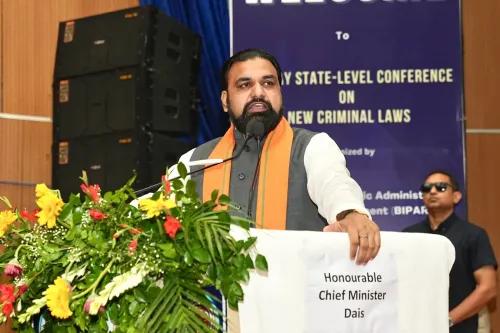
CM Samrat Choudhary flags Rajnath Singh's warning on 'regime change' bid
Synopsis
Bihar CM Samrat Choudhary amplifies Defence Minister Rajnath Singh's sharp warning that certain political actors, openly citing Bangladesh's 2024 regime change as inspiration, are attempting to destabilise India's democratic institutions by mobilising youth into a politics of anarchy.
Key Takeaways
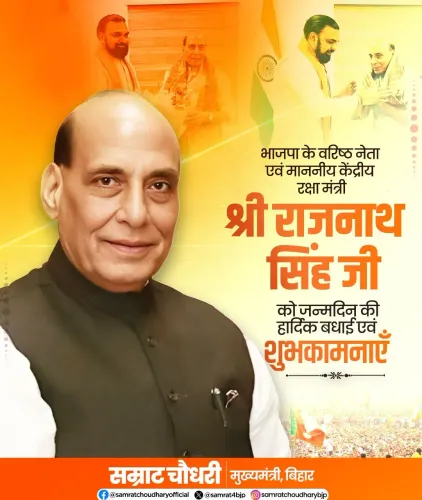
Bihar CM Samrat Choudhary shared Defence Minister Rajnath Singh 's statement on X on October 16, 2026 .
Rajnath Singh alleged that certain groups publicly cited Bangladesh's August 2024 political transition as inspiration for 'regime change' in India.
Singh accused these actors of openly declaring intent to bring down the elected government and 'demolish democratic institutions'.
The BJP has consistently invoked the Bangladesh example since 2024 to frame domestic opposition agitation as a threat to constitutional order.
The statement arrives ahead of the winter session of Parliament, raising the stakes for opposition responses.
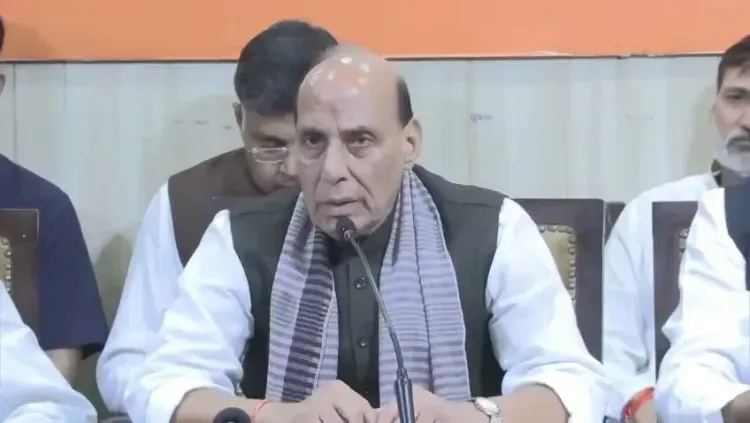
India's youth are being used as pawns in a politics of anarchy, Union Defence Minister Rajnath Singh has warned — and Bihar Chief Minister Samrat Choudhary amplified that warning on Friday, October 16, 2026, sharing the remarks on X to a national audience already watching domestic political temperatures rise.
The post quotes Rajnath Singh directly: 'देश के नौजवानों को अराजकता की राजनीति का मोहरा बनाने की कोशिश की जा रही है' — 'An attempt is being made to turn the country's youth into pawns of the politics of anarchy.' Singh goes further, asserting that certain groups have openly stated at press conferences that they drew inspiration from Bangladesh for 'regime change', and that another openly declared an intent to bring down the elected government.
The Bangladesh reference and what it signals
The Bangladesh comparison is deliberate and loaded. In August 2024, long-serving Prime Minister Sheikh Hasina stepped down amid student-led mass protests — a dramatic political transition that reverberated across South Asia. Ever since, BJP leaders have repeatedly invoked that episode as a cautionary parallel whenever opposition-linked street agitations gather momentum inside India.
Singh's formulation is pointed: he claims the inspiration was not merely tactical but publicly acknowledged — cited 'at a press conference', openly, without embarrassment. The defence minister frames this not as political rivalry but as a declared assault on democratic institutions. 'Their sole agenda,' the quoted statement reads, 'is to demolish democratic institutions and set the country on fire.'
Why a Bihar CM is carrying a Delhi minister's message
Samrat Choudhary's decision to repost the statement — without editorial addition — is itself a political act. Bihar, a perennial battleground state, has a history of youth mobilisation cutting across party lines. By amplifying a defence minister's national-security framing down to the state level, Choudhary signals that the BJP intends to fight any narrative of popular protest on ideological, not just administrative, ground.
The broader pattern is consistent: BJP voices in multiple states have deployed the Bangladesh analogy to pre-empt student activism and opposition calls for government accountability, framing such movements as extra-constitutional rather than democratic. Critics of this framing argue it conflates legitimate dissent with subversion — a debate that shows no sign of narrowing.
With the winter session of Parliament approaching and state-level political campaigns intensifying, expect opposition benches to push back hard — and expect the Bangladesh metaphor to become one of the defining rhetorical fault lines of the season.
Point of View
The party attempts to delegitimise street-level dissent before it gains momentum, a playbook that has appeared consistently across BJP-governed states. The rhetorical move is high-risk: it energises the base but hands opposition parties a ready-made counter-narrative about criminalising legitimate protest. Whether this framing sticks will depend largely on how credibly the 'press conference' claims Singh references can be substantiated in public discourse.
NationPress
16 Oct 2026
Frequently Asked Questions
What did Rajnath Singh say about regime change in India?
Defence Minister Rajnath Singh warned that certain political actors are attempting to engineer a 'regime change' in India, drawing explicit inspiration from Bangladesh's 2024 political transition, and have openly stated this at press conferences.
What happened in Bangladesh in 2024 that BJP leaders keep referencing?
In August 2024, Bangladesh Prime Minister Sheikh Hasina resigned amid large-scale student-led protests, marking a dramatic political transition. BJP leaders have since used this event as a cautionary reference when discussing domestic opposition agitation in India.
Why did Bihar CM Samrat Choudhary share Rajnath Singh's statement?
Samrat Choudhary, Bihar's Chief Minister and a senior BJP leader, shared the statement on X to amplify the party's national-security framing at the state level, particularly significant in Bihar given its history of youth-driven political movements.
Who is Samrat Choudhary?
Samrat Choudhary is the Chief Minister of Bihar and a prominent BJP leader known for amplifying the party's national political messaging alongside managing state governance.
What is the BJP's broader argument about democratic institutions being under threat?
BJP leaders have repeatedly argued that opposition-backed protests and calls to bring down elected governments amount to an extra-constitutional challenge to India's democratic order, a claim opposition parties reject as an attempt to silence legitimate dissent.