CM Samrat Choudhary Greets Postal Workers on National Postal Worker Day
Synopsis
Bihar Chief Minister Samrat Choudhary on 1 July 2026 extended greetings to postal employees nationwide on National Postal Worker Day, recognising India Post's role in last-mile service delivery, financial inclusion and rural outreach.
Key Takeaways
Bihar Chief Minister Samrat Choudhary posted greetings for National Postal Worker Day on 1 July 2026 .
He saluted postal workers for their 'loyalty, service and commitment' to reaching citizens across the country.
India Post , established in 1854 , remains a critical last-mile network for welfare payments, banking and e-commerce in underserved regions.
The India Post Payments Bank , launched in 2016 , extended basic banking to rural communities through the postal network.
Choudhary is a senior BJP leader and the Chief Minister of Bihar .
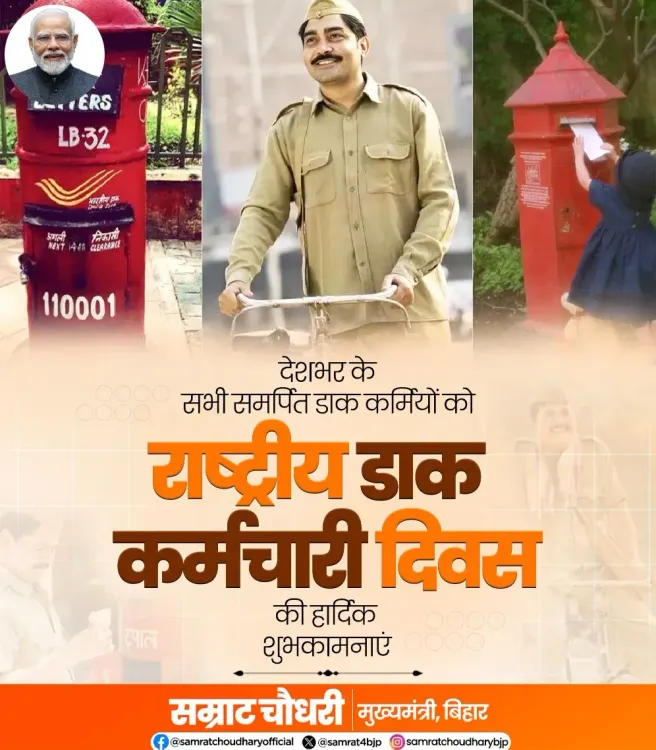
Bihar Chief Minister Samrat Choudhary on Wednesday, 1 July 2026, extended greetings to postal employees across the country on the occasion of National Postal Worker Day, saluting their dedication to public service and last-mile delivery of messages and welfare benefits.
Posting on X in Hindi, Choudhary wrote: 'देशभर के सभी समर्पित डाक कर्मियों को राष्ट्रीय डाक कर्मचारी दिवस की हार्दिक बधाई एवं शुभकामनाएँ' ['Heartfelt congratulations and best wishes to all dedicated postal workers across the country on National Postal Worker Day']. He added that their 'loyalty, service and commitment to reaching messages and facilities to every person contributes significantly to the nation's progress,' and offered a respectful salute to their 'tireless hard work.'
Context
National Postal Worker Day is an annual observance that recognises the contribution of postal employees to public service delivery across India. State and national leaders routinely mark such days with public messages acknowledging frontline government workers. Choudhary, a senior leader of the Bharatiya Janata Party (BJP) and the Chief Minister of Bihar, used the occasion to highlight the social and administrative role played by postal staff.
Policy Backdrop
India Post, operating under the Department of Posts, Ministry of Communications, is one of the oldest and most extensive public service networks in the country. The unified Indian postal system was formally established in 1854 and has since undergone successive rounds of modernisation. A landmark step came in 2016 with the launch of India Post Payments Bank, which extended basic banking services to underserved and rural communities through the postal network.
Today, India Post serves as a critical last-mile mechanism for welfare payment disbursements, postal banking, parcel logistics and e-commerce deliveries — particularly in regions where conventional banking and courier infrastructure remains thin. The network's reach into rural households makes its workforce central to the government's financial inclusion agenda.
Stakeholders and Impact
The primary beneficiaries of a robust postal workforce are rural households and citizens in remote areas who depend on India Post for pension disbursements, government correspondence, savings schemes and package deliveries. For these communities, the local postman or postal agent often represents the most accessible link to state services.
Postal workers themselves, as frontline public servants, benefit from institutional recognition on occasions such as this. Broader acknowledgement from political leaders reinforces the visibility of the workforce within the public discourse on governance and service delivery.
What's Next
Observers will watch for concrete policy announcements on postal employee welfare measures or further digital integration of India Post's services in the upcoming Union Budget or the Department of Posts annual report. Ceremonial recognition, while symbolic, often precedes or accompanies announcements on service expansion or workforce upgradation within the postal sector.
Point of View
High-visibility gesture that reinforces the ruling party's image as attentive to public servants. In Bihar's context, where India Post's rural penetration is particularly significant, the tribute also implicitly signals alignment with the Centre's financial inclusion and last-mile governance agenda. The shoutout to postal workers, who underpin welfare delivery in one of India's most populous states, carries a quiet administrative subtext beyond ceremonial goodwill. Whether such recognition translates into concrete workforce or infrastructure announcements will be the more consequential measure to watch.
NationPress
30 Sept 2026
Frequently Asked Questions
What is National Postal Worker Day in India?
National Postal Worker Day is an annual observance that honours the contribution of postal employees to public service, mail delivery and financial inclusion across India. The precise date and formal status of the observance are not confirmed in established public records.
Who is Samrat Choudhary?
Samrat Choudhary is the Chief Minister of Bihar and a senior leader of the Bharatiya Janata Party (BJP) .
What is India Post and what does it do?
India Post is the national postal service operating under the Department of Posts, Ministry of Communications . It handles mail, parcels, financial services and welfare payment disbursements, serving as a critical last-mile network especially for rural and underserved communities.
When was India Post Payments Bank launched?
India Post Payments Bank was launched in 2016 to extend basic banking services to rural and underserved populations through the existing postal network.
Why do political leaders post greetings on days like National Postal Worker Day?
Messages from state and national leaders on such observances form part of routine public recognition of frontline government employees, reinforcing institutional visibility and the government's commitment to public service workers.