CM Sawant Shares Dussehra Wishes with Marathi Devotional Verse
Synopsis
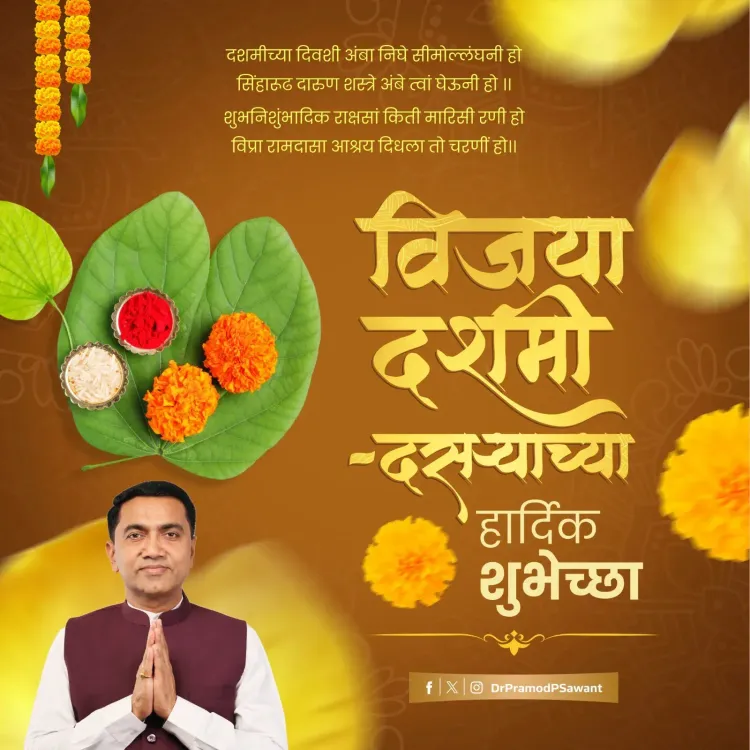
Goa Chief Minister Pramod Sawant marked Vijayadashami 2026 by sharing a traditional Marathi devotional verse attributed to saint-poet Samarth Ramdas, invoking goddess Amba and extending heartfelt Dussehra greetings to the people of Goa.
Key Takeaways
Goa CM Pramod Sawant posted Vijayadashami greetings on X on 20 October 2026 .
The post features a Marathi verse from the devotional tradition of 17th-century saint-poet Samarth Ramdas , invoking goddess Amba .
The verse references Simollanghan , the ceremonial boundary-crossing observed on Dashami in Maharashtra and Goa.
Demons Shumbha and Nishumbha are named in the verse, echoing classical goddess-mythology central to Vijayadashami.
The post carries no policy announcement — it is a cultural and devotional greeting reflecting Goa's Marathi heritage .
On the auspicious morning of Vijayadashami 2026, Goa Chief Minister Pramod Sawant marked the festival by sharing a traditional Marathi devotional verse on X, offering warm greetings to the people of Goa and beyond.
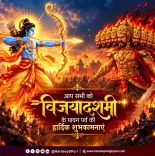
The verse — drawn from the devotional tradition associated with the 17th-century Marathi saint-poet Samarth Ramdas — invokes the goddess Amba riding a lion, wielding fierce weapons, and slaying demons such as Shumbha and Nishumbha on the battlefield. The closing lines seek refuge at the goddess's feet, a hallmark sentiment of Ramdas's bhakti (devotional) poetry. CM Sawant accompanied the verse with the greeting: 'Vijayadashami — Dasaryachya hardik shubhechha' — 'heartfelt good wishes on Vijayadashami — Dussehra.'
The Festival of Simollanghan and Divine Victory
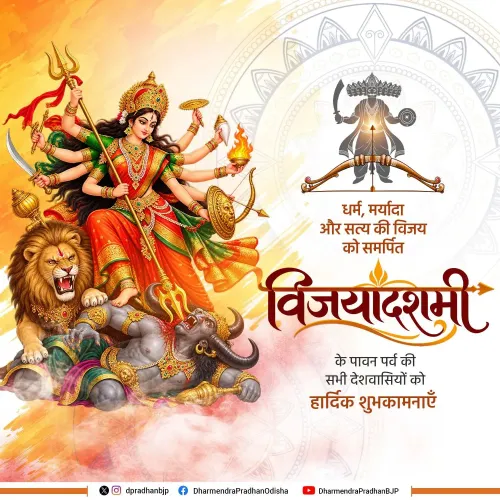
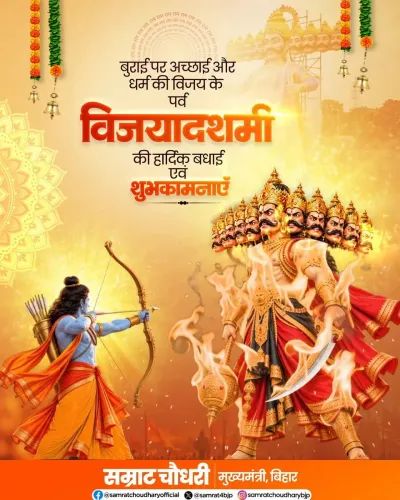
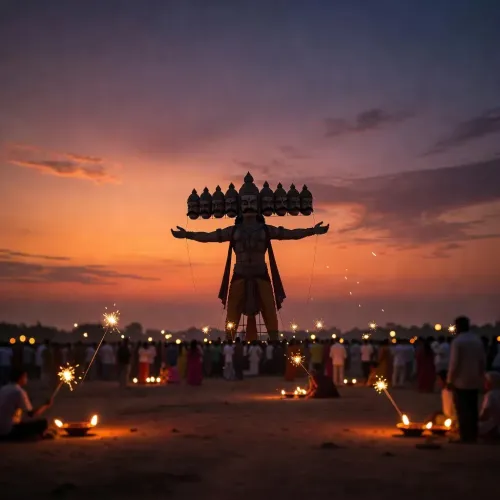
Vijayadashami, observed on the tenth day of the Navaratri cycle, celebrates the triumph of good over evil — most widely understood as Lord Rama's victory over Ravana, and the goddess Durga's vanquishing of the demon Mahishasura. In Maharashtra and Goa's Marathi cultural tradition, the day also carries the practice of Simollanghan — the ceremonial crossing of the village boundary — symbolising a new beginning and the extension of one's reach beyond familiar limits.
The verse CM Sawant chose opens with precisely this image: 'Dashmichya divashi Amba nighe Simollanghani' — 'On the day of Dashami, Amba sets out for Simollanghan.' It is a verse that resonates deeply with Maharashtrian and Konkani communities, grounding the greeting in lived cultural memory rather than generic festivity.
BJP Leaders and the Dussehra Social-Media Tradition
Across India, political figures — particularly those from the BJP — regularly mark Vijayadashami with devotional posts, making it one of the most active days for cultural messaging on social media. For CM Sawant, who leads Goa's government, the choice of a Marathi-language verse speaks directly to the state's substantial Marathi-speaking constituency and its deep roots in the Warkari and Ramdasi devotional streams.
The post carries no policy announcement or governance content — it is, by design, a moment of shared cultural pause before the full ceremonial day unfolds across Panaji and the rest of the state.
On a day when the goddess is said to cross every boundary, the Chief Minister's message is a reminder that in Goa, faith, language, and festivity remain tightly woven into public life.
Point of View
And Sawant's post fits squarely within that broader party-wide communication pattern. The selection of a verse centred on Simollanghan — the crossing of boundaries — subtly echoes themes of expansion and new beginnings, even if no explicit political intent can be attributed. It is, in sum, routine cultural statecraft: personally resonant, regionally targeted, and risk-free.
NationPress
20 Oct 2026
Frequently Asked Questions
What is Vijayadashami and why is it celebrated?
Vijayadashami, also called Dussehra, is a Hindu festival on the tenth day of Navaratri marking the victory of good over evil — celebrated as Lord Rama's defeat of Ravana and the goddess Durga's slaying of the demon Mahishasura.
Who is Samarth Ramdas and what is his connection to this verse?
Samarth Ramdas was a 17th-century Marathi saint-poet and spiritual guide whose devotional compositions praising goddess Amba and Lord Rama are deeply embedded in Maharashtra and Goa's cultural tradition.
What is Simollanghan and why does it feature in Dussehra celebrations?
Simollanghan is the ritual crossing of a village or town's boundary performed on Vijayadashami, symbolising the extension of one's limits and a fresh beginning — it is especially prominent in Maharashtrian and Konkani communities.
Why did Goa CM Pramod Sawant post in Marathi on Dussehra?
Goa has a significant Marathi-speaking population and strong ties to Maharashtra's devotional traditions; using Marathi for the Vijayadashami greeting reflects both cultural authenticity and a connection to the state's Marathi heritage.
Is there any policy announcement in CM Sawant's Dussehra post?
No. The post is purely a devotional and festive greeting with no policy, governance, or administrative announcement attached to it.