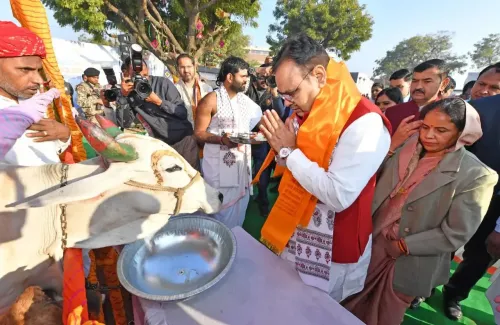
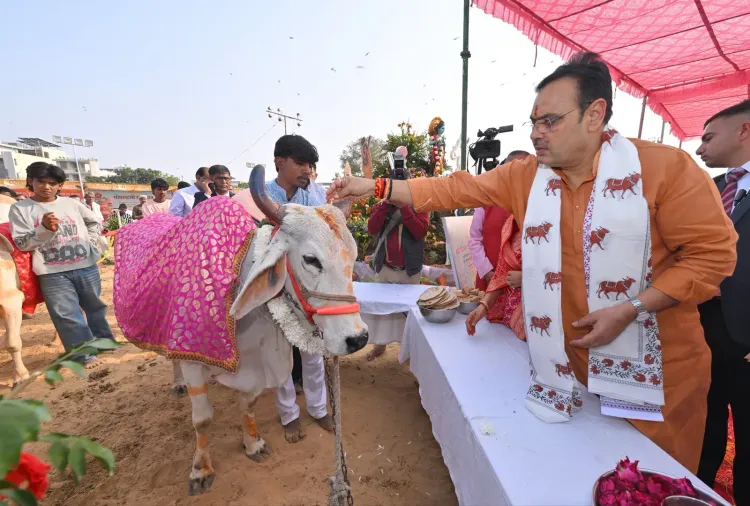
CM Bhajan Lal Sharma Offers Prayers at Sanganer Gaushala on Gopashtami
Synopsis
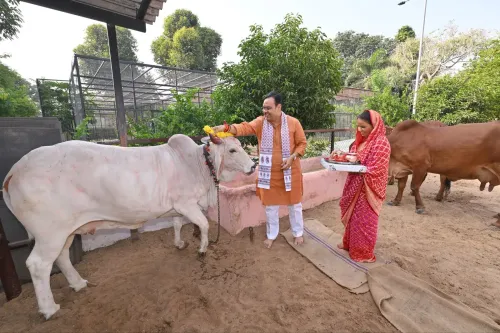
Rajasthan Chief Minister Bhajan Lal Sharma marked Gopashtami by worshipping cows and offering jaggery at Pinjarapol Gaushala in Sanganer, Jaipur, reaffirming his government's commitment to cow protection and cultural tradition on November 17, 2026.
Key Takeaways
Rajasthan CM Bhajan Lal Sharma visited Pinjarapol Gaushala, Sanganer on November 17, 2026 for Gopashtami prayers.
He performed a traditional ritual cow worship and offered jaggery (gud) to the cows as a mark of reverence.
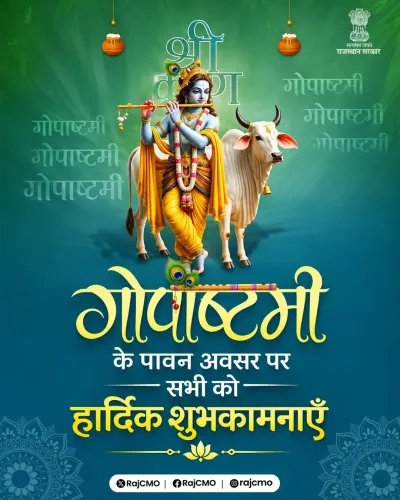
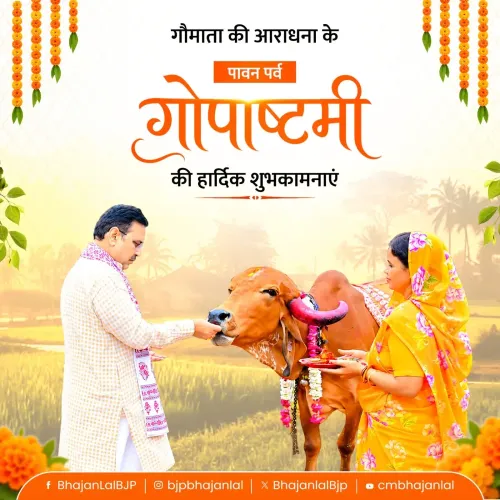
Gopashtami falls on the eighth day of Kartik's bright fortnight and is dedicated to cow worship linked with Lord Krishna.
Rajasthan enforces the Rajasthan Bovine Animals (Prohibition of Slaughter) Act , one of India's stricter cattle-protection frameworks.
CM Sharma stated his government is 'resolved to serve and protect' cows, affirming gaushala support as a policy priority.
BJP-led state governments across India regularly mark such festivals as a public statement of cultural governance.
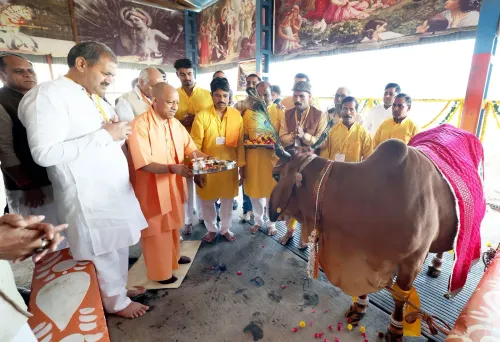
On the auspicious occasion of Gopashtami, Rajasthan Chief Minister Bhajan Lal Sharma visited the Pinjarapol Gaushala in Sanganer, Jaipur on Tuesday, November 17, 2026, performing a traditional ritual worship of cows and offering them jaggery as a mark of reverence — a gesture steeped in centuries of Hindu pastoral tradition.
Sharing a Sanskrit verse with his post, the Chief Minister wrote: 'Bhuktva trinani shushkani pitva toyam jalashayat, dugdham dadati lokebhyo gavo vishvasya mataraha' — 'Having eaten dry grass and drunk water from the pond, cows give milk to the world; they are the mothers of the universe.' The verse set the philosophical tone for what was both a personal act of faith and a pointed public statement.
Gopashtami's Significance and the Sanganer Gaushala
Gopashtami falls on the eighth day of the bright half of the Hindu month of Kartik and is dedicated to the worship of cows, believed in Hindu tradition to be intimately linked with Lord Krishna. It is one of the year's most significant occasions for cow shelters and livestock communities across India.
The Pinjarapol Gaushala in Sanganer — an area in Jaipur district historically known for its textile crafts — is one of Rajasthan's established cattle-protection facilities. Gaushalas like this one form a crucial node in the state's livestock care network, sheltering abandoned and aged cattle that can no longer be commercially kept.
Rajasthan's Cow Protection Framework
Rajasthan has long maintained one of India's stricter legislative regimes around bovine protection. The state operates under the Rajasthan Bovine Animals (Prohibition of Slaughter and Regulation of Temporary Migration or Export) Act, which prohibits cow slaughter and restricts inter-state movement of cattle. The BJP government in Jaipur has positioned gaushala support as both a cultural commitment and an animal-husbandry policy priority.
CM Sharma underlined that commitment on Tuesday, stating that his government is 'resolved to serve and protect the cow mother,' and describing cows as holding a 'special place in our culture, faith, and traditions.' For BJP-led state governments across India, marking Gopashtami publicly is a recurring and deliberate affirmation of this strand of cultural governance.
With state budget discussions on the horizon and ongoing conversations about gaushala funding in Rajasthan's assembly, Tuesday's visit signals that cattle welfare will remain a visible pillar of the Sharma administration's public identity — not just a ceremonial footnote.
Point of View
Linking public ritual to enforceable policy. With gaushala funding expected to feature in upcoming budget deliberations, the visit pre-positions the government as a credible steward of a cause that energises a significant slice of its core voter base. The Sanskrit verse was a deliberate rhetorical touch — it elevated a local event into a civilisational statement.
NationPress
17 Nov 2026
Frequently Asked Questions
What is Gopashtami and why is it celebrated?
Gopashtami is a Hindu festival observed on the eighth day of the bright fortnight of the month of Kartik. It is dedicated to the worship of cows and is associated with Lord Krishna, who is believed to have begun herding cows on this day. Devotees perform ritual worship, offer food to cows, and seek their blessings.
Where is Pinjarapol Gaushala in Sanganer?
Pinjarapol Gaushala is a cattle shelter located in Sanganer, an area within Jaipur district in Rajasthan. The gaushala cares for abandoned and aged cattle and is part of the region's animal welfare network.
What did CM Bhajan Lal Sharma do on Gopashtami 2026?
Chief Minister Bhajan Lal Sharma visited Pinjarapol Gaushala in Sanganer on November 17, 2026, performed a traditional ritual worship of cows, offered them jaggery, and sought their blessings. He also shared a Sanskrit verse on the significance of cows.
What is Rajasthan's cow protection law?
Rajasthan operates under the Rajasthan Bovine Animals (Prohibition of Slaughter and Regulation of Temporary Migration or Export) Act, which prohibits the slaughter of cows and regulates their inter-state movement, making it one of the stricter cattle-protection frameworks in India.
Why do BJP leaders visit gaushalas on Gopashtami?
For BJP leaders, visiting gaushalas on Gopashtami is both a religious observance and a public reaffirmation of the party's cultural and policy commitment to cow protection. It signals continuity with Hindu tradition and underscores legislative and budgetary support for gaushala networks in BJP-governed states.