CM Shivakumar Reviews Belagavi Division's Holistic Development

Synopsis
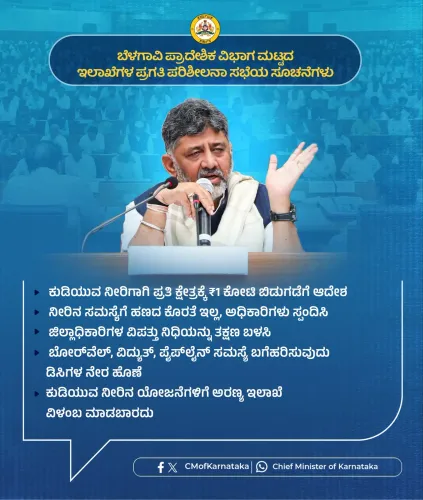
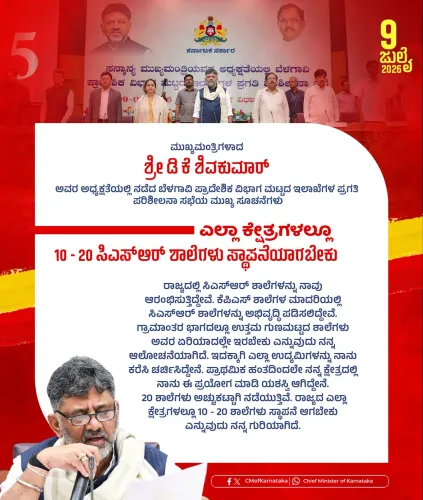
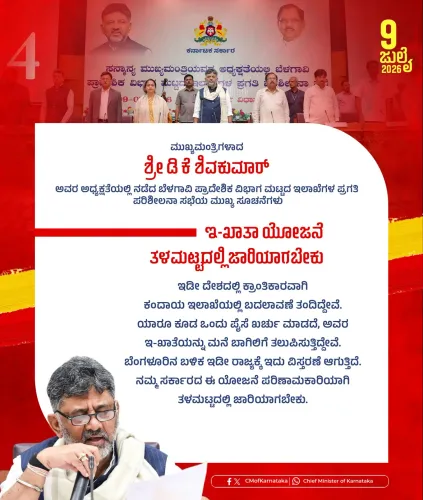
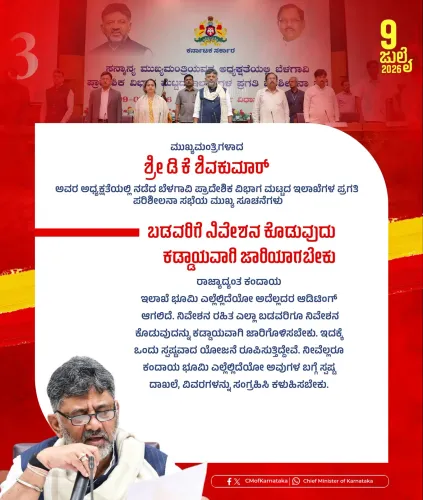
CM DK Shivakumar chaired a departmental progress review for Belagavi division at Suvarna Vidhana Soudha on 9 July 2026, declaring the government's goal is comprehensive, balanced, and sustainable regional development — not just drought management or irrigation.
Key Takeaways
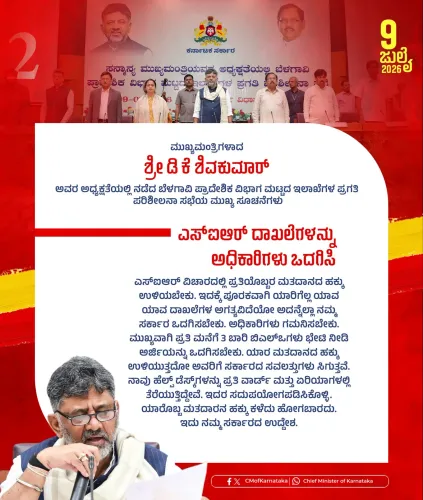
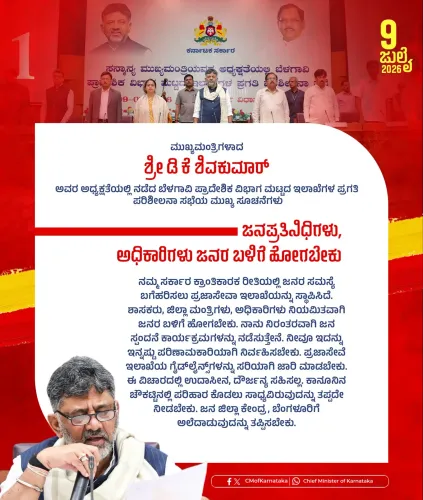
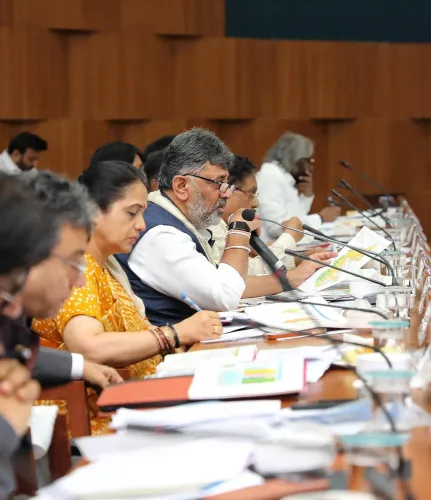
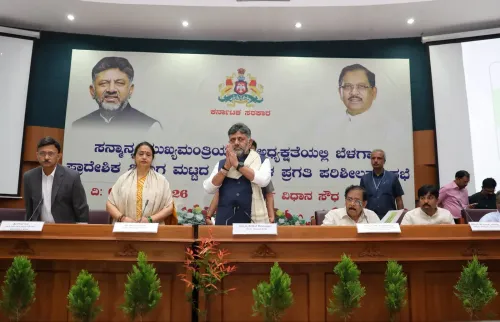
CM DK Shivakumar chaired a divisional-level departmental progress review meeting at Suvarna Vidhana Soudha, Belagavi on 9 July 2026 .
The CM stated the government's goal extends beyond drought management and irrigation to 'comprehensive, balanced, and sustainable development' of Belagavi division .
Belagavi division covers several districts in northern Karnataka with a largely agrarian economy historically prone to drought.
Karnataka governments have pursued special development packages for north Karnataka since the early 2000s to address regional disparities.
Follow-up project announcements and fund allocations for the division are anticipated after the review meeting.
The Chief Minister's Office of Karnataka announced on Thursday, 9 July 2026, that DK Shivakumar chaired a divisional-level departmental progress review meeting at Suvarna Vidhana Soudha, Belagavi, reaffirming the state government's commitment to comprehensive and sustainable development across the Belagavi division.
Addressing the review, CM Shivakumar stated: 'Our focus is not limited to drought management or irrigation alone. Our goal is the comprehensive, balanced, and sustainable development of the Belagavi division.' The remark, originally in Kannada (ನಮ್ಮ ಗಮನ ಕೇವಲ ಬರ ನಿರ್ವಹಣೆ ಅಥವಾ ನೀರಾವರಿಯ ಮೇಲಷ್ಟೇ ಇಲ್ಲ), signals a deliberate broadening of the government's development lens for the region.
Context
Belagavi division is a large administrative zone in northern Karnataka encompassing multiple districts with a predominantly agrarian economy. The region has historically faced recurring drought cycles and a persistent perception of developmental neglect compared to the state's southern urban centres, particularly Bengaluru. Periodic review meetings at the divisional headquarters are a standard administrative mechanism to track departmental performance on ground. Suvarna Vidhana Soudha, the legislative complex in Belagavi, has served as an alternative seat of government for such engagements, reinforcing the state's symbolic and administrative outreach to northern Karnataka.Policy Backdrop
Karnataka governments have, since the early 2000s, periodically announced special development packages targeting north Karnataka districts to bridge the regional disparity gap. These efforts have spanned irrigation infrastructure, road connectivity, industrial investment, and social welfare delivery. The framing of CM Shivakumar's statement — explicitly moving beyond drought relief and irrigation — suggests an intent to position the current administration's approach as structurally different from reactive, crisis-driven governance. Balanced regional growth has been a recurring political commitment in Karnataka, often surfacing during budget sessions and divisional review tours. The emphasis on 'sustainable development' (ಸುಸ್ಥಿರ ಅಭಿವೃದ್ಧಿ) aligns with a broader national policy vocabulary around long-term, inclusive growth frameworks.Stakeholders and Impact
The primary stakeholders of this review are Belagavi division's farming communities, who depend heavily on timely irrigation support and drought relief, as well as local industries and small businesses seeking infrastructure improvements. Regional administrators and district-level departments are directly accountable under such review processes, which typically assess progress on sanctioned projects and pending fund utilisation. For ordinary residents, the meeting's outcome could translate into accelerated clearances on stalled infrastructure projects, improved water resource planning beyond emergency relief, and greater inter-departmental coordination on welfare scheme delivery across the division's districts.What's Next
The government is expected to follow up with specific project announcements or fund allocations for Belagavi division in the wake of this review. Any concrete decisions taken during the meeting are likely to surface in the next state legislative session or through official departmental orders. Observers will watch whether the stated ambition of 'comprehensive, balanced, and sustainable development' translates into measurable budget commitments and implementation timelines for the region.Point of View
A constituency that has long felt sidelined by Bengaluru-centric governance. Holding the review at Suvarna Vidhana Soudha reinforces a symbolic commitment to administrative decentralisation. The emphasis on 'sustainable development' also positions the Karnataka Congress within a contemporary policy vocabulary that resonates with both rural communities and urban-educated voters. Whether this rhetoric converts into measurable budget allocations will determine its lasting political and developmental impact.
NationPress
8 Oct 2026
Frequently Asked Questions
Why did CM DK Shivakumar hold a meeting in Belagavi?
CM DK Shivakumar chaired a divisional-level departmental progress review in Belagavi to assess development across the Belagavi division, with a stated focus on comprehensive and sustainable growth beyond drought relief.
What is Suvarna Vidhana Soudha in Belagavi?
Suvarna Vidhana Soudha is a legislative complex in Belagavi that serves as an alternative seat of the Karnataka government, used for assembly sessions and high-level administrative meetings outside Bengaluru.
What did CM Shivakumar say about Belagavi development?
CM Shivakumar said the government's focus is not limited to drought management or irrigation, but aims for 'comprehensive, balanced, and sustainable development' of the Belagavi division.
What are the main issues in Belagavi division Karnataka?
Belagavi division faces recurring drought, dependence on agriculture, infrastructure gaps, and a historical perception of developmental disparity compared to southern Karnataka, particularly Bengaluru.
What happens after a Karnataka divisional review meeting?
After a divisional review meeting, the state government typically issues follow-up directives, project clearances, or fund allocation orders, with outcomes sometimes discussed in the next legislative session.