CM Siddaramaiah Greets Karnataka on 70th Rajyotsava
Synopsis
Karnataka Chief Minister Siddaramaiah greeted Kannadigas on the 2026 Rajyotsava, November 1, honouring the 1956 unification, calling Kannada the lifeline of identity, and urging its primacy across education, employment and governance while affirming that every resident of Karnataka is a Kannadiga.
Key Takeaways
Karnataka CM Siddaramaiah posted a Rajyotsava greeting on November 1, 2026 marking the state's formation anniversary.
He paid tribute to leaders who sacrificed for the unification of Kannada-speaking regions under the States Reorganisation Act of 1956 .
He described Kannada as 'annada bhaashe' — the language of livelihood — and called for its primacy in education, employment and administration.
He declared that every person residing in Karnataka is a Kannadiga, regardless of caste, religion, language or region.
He envisioned Karnataka as a 'garden of peace for all communities' advancing on a path of development.
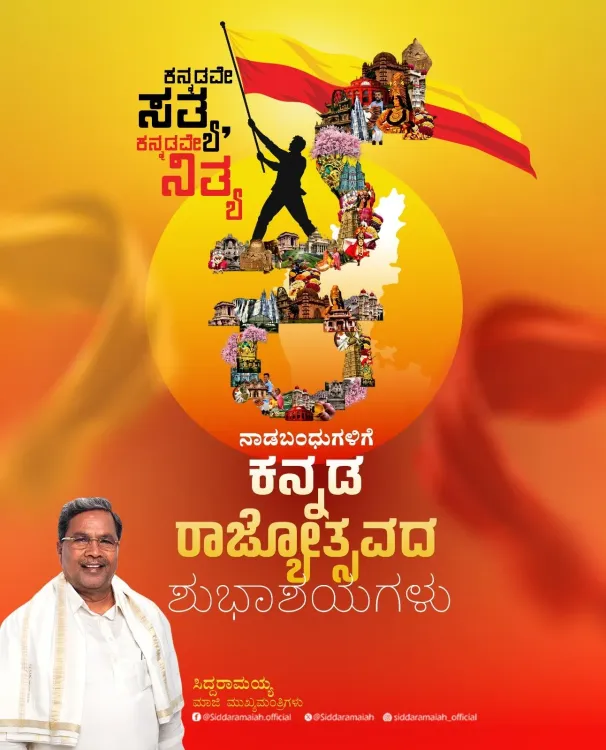
Every November 1, Karnataka pauses to remember a single audacious act of nation-building — the moment Kannada-speaking regions scattered across colonial-era provinces were knitted into one state. Karnataka Chief Minister Siddaramaiah marked the 2026 Karnataka Rajyotsava on Sunday, November 1 with a message on X calling on all residents — regardless of caste, religion, language or region — to live as children of one motherland.
What the Chief Minister actually said
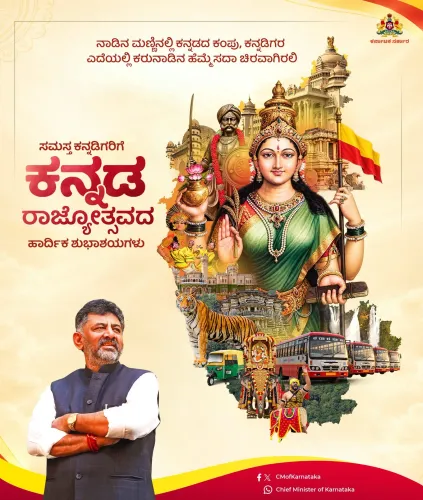
Writing in Kannada, Siddaramaiah opened with warm greetings to 'naadabandhugalige' — 'fellow sons of the soil' — and described Kannada as a language carrying thousands of years of proud history. 'Karnataka is the birthplace of rich art, literature and diverse culture,' he wrote, before paying tribute to every freedom fighter and sacrificer who struggled to make the unified state a reality.
He offered a pointed aspiration: that Kannada become not just the language of pride but the language of livelihood — 'annada bhaashe' — spoken and used in education, employment and governance across the state. He closed with the twin salutes 'Jai Karnataka! Jai Kannadaamba!' — 'Long live Karnataka! Long live Mother Kannada!'
The 1956 unification Karnataka still celebrates
The Rajyotsava traces directly to the States Reorganisation Act of 1956, which redrew India's internal map along linguistic lines. Kannada-speaking territories from the former Mysore State, Hyderabad, Bombay and Coorg provinces were merged into a single administrative unit — initially called Mysore, renamed Karnataka in 1973. The red-and-yellow flag unfurled on that first November 1 has flown every year since.
Siddaramaiah's message sits within a long tradition of Karnataka chief ministers using Rajyotsava as both a cultural affirmation and a policy signal — reminding departments that Kannada must hold primacy in official communication, school curricula and public recruitment.
'Every resident is a Kannadiga'
Perhaps the sharpest line in the message was its inclusive definition of identity. 'Everyone who lives in Karnataka is a Kannadiga,' Siddaramaiah wrote, pushing back against any exclusivist reading of linguistic pride. The state has a large migrant workforce from across India, and the sentiment directly addresses anxieties around belonging that periodically surface in Bengaluru and other urban centres.
He called for Karnataka to grow as a 'garden of peace for all communities' — 'sarvajanaangada shaanthiya tota' — and to advance on a path of development that benefits every Kannadiga.
Rajyotsava celebrations this year bring Siddaramaiah's Congress government to the podium at a moment when the state watches closely for any fresh government orders translating that linguistic aspiration into concrete policy — in school admissions, government job notifications, and official correspondence.
Point of View
Reminding the state bureaucracy that Kannada primacy in administration and education is non-negotiable. The explicit 'every resident is a Kannadiga' framing signals that the Congress government is trying to hold together linguistic pride and cosmopolitan inclusion — a balance that grows harder as Bengaluru's migrant economy expands. Rajyotsava messages from sitting chief ministers have historically preceded government orders on official-language use, making this a statement worth watching for follow-through. For Siddaramaiah personally, the occasion is also a show of ground-level cultural credibility at a time when his administration faces political headwinds.
NationPress
1 Nov 2026
Frequently Asked Questions
What is Karnataka Rajyotsava and why is it celebrated on November 1?
Karnataka Rajyotsava marks the formation of the unified Karnataka state on November 1, 1956, when the States Reorganisation Act merged Kannada-speaking regions from several former provinces into a single state, originally called Mysore and renamed Karnataka in 1973.
What did CM Siddaramaiah say on Karnataka Rajyotsava 2026?
Siddaramaiah greeted Kannadigas, honoured unification-era leaders, called Kannada the lifeline of identity and livelihood, and urged its primacy in education, employment and governance, while stressing that every person living in Karnataka is a Kannadiga.
What does 'annada bhaashe' mean in Siddaramaiah's Rajyotsava post?
'Annada bhaashe' translates from Kannada as 'the language of livelihood' or 'the language of bread' — a phrase emphasising that Kannada should be practically useful for jobs and daily economic life, not just a cultural symbol.
Which act led to the creation of Karnataka?
The States Reorganisation Act of 1956 reorganised Indian states along linguistic lines, unifying Kannada-speaking territories from the former Mysore, Hyderabad, Bombay and Coorg regions into what became the present-day Karnataka.
Why does the Karnataka CM say 'every resident is a Kannadiga'?
The statement is an inclusive definition of identity aimed at the state's large migrant workforce and linguistic minorities, asserting that belonging to Karnataka is not restricted by one's mother tongue, caste or region of origin.