CM Soren Directs DCs to Ensure No Voter Is Left Out in SIR Drive
Synopsis
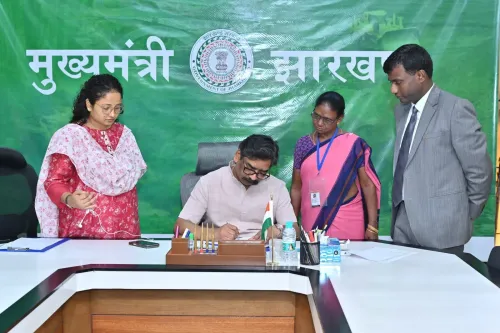
Jharkhand Chief Minister Hemant Soren on 19 July 2026 directed all deputy commissioners to guarantee no citizen is excluded from the ongoing Special Intensive Revision of electoral rolls, with special focus on tribal communities, the elderly, persons with disabilities, and Jharkhandis living outside the state.
Key Takeaways
CM Hemant Soren issued a public directive on 19 July 2026 to all Jharkhand deputy commissioners regarding the ongoing Special Intensive Revision (SIR) of electoral rolls.
All Booth Level Officers (BLOs) are to receive continuous training and sensitisation to support the enumeration drive.
Sustained public-awareness campaigns must be run to eliminate citizen confusion over forms, documents, and deadlines.
Special outreach is mandated for elderly citizens , persons with disabilities , remote-area residents , tribal communities , and Jharkhandis residing outside the state .
BLOs are directed to maintain courteous and cooperative conduct with every eligible voter.
The SIR is an Election Commission of India -mandated exercise under the Representation of the People Act, 1950 .
Jharkhand Chief Minister Hemant Soren on Sunday, 19 July 2026, directed all deputy commissioners in the state to ensure that no citizen is excluded from the ongoing Special Intensive Revision (SIR) of electoral rolls due to lack of information. Soren issued the directive via a post on X, urging district officials to run sustained public-awareness campaigns and provide special outreach to vulnerable and hard-to-reach populations.
Context
Writing in Hindi, the Chief Minister stated: 'झारखंड के सभी उपायुक्त यह सुनिश्चित करें कि विशेष गहन पुनरीक्षण (SIR) के दौरान कोई भी नागरिक जानकारी के अभाव में वंचित न रह जाए' — ('All deputy commissioners of Jharkhand must ensure that no citizen is left out during the Special Intensive Revision due to lack of information'). He specifically called for correct information about filling enumeration forms to reach every household, and for continuous training and sensitisation of all Booth Level Officers (BLOs).
Soren also stressed that citizens must face no confusion regarding the enumeration form-filling process, the required documents, or the applicable deadlines, and that wide-ranging awareness campaigns must be run without interruption.
Policy Backdrop
The Special Intensive Revision is an Election Commission of India (ECI)-mandated exercise conducted periodically under the Representation of the People Act, 1950, requiring door-to-door verification and updating of electoral rolls ahead of assembly or parliamentary elections. BLOs are the ECI-appointed grassroots functionaries responsible for carrying out this exercise at the booth level.
Jharkhand, an eastern Indian state with a large tribal population and significant mineral-belt geography, has historically faced challenges in electoral roll management in its dispersed rural and forest-fringe areas. State governments across India routinely issue such directives to district administrations to support and supplement ECI-led revision exercises, particularly where mobility barriers and document deficits are common.
Stakeholders and Impact
Chief Minister Soren's directive specifically named four groups requiring special outreach: elderly citizens, persons with disabilities, residents of remote areas, and tribal communities. He also called for efforts to reach Jharkhandis living outside the state — a significant population given the large number of migrant workers from the state employed in other parts of India.
The directive further mandated that BLOs maintain courteous, respectful, and cooperative behaviour with citizens and ensure that every eligible voter receives the necessary assistance to complete the enumeration process.
What's Next
The completion of the current SIR phase will be followed by a claims-and-objections period, as is standard ECI procedure, during which citizens may apply for inclusion, deletion, or correction of entries in the electoral rolls. The effectiveness of the district-level outreach ordered by CM Soren will determine how comprehensively Jharkhand's voter list is updated ahead of the next electoral cycle. Observers will watch for any ECI communication on the schedule and coverage statistics for the ongoing revision in the state.
Point of View
A state where tribal voter mobilisation has historically been decisive. By publicly instructing deputy commissioners — rather than routing the directive through internal channels — the Chief Minister is placing political accountability on district machinery while simultaneously projecting a pro-inclusion image. The emphasis on migrants and remote tribal communities reflects the JMM's core voter base and its long-standing narrative of protecting Jharkhand's indigenous identity. The move also positions the state government as a proactive partner to the Election Commission, pre-empting any criticism of administrative lapses in roll revision.
NationPress
20 Jul 2026
Frequently Asked Questions
What is the Special Intensive Revision (SIR) of electoral rolls in Jharkhand?
The Special Intensive Revision (SIR) is an Election Commission of India-mandated door-to-door exercise to update and verify electoral rolls under the Representation of the People Act, 1950. It involves Booth Level Officers visiting households to collect enumeration forms and ensure eligible citizens are registered as voters.
What did CM Hemant Soren say about the SIR drive?
On 19 July 2026, CM Hemant Soren directed all Jharkhand deputy commissioners to ensure no citizen is excluded from the SIR due to lack of information, called for continuous BLO training, and mandated special outreach to elderly, disabled, tribal, remote-area, and out-of-state Jharkhand residents.
Who are Booth Level Officers (BLOs) and what is their role?
Booth Level Officers are Election Commission of India-appointed grassroots officials responsible for conducting door-to-door voter verification, distributing enumeration forms, and updating electoral rolls at the polling-booth level during revision exercises like the SIR.
Why are tribal and migrant voters specifically mentioned in Soren's directive?
Jharkhand has a large tribal population spread across remote and forest-fringe areas, as well as a significant number of migrant workers living in other states. These groups face higher risks of being excluded from electoral rolls due to mobility barriers, document gaps, and distance from administrative centres.
What happens after the Special Intensive Revision is completed?
After the SIR phase ends, the Election Commission of India typically opens a claims-and-objections period during which citizens can apply for inclusion, deletion, or correction of entries in the electoral rolls before they are finalised ahead of elections.