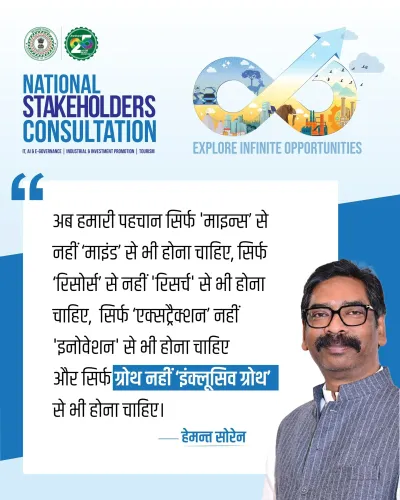
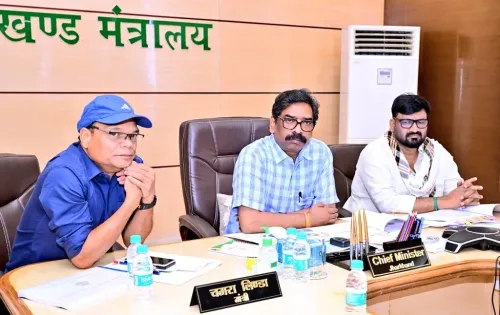
CM Soren Pushes AI Governance Platform, Seeks Central Data Help
Synopsis
Jharkhand Chief Minister Hemant Soren has called for central government data sharing and technical help to fight DBT fraud, while spotlighting the state's AI-powered CM-DIP platform, over 10 lakh nutrition gardens, the Birsa Harit Gram Yojana, and mega lift irrigation projects as pillars of rural transformation.
Key Takeaways
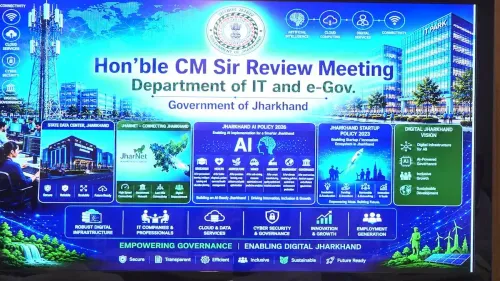
Jharkhand is deploying an AI-driven Chief Minister Data Intelligence Platform (CM-DIP) and an Integrated Command and Control Centre for data-based governance.
CM Hemant Soren has formally urged the Centre for timely data sharing and technical cooperation to prevent digital fraud and leakages in DBT schemes .
The state claims to have established more than 10 lakh Poshan Vatikas (nutrition gardens) under the national POSHAN Abhiyaan framework.
The Birsa Harit Gram Yojana , a state afforestation scheme named after tribal icon Birsa Munda , is being cited as a driver of rural economic change alongside mega lift irrigation projects.
Soren called for national cooperation to address climate change challenges affecting Jharkhand's agriculture and rural communities.
Jharkhand Chief Minister Hemant Soren on Thursday, June 11, 2026, outlined the state's push toward AI-driven governance and formally urged the central government for timely data sharing and technical cooperation to curb digital fraud in welfare delivery. Speaking through a post on X, Soren highlighted the Chief Minister Data Intelligence Platform (CM-DIP) and an Integrated Command and Control Centre as cornerstones of Jharkhand's data-based administration. He also underscored the state's agricultural and nutrition initiatives, calling for national partnership to address climate change.
Context
Soren's post, written in Hindi, states: 'AI-driven Chief Minister Data Intelligence Platform (CM-DIP) aur Integrated Command and Control Centre ke madhyam se data aadharit sushasan ko majboot kiya ja raha hai' — 'Data-based good governance is being strengthened through the AI-driven CM-DIP and the Integrated Command and Control Centre.' The statement represents a public articulation of Jharkhand's digital governance roadmap and doubles as a direct appeal to New Delhi for cooperation on welfare delivery infrastructure.
The CM specifically sought 'timely data sharing' from the central government and 'technical cooperation' to prevent digital fraud and leakages in Direct Benefit Transfer (DBT) schemes. DBT, rolled out by the Government of India in 2013, routes welfare payments directly into beneficiaries' bank accounts to reduce intermediary leakage — a mechanism that requires seamless data exchange between state and central systems to function effectively.
Policy Backdrop
The Integrated Command and Control Centre model has precedents in the Smart Cities Mission, launched in 2015, which funded similar real-time administrative monitoring infrastructure across multiple states. Jharkhand's CM-DIP appears to extend that framework to welfare governance, using AI to track scheme delivery. Centre-state friction over timely data access for fraud detection in DBT schemes has been a recurring issue across several opposition-governed states.
On the nutrition front, Soren cited more than 10 lakh Poshan Vatikas (nutrition gardens) established in the state, alongside the Birsa Harit Gram Yojana — a state scheme promoting village-level afforestation named after 19th-century tribal leader Birsa Munda — and mega lift irrigation projects as drivers of rural economic transformation. The Poshan Vatika model aligns with the national POSHAN Abhiyaan, launched by the Centre in 2018, which promotes community-level nutrition gardens to combat malnutrition.
Stakeholders and Impact
The primary beneficiaries of these initiatives are rural households, DBT scheme recipients, and small and marginal farmers across Jharkhand. Successful AI-driven fraud detection in DBT pipelines could ensure that subsidies and welfare transfers reach intended beneficiaries without diversion, a concern that affects millions of scheme enrollees in the state.
The Birsa Harit Gram Yojana and mega lift irrigation projects are particularly significant for Jharkhand's agrarian communities, which face acute water stress and climate vulnerability. By pairing green cover expansion with irrigation infrastructure, the state is attempting to build climate resilience at the village level. Soren's explicit call for 'national cooperation' on climate change signals that Jharkhand views this as a challenge requiring coordinated Centre-state action, not a unilateral state effort.
What's Next
The immediate test will be whether the central government responds with formal data-sharing agreements or Memoranda of Understanding with Jharkhand for DBT fraud prevention. Progress on the physical completion targets for the mega lift irrigation projects will also be a key indicator of whether the rural economy push translates into measurable outcomes. Analysts will watch annual budget reviews for specific allocations tied to the CM-DIP platform's expansion and the irrigation rollout.
Soren's framing — pairing a technology governance pitch with a climate cooperation appeal — suggests Jharkhand is positioning itself as a proactive state actor seeking structured central partnership rather than merely requesting funds. How New Delhi responds to the data-sharing request will shape the credibility of the state's anti-leakage agenda in the months ahead.
Point of View
It validates the model; if it does not, Soren has a ready-made narrative for the next election cycle.
NationPress
26 Oct 2026
Frequently Asked Questions
What is the CM-DIP platform in Jharkhand?
The Chief Minister Data Intelligence Platform (CM-DIP) is an AI-driven governance tool being deployed by the Jharkhand government to strengthen data-based administration and real-time monitoring of welfare delivery across the state.
Why is Hemant Soren asking the central government for data sharing?
Soren is seeking timely data sharing from the Centre to detect and prevent digital fraud and leakages in Direct Benefit Transfer (DBT) schemes, which require seamless data exchange between state and central systems to ensure welfare funds reach intended beneficiaries.
What is the Birsa Harit Gram Yojana?
Birsa Harit Gram Yojana is a Jharkhand state scheme that promotes tree plantation and green cover in villages, named after 19th-century tribal leader Birsa Munda. It is part of the state's rural economy and climate resilience strategy.
What are Poshan Vatikas and how many are there in Jharkhand?
Poshan Vatikas are nutrition gardens established at household and community levels under the national POSHAN Abhiyaan mission to combat malnutrition. CM Soren stated that more than 10 lakh such gardens have been set up in Jharkhand.
What are the mega lift irrigation projects mentioned by Jharkhand CM?
Mega lift irrigation projects are large-scale water infrastructure initiatives being implemented in Jharkhand to address water scarcity and support agricultural productivity in rural areas, particularly for small and marginal farmers facing climate-related water stress.