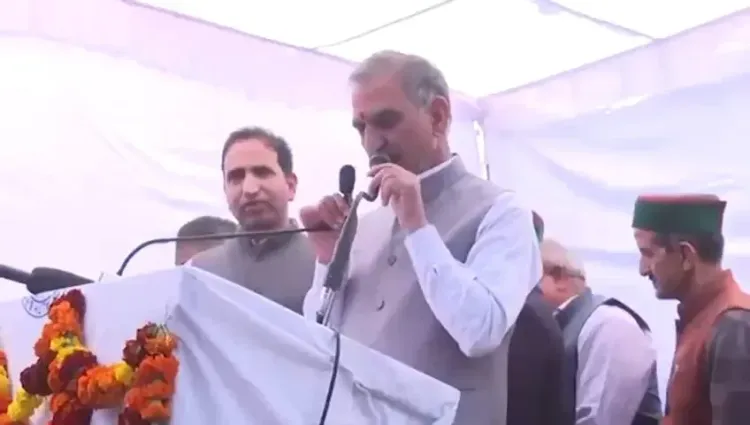
CM Sukhu flags BJP-era health staffing gaps, vows 70% fill rate
Synopsis
CM Sukhvinder Singh Sukhu says BJP left Himachal Pradesh health centres at barely 35% of required staff. His Congress government has launched rapid recruitment, targeting 60-70% staffing at public health institutions within two years of taking office.
Key Takeaways
Shahpur health institution cited as example: needed 100 staff , had only 35 under the previous BJP government.
CM Sukhu says the same understaffing pattern affected health institutions across Himachal Pradesh .
Congress government claims rapid recruitment of doctors, staff nurses, and other workers over the past two years .
Stated target is to raise staffing availability to 60–70 percent of sanctioned strength at public health institutions.
BJP's Jairam Thakur administration governed Himachal Pradesh from 2017 to 2022 ; Congress under Sukhu took over in December 2022 .
When Himachal Pradesh Chief Minister Sukhvinder Singh Sukhu pointed to Shahpur on Friday, 20 November 2026, he was not describing an outlier — he was describing a system. Health institutions that needed 100 staff were running on 35. One in three. That is the baseline his government says it inherited.
In a post on X, Sukhu stated that before the Congress government took office, the previous Bharatiya Janata Party administration had left public health institutions severely understaffed across the state. He cited Shahpur — a town in Kangra district — as a case in point: a facility requiring 100 workers had only 35 on the ground. 'The same situation prevailed in other health institutions across the state,' he said.
Two years of rapid hiring — and what the numbers claim now
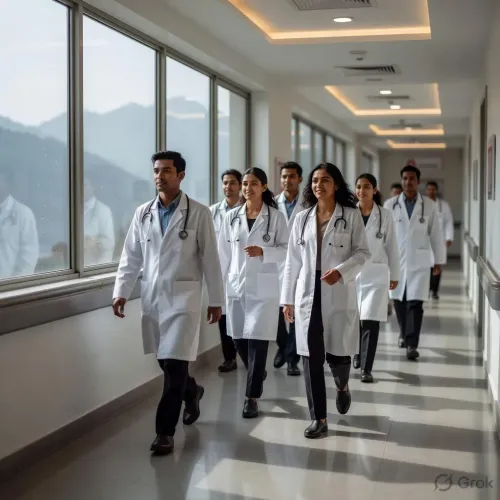
The Chief Minister said his government has responded with an accelerated recruitment drive over the past two years, targeting doctors, staff nurses, and other health workers. The stated goal: push staffing availability at health institutions from roughly one-third to between 60 and 70 percent of sanctioned strength. That would represent, by the government's own framing, a near-doubling of functional capacity.
The Congress government has treated vacancy-filling as a central governance pitch since it replaced the BJP's Jairam Thakur administration in December 2022. Sukhu's remarks fit a pattern seen across newly elected state governments in India — lead with inherited deficits, then claim visible progress. The health sector, where vacancies directly translate to unserved patients in rural catchments, carries particular political and human weight.
Shahpur as a symbol of Himachal's rural health gap
The specific invocation of Shahpur matters. Rural and semi-urban health centres in hill states like Himachal Pradesh face a structural recruitment challenge: geography makes postings unattractive, and specialists are harder to retain than to hire. A 35 percent staffing level at any public facility would mean routine services — OPD, emergency care, maternity — stretched thin or simply absent on many days.
Sukhu's target of 60–70 percent would still leave facilities short of full sanctioned strength, but the government's framing positions it as a meaningful, achievable step rather than a distant ideal. Whether independent assessments of Himachal's health recruitment — including assembly floor data and department notifications — will corroborate these figures is the number to watch.
For the rural patients of Himachal Pradesh, the arithmetic is simple: more posted staff means shorter waits, fewer referrals to distant district hospitals, and care closer to home. The government has staked a claim. The staffing registers will keep the score.
Point of View
Then claim measurable progress. The Shahpur example gives a human-scale number to an otherwise abstract vacancy statistic, making it politically portable. The 60-70% target is strategically modest — achievable enough to defend, significant enough to cite. The broader pattern across Congress-governed states suggests this is coordinated messaging ahead of budget season, where health recruitment figures become both governance proof and opposition ammunition.
NationPress
20 Nov 2026
Frequently Asked Questions
What was the staffing situation in Himachal Pradesh health centres before the Sukhu government?
CM Sukhu says health institutions were running at roughly 35 percent of required staffing under the previous BJP government, citing Shahpur as an example where only 35 of 100 needed staff were in place.
What is the Sukhu government's target for health staffing in Himachal Pradesh?
The government aims to raise staffing at public health institutions to between 60 and 70 percent of sanctioned strength through rapid recruitment of doctors, staff nurses, and other workers.
When did Sukhvinder Singh Sukhu become Chief Minister of Himachal Pradesh?
Sukhvinder Singh Sukhu took office as Chief Minister of Himachal Pradesh in December 2022 , after the Indian National Congress defeated the BJP in the state assembly elections.
Which party governed Himachal Pradesh before the Congress?
The Bharatiya Janata Party under Chief Minister Jairam Thakur governed Himachal Pradesh from 2017 to 2022 .
Where is Shahpur, mentioned by CM Sukhu in his post?
Shahpur is a town in Kangra district , Himachal Pradesh, used by CM Sukhu as an illustration of the state-wide health staffing shortfall his government inherited.