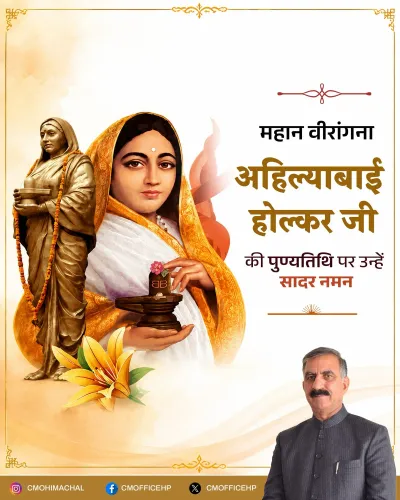
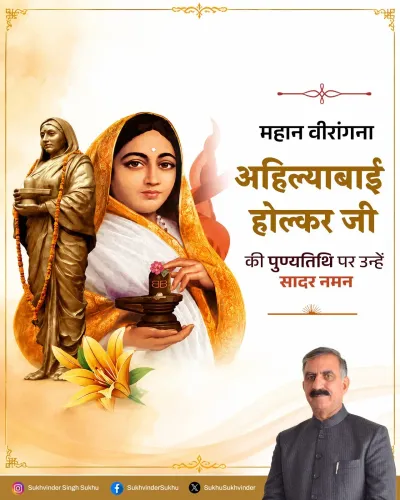
CM Sukhu pays tribute to Ahilyabai Holkar on birth anniversary
Synopsis
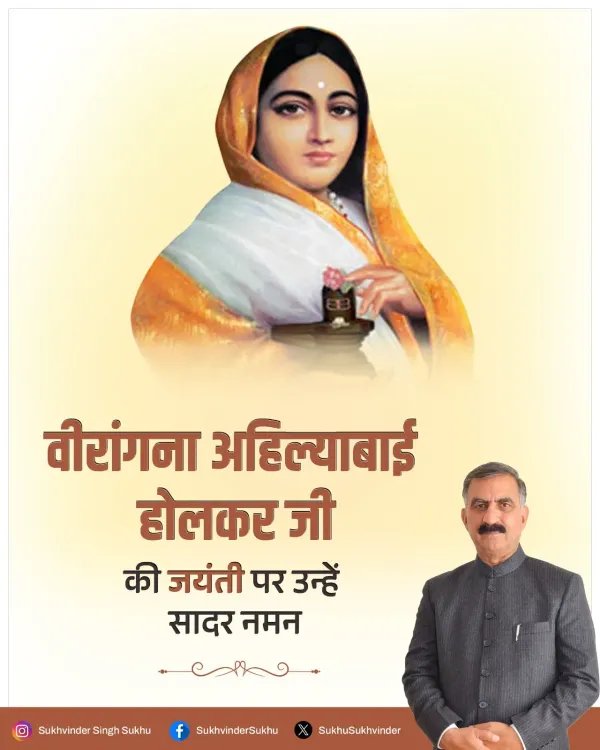
Himachal Pradesh Chief Minister Sukhvinder Singh Sukhu on 31 May 2026 paid homage to Ahilyabai Holkar on her birth anniversary, calling her an unparalleled symbol of public service, justice, ideal governance, and an inspiration for women's empowerment.
Key Takeaways
CM Sukhvinder Singh Sukhu paid tribute to Ahilyabai Holkar on her birth anniversary on 31 May 2026 .
Ahilyabai Holkar ruled the Malwa kingdom from 1767 to 1795 , known for justice, temple restorations, and public infrastructure.
Sukhu described her as an unparalleled symbol of public service, justice, and ideal governance .
He highlighted her life as an inspiration for nari shakti (women's empowerment).
Indian leaders across parties mark her birth anniversary as part of a recurring tradition of invoking pre-colonial women rulers.
The Himachal Pradesh Congress government has consistently emphasised women's empowerment and ideal governance in its public messaging.
Himachal Pradesh Chief Minister Sukhvinder Singh Sukhu on Sunday, 31 May 2026, paid homage to Ahilyabai Holkar, the 18th-century ruler of the Malwa kingdom, on her birth anniversary, hailing her as an unparalleled symbol of public service, justice, and ideal governance.
Context
In a post shared on X (formerly Twitter), Chief Minister Sukhu offered his respects, describing Ahilyabai Holkar as 'janseva, nyay aur aadarsh shasan ki apratim prateek' — an unparalleled symbol of public service, justice, and ideal governance — and as an inspiration for women's empowerment. He noted that her life, devoted to sacrifice, duty, and public welfare, 'illuminates the path of service and public interest.'
The tribute marks the annual birth anniversary of one of India's most celebrated pre-colonial women rulers, observed widely across the country on 31 May.
Policy Backdrop
Ahilyabai Holkar ruled the Malwa kingdom from 1767 to 1795, earning a lasting reputation for impartial justice, extensive temple restorations, and large-scale infrastructure projects spanning wells, roads, and rest houses across the subcontinent. Her reign is frequently cited as a model of ethical and people-centric administration.
Indian political leaders across party lines regularly invoke her legacy on her birth anniversary, framing her governance as a historical benchmark for justice and welfare. The Himachal Pradesh Congress government has consistently emphasised themes of women's empowerment and ideal governance in its public messaging, making such tributes a recurring feature of its official communication.
Stakeholders and Impact
The tribute resonates with women leaders, public administrators, and citizens who look to historical figures as touchstones for contemporary governance values. Ahilyabai Holkar's legacy holds particular significance for discussions around nari shakti — women's power — a theme that has gained prominence in both state and national political discourse.
By publicly honouring her, CM Sukhu aligns the Himachal Pradesh government with a broader national narrative that draws on pre-colonial women rulers to articulate principles of service, accountability, and public welfare.
What's Next
Across India, state and central government bodies periodically reference historical models of governance — including Ahilyabai Holkar's administration — when framing welfare schemes and administrative reform initiatives. Observers will watch whether the Himachal Pradesh government follows such tributes with concrete programmatic announcements linked to women's empowerment or governance reform. The annual recurrence of this tribute underscores a sustained political interest in positioning ethical, service-oriented leadership as a guiding ideal for modern public administration.
Point of View
Such messaging serves a dual purpose: it anchors the party's welfare narrative in a historically resonant figure while reinforcing its outreach to women voters. The invocation of 'aadarsh shasan' — ideal governance — is particularly pointed in a state where the ruling party has faced political competition on governance credibility. Whether these tributes translate into tangible policy action on women's empowerment remains the key question for observers watching the Himachal Pradesh government's agenda.
NationPress
15 Oct 2026
Frequently Asked Questions
Who was Ahilyabai Holkar?
Ahilyabai Holkar was an 18th-century ruler of the Malwa kingdom who governed from 1767 to 1795, celebrated for impartial justice, public welfare projects, temple restorations, and infrastructure development across India.
When is Ahilyabai Holkar's birth anniversary?
Ahilyabai Holkar's birth anniversary is observed on 31 May each year.
Why did CM Sukhu pay tribute to Ahilyabai Holkar?
CM Sukhvinder Singh Sukhu paid tribute on her birth anniversary, honouring her legacy as a symbol of public service, justice, ideal governance, and inspiration for women's empowerment.
What did CM Sukhu say about Ahilyabai Holkar?
CM Sukhu described her as an unparalleled symbol of public service, justice, and ideal governance, and said her life devoted to sacrifice, duty, and public welfare illuminates the path of service and public interest.
How do Indian politicians mark Ahilyabai Holkar's birth anniversary?
Indian politicians across parties routinely issue statements on 31 May highlighting her ethical rule and contributions to women's empowerment, making it a recurring feature of national political communication.