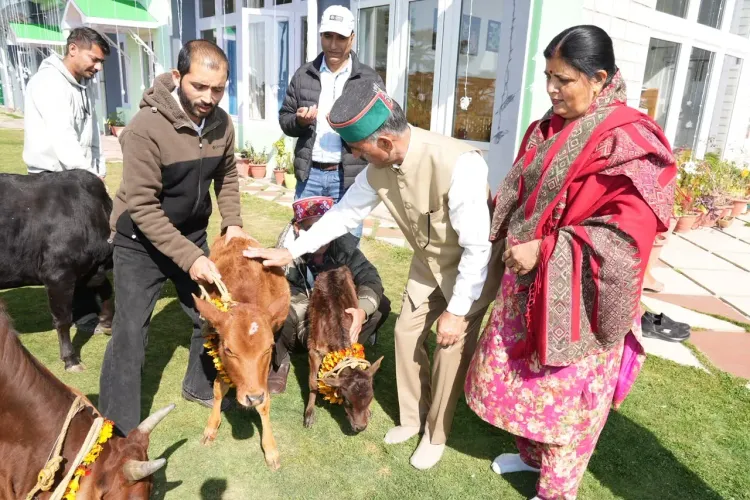
CM Sukhu performs Govardhan and Vishwakarma Puja with family
Synopsis
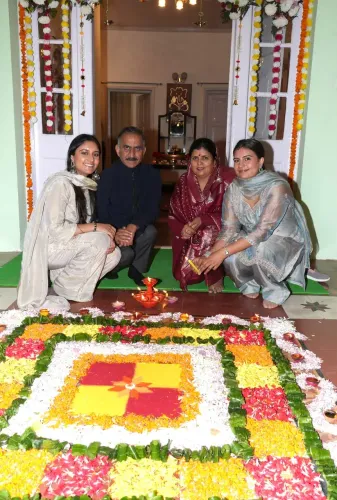
Chief Minister Sukhvinder Singh Sukhu performed Govardhan and Vishwakarma Puja with his wife on 9 November 2026, invoking a Sanskrit verse on cow veneration and calling for Himachal Pradesh to become a model of development, harmony, and well-being.
Key Takeaways
CM Sukhvinder Singh Sukhu performed Govardhan Puja and Vishwakarma Puja alongside his wife on 9 November 2026 .
He opened with the Sanskrit verse 'Gavo vishvasya matarah, gau seva paramo dharmah' — 'The cow is the mother of the universe; serving the cow is the highest duty.' The post expressed a wish for all Himachal Pradesh residents to remain happy and prosperous.
Sukhu framed the state's cultural identity as rooted in faith, tradition, and life values.
Both festivals carry distinct religious significance: Govardhan Puja honours Lord Krishna and cow veneration; Vishwakarma Puja celebrates the deity of crafts and skilled labour.
With a Sanskrit invocation on his lips — 'Gavo vishvasya matarah, gau seva paramo dharmah' ('The cow is the mother of the universe; serving the cow is the highest duty') — Himachal Pradesh Chief Minister Sukhvinder Singh Sukhu marked Govardhan Puja and Vishwakarma Puja alongside his wife on Monday, 9 November 2026, sharing the observance publicly as a message of cultural continuity and statewide prosperity.
In his post, CM Sukhu wrote that the identity of India's culture is rooted in faith, tradition, and life values — and he offered prayers for every resident of Himachal Pradesh to remain happy and prosperous, expressing the hope that the state would set a new example of development, harmony, and well-being.
Govardhan and Vishwakarma: two strands of one message
Govardhan Puja, observed in the days following Diwali, is linked to Lord Krishna's lifting of the Govardhan hill to protect villagers — and centrally to the reverence of the cow as a symbol of sustenance and abundance. Vishwakarma Puja, honouring the Hindu deity of architecture and crafts, is widely observed by artisans, workers, and engineers as a celebration of skilled labour and creation.
By performing both rites together and invoking the Sanskrit verse on cow veneration, Sukhu wove two threads of Hindu devotional tradition — pastoral and artisanal — into a single public gesture addressed to all of Himachal Pradesh's residents.
A chief minister's festival post and what it signals
Indian chief ministers have long used social media observances of Hindu festivals to signal cultural attunement and social harmony — particularly in states with deep rural and agrarian traditions. Himachal Pradesh, a northern hill state where agriculture, animal husbandry, and craft traditions remain central to daily life, provides a natural audience for exactly this kind of message.
For Sukhu, the post also carries a political subtext: the Indian National Congress leader is positioning himself — and his government — as a custodian of the state's cultural and spiritual fabric, not just its development agenda. The dual invocation of prosperity and harmony is a staple of chief ministerial public communication, but the specificity of the Sanskrit verse and the personal, familial framing give this post a warmer, more grounded register.
What to watch in the months ahead: whether Sukhu's government follows the festival messaging with concrete state-level policy on animal welfare or cultural preservation — the natural next step if the rhetoric is to become programme.
Point of View
Visibly owning festivals like Govardhan Puja is as much strategic as it is sincere. The dual performance of two distinct Hindu observances in one post signals breadth of cultural reach — from pastoral communities to artisan and worker constituencies. Watch whether this cultural messaging translates into announced policy on cow welfare or craft-sector support, which would give it lasting news traction beyond the festival cycle.
NationPress
9 Nov 2026
Frequently Asked Questions
What is Govardhan Puja and when is it celebrated?
Govardhan Puja is a Hindu festival observed the day after Diwali, commemorating Lord Krishna's lifting of Mount Govardhan to protect villagers from floods. It is closely associated with cow veneration and agricultural traditions across India.
What is Vishwakarma Puja?
Vishwakarma Puja honours the Hindu deity of architecture, crafts, and engineering. It is widely celebrated by artisans, factory workers, and engineers as a day to bless their tools and workplaces.
What did CM Sukhu say during Govardhan Puja 2026?
CM Sukhu invoked the Sanskrit verse 'Gavo vishvasya matarah, gau seva paramo dharmah' and wished all Himachal Pradesh residents happiness and prosperity, expressing hope that the state would become a new model of development, harmony, and well-being.
Is Govardhan Puja a public holiday in Himachal Pradesh?
Govardhan Puja is observed as a religious festival across India; its status as a public holiday varies by state. No specific Himachal Pradesh holiday declaration was mentioned in this post.
What is the significance of the Sanskrit verse CM Sukhu quoted?
The verse 'Gavo vishvasya matarah, gau seva paramo dharmah' translates to 'The cow is the mother of the universe; serving the cow is the highest duty.' It is a traditional Hindu invocation used to emphasise the sanctity of the cow and its centrality to Indian culture and agriculture.