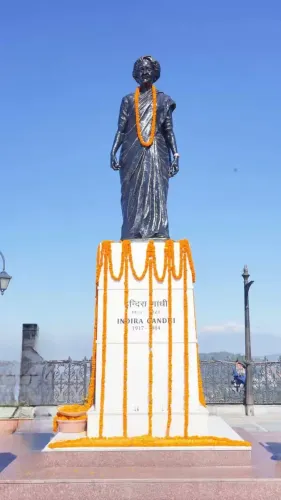
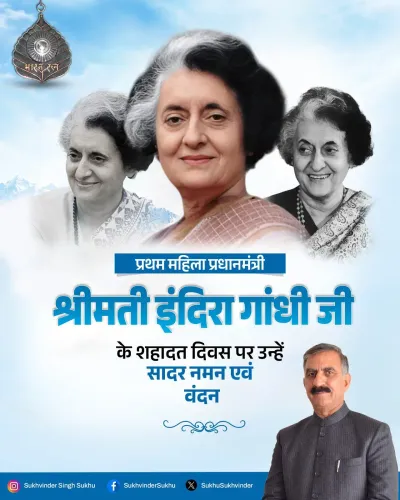
CM Sukhu pays tribute to Indira Gandhi on death anniversary
Synopsis
Himachal Pradesh CM Sukhvinder Singh Sukhu paid tribute to Indira Gandhi on her assassination anniversary, highlighting her role in the 1971 war, bank nationalisation, abolition of privy purses, and land reforms as defining acts of national statecraft.
Key Takeaways
HP CM Sukhu issued a tribute to Indira Gandhi on 31 October 2026 , her assassination anniversary.
He credited her with the 'indomitable courage' to take decisive national-interest decisions, including the 1971 war that created Bangladesh .
The tribute highlighted the nationalisation of 14 major banks in July 1969 to expand credit access.
The 26th Constitutional Amendment of 1971 abolishing privy purses for former princely rulers was cited as a landmark reform.
Sukhu noted Indira Gandhi sacrificed her life defending national unity, referencing her assassination on 31 October 1984 .
Such commemorations form a core part of Congress party historical narrative and political identity.
Forty-two years after a bullet ended her life at 1 Safdarjung Road, Indira Gandhi remains a fault line in Indian political memory — and Himachal Pradesh Chief Minister Sukhvinder Singh Sukhu marked her assassination anniversary on 31 October 2026 with a sweeping tribute that walked through the decisions that reshaped a nation.
Writing in Hindi, CM Sukhu described Indira Gandhi as a 'courageous personality who feared no one' — साहसी शख्सियत थीं, वह किसी से नहीं डरती थीं — and credited her with the 'indomitable courage to take big, decisive steps in the national interest.' The tribute did not stop at sentiment. It catalogued specific moves: the 1971 war decision that created Bangladesh, the nationalisation of banks, the abolition of privy purses, and land reforms.
The decision that split Pakistan
Of all the actions cited, Sukhu placed the 1971 Indo-Pakistani War at the centre — 'one decision that changed the shape of Pakistan.' Indian military intervention in East Pakistan in December 1971 ended in the creation of Bangladesh and the surrender of over 90,000 Pakistani troops, one of the most decisive military outcomes of the Cold War era. For Congress leaders, this remains the definitive proof of Indira Gandhi's strategic nerve.
Banks, princes, and land — the domestic revolution
Sukhu's tribute also foregrounded three economic landmarks. In July 1969, Indira Gandhi's government nationalised 14 major commercial banks, directing credit toward agriculture and small enterprise and cementing state control over finance. Two years later, the 26th Constitutional Amendment of 1971 abolished privy purses — the annual payments guaranteed to former rulers of India's hundreds of princely states — stripping a symbolic and financial privilege in one legislative stroke. Land reform efforts completed what Sukhu called an attempt to 'change the social and economic direction of the country.'
Sacrifice as the final chapter
The tribute closed where history did. CM Sukhu noted that Indira Gandhi 'sacrificed her life while protecting the unity and integrity of the country' — a reference to her assassination on 31 October 1984 by her own security detail, following her order to send the army into the Golden Temple in Amritsar during Operation Blue Star earlier that year. She was India's first and only woman Prime Minister, serving from 1966 to 1977 and again from 1980 until her death.
Tributes to Indira Gandhi on this date are a recurring feature of Congress political culture, but they carry particular resonance in Himachal Pradesh, a state with deep Congress roots. Sukhu, who leads a Congress government in Shimla, used the occasion to anchor the party's historical identity in a legacy of decisive statecraft and social equity — a message directed as much at the present as at the past.
The India that emerged from those years — with nationalised banks, a redefined neighbourhood, and a constitution stripped of feudal obligations — was, in large part, the India Indira Gandhi chose to build. That argument is very much still alive.
Point of View
Not just personal homage. By leading with the 1971 war and the economic reforms, he anchors Congress's contemporary identity in a legacy of decisive, transformative governance — an implicit contrast with rivals. The emphasis on Indira Gandhi's 'sacrifice' for national integrity also signals a readiness to invoke her martyrdom as a moral benchmark. In a state where Congress remains in power, this kind of historical framing serves to consolidate the party's base while projecting ideological continuity across generations.
NationPress
31 Oct 2026
Frequently Asked Questions
Why is 31 October significant in India?
31 October is the assassination anniversary of Indira Gandhi , who was shot by her security guards on this date in 1984 . It is also observed as Rashtriya Ekta Diwas (National Unity Day), the birth anniversary of Sardar Vallabhbhai Patel.
What did Indira Gandhi do in the 1971 war?
Indira Gandhi ordered Indian military intervention in East Pakistan in December 1971 , supporting the Bengali independence movement. The war ended with the creation of Bangladesh and the surrender of over 90,000 Pakistani troops.
What was India's bank nationalisation under Indira Gandhi?
In July 1969 , Indira Gandhi's government nationalised 14 major commercial banks to direct credit toward agriculture, small businesses, and rural areas, and to bring the banking sector under state control.
What were privy purses and why were they abolished?
Privy purses were annual financial payments guaranteed to former rulers of India's princely states after independence. They were abolished by the 26th Constitutional Amendment in 1971 under Indira Gandhi, ending a post-colonial feudal privilege.
Who is Sukhvinder Singh Sukhu?
Sukhvinder Singh Sukhu is the Chief Minister of Himachal Pradesh and a senior leader of the Indian National Congress . He leads the Congress government in the state with its capital at Shimla .