CM Sukhu Pays Tribute to Indira Gandhi on Martyrdom Anniversary
Synopsis
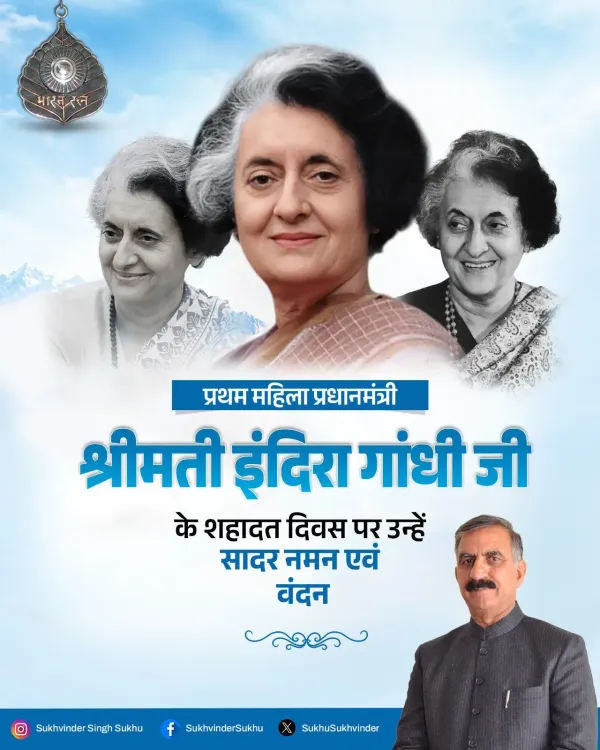
On Indira Gandhi's martyrdom anniversary, Himachal Pradesh CM Sukhvinder Singh Sukhu paid tribute on X, recalling how her government granted the state full statehood on 25 January 1971 — a milestone he called unforgettable in Himachal's political and historical journey.
Key Takeaways
CM Sukhvinder Singh Sukhu posted a tribute to Indira Gandhi on her martyrdom anniversary, 31 October 2026 .
He recalled that on 25 January 1971 , under Indira Gandhi's government, Himachal Pradesh was granted full statehood — becoming India's 18th state .
Before 1971, Himachal Pradesh was a Union Territory under the States Reorganisation Act of 1956.
Indira Gandhi, India's first and only woman Prime Minister , was assassinated on 31 October 1984 .
Sukhu described her contribution to Himachal as 'unforgettable' and offered a 'hundredfold salute' in her memory.
Fifty-five years after Indira Gandhi signed off on one of the most consequential decisions for the hills of northern India, Himachal Pradesh Chief Minister Sukhvinder Singh Sukhu on Saturday, 31 October 2026 — her martyrdom anniversary — invoked that legacy with a tribute on X, linking her statehood decision to the identity of the state he now leads.
Posting in Hindi, CM Sukhu wrote: 'हिमाचल प्रदेश के प्रति उनका योगदान भी अविस्मरणीय है' ['Her contribution to Himachal Pradesh is also unforgettable']. He specifically recalled that on 25 January 1971, under Indira Gandhi's leadership, 'हमारी देवभूमि को पूर्ण राज्य का दर्जा मिला' — 'our sacred land received the status of a full state.' He described it as a defining milestone in Himachal's political and historical journey, and closed with the words 'शत-शत नमन एवं वंदन' — a hundredfold salute — to India's first woman Prime Minister on her day of martyrdom.
From Union Territory to Statehood: The 1971 Decision That Shaped Himachal
The road to full statehood for Himachal Pradesh was long. After independence, the region was assembled from a clutch of princely hill states and placed under central administration. The States Reorganisation Act of 1956 formalised its status as a Union Territory, giving Delhi direct control but denying the region the fuller self-governance that statehood brings — its own legislature, its own constitutional standing, its own claim on federal resources.
That changed under Indira Gandhi's government. On 25 January 1971, Himachal Pradesh was elevated to a full state of the Indian Union — the 18th state — giving its people a Legislative Assembly with complete powers and a place at the table of Indian federalism. The timing mattered: it came weeks before the general elections of that year, and the decision embedded the Congress party's name into the founding narrative of the state.
31 October: A Date Congress Marks with Particular Weight
Indira Gandhi was assassinated on 31 October 1984 by her own security guards, in the aftermath of Operation Blue Star, the Indian Army's June 1984 action at the Golden Temple in Amritsar. Her death sent shockwaves across the country and triggered some of the worst communal violence in post-independence India. She remains, decades later, the only woman to have held the office of Prime Minister of India — a fact CM Sukhu explicitly highlighted in his tribute.
For Congress-governed states with direct administrative debts to her decisions, 31 October carries a layer of political memory beyond the national. Himachal Pradesh is one such state. CM Sukhu's tribute on that date — weaving together her national legacy, her regional contribution, and her place in history — follows a pattern of linking party history to regional identity that Congress leaders in such states have sustained for decades.
Point of View
He reinforces the party's foundational claim on the state's identity at a time when it holds government there. The 1971 statehood decision is not merely historical sentiment — it is a recurring political asset that Congress leaders in Himachal deploy to remind voters of the party's formative role. With state politics always in motion in the hills, such commemoration serves a dual purpose: honouring a national icon and quietly underlining who built the house. The pattern is deliberate and durable.
NationPress
31 Oct 2026
Frequently Asked Questions
When was Indira Gandhi's martyrdom anniversary?
Indira Gandhi was assassinated on 31 October 1984 , and that date is observed each year as her martyrdom anniversary.
When did Himachal Pradesh become a full state?
Himachal Pradesh was granted full statehood on 25 January 1971 , under the government of Prime Minister Indira Gandhi, becoming India's 18th state.
What was Himachal Pradesh before it became a full state?
Before 25 January 1971 , Himachal Pradesh was a Union Territory , a status it had held under the States Reorganisation Act of 1956.
Who is Himachal Pradesh Chief Minister in 2026?
Sukhvinder Singh Sukhu of the Indian National Congress is the Chief Minister of Himachal Pradesh.
Why did CM Sukhu mention Indira Gandhi and Himachal Pradesh statehood together?
CM Sukhu linked the two because it was Indira Gandhi's government that elevated Himachal Pradesh from a Union Territory to a full state on 25 January 1971 , a milestone he described as an unforgettable contribution to the state.