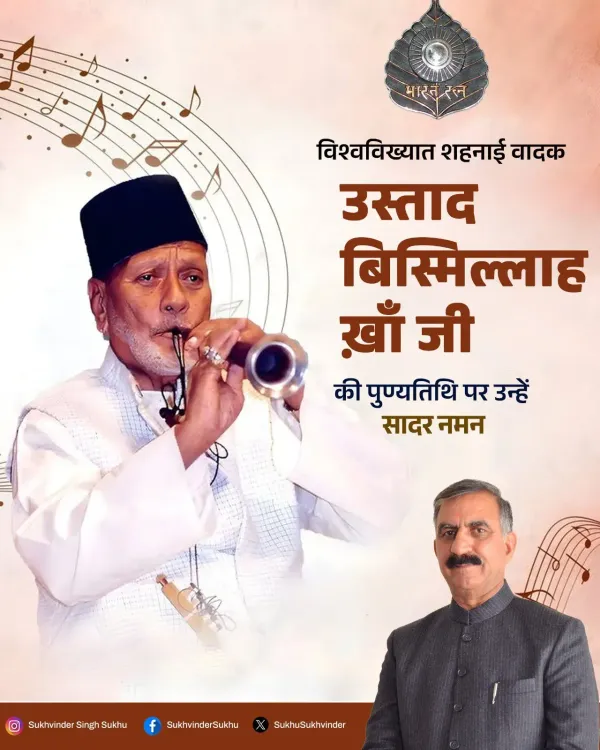
CM Sukhu pays tribute to Ustad Bismillah Khan on death anniversary
Synopsis
Himachal Pradesh Chief Minister Sukhvinder Singh Sukhu paid homage to Bharat Ratna shehnai legend Ustad Bismillah Khan on his death anniversary, calling his music a reflection of India's syncretic Ganga-Jamuni heritage and an eternal contribution to Indian classical music.
Key Takeaways
HP CM Sukhvinder Singh Sukhu posted a tribute to Ustad Bismillah Khan on his death anniversary on 21 August .
Sukhu described Khan's shehnai as carrying 'the soul of Hindustan' and the spirit of Ganga-Jamuni tehzeeb .
Khan was a recipient of the Bharat Ratna , India's highest civilian honour, and one of the foremost Hindustani classical musicians.
Sukhu called Khan's contribution to Indian classical music 'eternally unforgettable.' The tribute reflects a broader pattern of Indian political leaders honouring classical performing arts icons on their death anniversaries.
The soul of Indian classical music lives in the notes of a shehnai — and on the death anniversary of Ustad Bismillah Khan, Himachal Pradesh Chief Minister Sukhvinder Singh Sukhu paused to honour the maestro whose art became synonymous with the nation itself.
Posting on Friday, 21 August, Chief Minister Sukhu wrote in Hindi: 'उनकी शहनाई के सुरों में हिंदुस्तान की आत्मा और हमारी गंगा-जमुनी तहज़ीब की खूबसूरत झलक मिलती थी' — 'In the notes of his shehnai, one found the soul of Hindustan and a beautiful reflection of our Ganga-Jamuni tehzeeb.' He added that by mastering the notes, Khan transformed music into a form of devotion and made his art the identity of the country.
A shehnai that carried a civilisation
Ustad Bismillah Khan was among the most decorated classical musicians India has produced. A recipient of the Bharat Ratna — the country's highest civilian honour — he spent decades elevating the shehnai from a ceremonial instrument to a pillar of Hindustani classical music. His performances at sacred ghats in Varanasi, at independence celebrations, and on concert stages across the world made him a living symbol of India's pluralist cultural fabric. The concept of Ganga-Jamuni tehzeeb — the syncretic Hindu-Muslim cultural tradition that flourished in the Gangetic plains — was not merely a phrase Khan invoked. It was the texture of his life and music. Born into a Muslim family of hereditary shehnai players, he devoted his art to temples and rivers with equal reverence, embodying a tradition that refused the boundaries of faith.State recognition and the politics of cultural memory
Tributes from political leaders on the death anniversaries of national cultural icons are a consistent feature of Indian public life. They serve as moments of reaffirmation — of classical arts, of composite heritage, and of the idea that artistic devotion is itself a form of national service. Chief Minister Sukhu's post fits squarely within this tradition, invoking Khan's legacy at a time when conversations about India's syncretic identity carry particular resonance. Khan's contribution to Indian classical music remains, as Sukhu put it, 'sada avismarniya' — eternally unforgettable. The shehnai he carried through decades of performance still echoes wherever India reaches for the deepest notes of its own story.Point of View
Particularly resonant from a Congress leader in the current political climate. Indian political parties have long competed to claim the mantle of syncretic heritage, and tributes to figures like Khan serve as soft assertions of that identity. The framing of music as 'sadhana' — devotional practice — also subtly elevates classical arts as a site of national pride that transcends communal lines. Consistent state-level recognition of this kind shapes the cultural policy conversation around funding and preserving classical performing arts.
NationPress
21 Aug 2026
Frequently Asked Questions
When did Ustad Bismillah Khan pass away?
Ustad Bismillah Khan passed away on 21 August 2006 in Varanasi, at the age of 90. His death anniversary is observed annually by musicians, cultural institutions, and public figures across India.
What is Ganga-Jamuni tehzeeb?
Ganga-Jamuni tehzeeb refers to the syncretic Hindu-Muslim cultural tradition that developed in the Gangetic plains of north India, blending artistic, linguistic, and social practices from both communities. Ustad Bismillah Khan is widely regarded as one of its greatest living symbols.
What awards did Ustad Bismillah Khan receive?
Ustad Bismillah Khan received the Bharat Ratna, India's highest civilian honour, in 2001. He was also awarded the Padma Shri, Padma Bhushan, and Padma Vibhushan at various stages of his career.
Why did CM Sukhu pay tribute to Bismillah Khan?
Himachal Pradesh Chief Minister Sukhvinder Singh Sukhu posted a tribute on the death anniversary of Ustad Bismillah Khan, honouring his legacy as a shehnai maestro and his role in embodying India's composite cultural heritage.
What is the shehnai and why is it significant in Indian music?
The shehnai is a double-reed wind instrument traditionally used in ceremonial and devotional contexts in north India. Ustad Bismillah Khan elevated it to a concert-stage instrument and a cornerstone of Hindustani classical music, giving it global recognition.