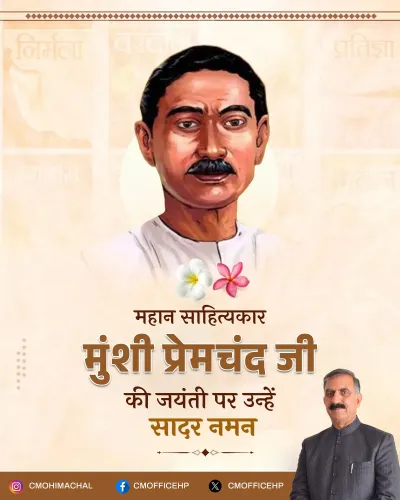
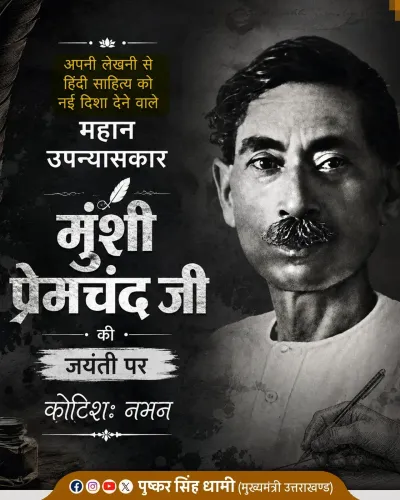
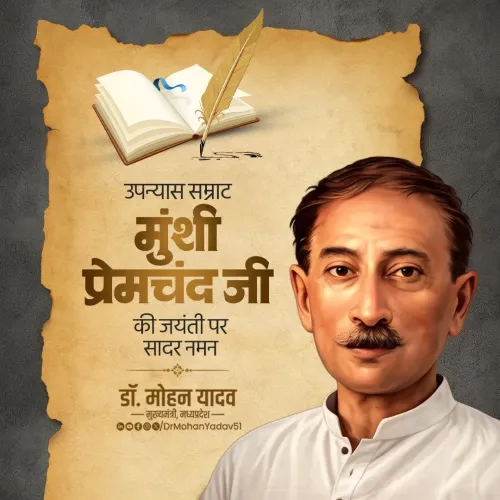
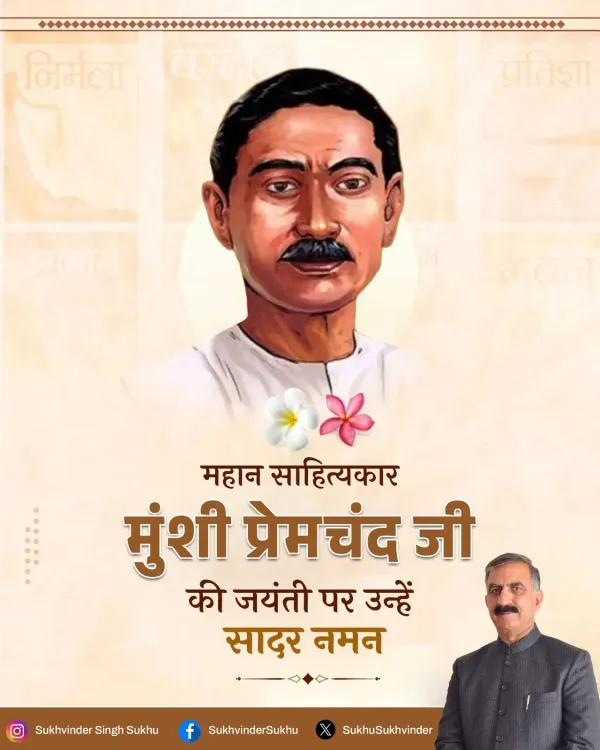
CM Sukhu pays tribute to Munshi Premchand on Jayanti
Synopsis
Himachal Pradesh Chief Minister Sukhvinder Singh Sukhu marked Premchand Jayanti on 31 July with a tribute to the 'Emperor of Novels,' honouring the writer's enduring portrayal of rural India's struggles and humanity.
Key Takeaways
CM Sukhvinder Singh Sukhu posted a tribute to Munshi Premchand on his birth anniversary, 31 July .
Premchand, born 1880 in Lamhi near Varanasi , is celebrated as the 'Upanyas Samrat' — Emperor of Novels — in Hindi-Urdu literature.
His landmark works include Godan and Gaban , which depict caste, poverty, and rural life with unflinching social realism.
Sukhu noted that Premchand's portrayal of village life, the poor, and ordinary people 'still touches the hearts of readers today.' Indian leaders across parties mark Premchand Jayanti annually, reflecting how his themes of agrarian distress and social equity remain central to Indian public discourse.
The voice of India's villages never really went silent. On the birth anniversary of Munshi Premchand, Himachal Pradesh Chief Minister Sukhvinder Singh Sukhu offered a heartfelt tribute to the writer widely regarded as the conscience of Hindi-Urdu literature — a man who gave the rural poor a language the world could not ignore.
Posting on 31 July, CM Sukhu wrote: 'उपन्यास सम्राट मुंशी प्रेमचंद जी की जयंती पर उन्हें सादर नमन' — 'Respectful salutations to the Emperor of Novels, Munshi Premchand, on his birth anniversary.' He noted that Premchand gave 'extraordinary expression to the ordinary life of society' through his pen, and that the emotions and struggles of villages, the poor, and common people that he captured 'still touch the hearts of readers today.'
The writer who made the village the centre of Indian literature
Munshi Premchand, born 31 July 1880 in Lamhi, near Varanasi, spent his life translating the weight of rural India into prose that endured long after his death in 1936. His novels — Godan (The Gift of a Cow) and Gaban among the most celebrated — dissected caste oppression, debt bondage, and the quiet dignity of the dispossessed with a clarity that no political pamphlet could match. He wrote in both Hindi and Urdu, bridging communities even as the subcontinent strained under colonial rule. The title 'Upanyas Samrat' — Emperor of Novels — was not given lightly. Premchand's social realism remains a living curriculum in Indian schools and universities, ensuring that each generation meets his characters: the indebted farmer, the struggling widow, the idealistic village schoolteacher.A tradition of literary remembrance in Indian public life
Indian elected leaders across party lines mark Premchand Jayanti each year, a practice that underscores how deeply his themes — agrarian distress, social equity, the dignity of labour — remain embedded in the political vocabulary of the country. For a Chief Minister governing a largely rural, mountainous state like Himachal Pradesh, invoking Premchand carries a particular resonance: the struggles he chronicled are not merely historical footnotes but living realities for many constituents. Schools and literary bodies across India typically organise readings, essay competitions, and cultural programmes on 31 July each year to keep that conversation alive. Nearly ninety years after his death, Premchand's pen still moves people. That is the only legacy that matters.Point of View
Empathy for the rural poor and social equity. For a Congress-led government in a predominantly rural state like Himachal Pradesh, the symbolism is deliberate: Premchand's themes of agrarian struggle and the dignity of ordinary labour map directly onto the party's traditional electoral narrative. While the tribute is ceremonial, the regularity with which leaders across the spectrum honour Premchand on 31 July reflects how his social-realist legacy has become a shared moral reference point in Indian public life — one that transcends party lines even as individual politicians use it to reinforce their own positioning.
NationPress
14 Sept 2026
Frequently Asked Questions
Why is 31 July celebrated as Premchand Jayanti?
31 July is the birth anniversary of Munshi Premchand , born on this date in 1880 in Lamhi, near Varanasi. It is observed across India with literary events, school programmes, and public tributes honouring his contribution to Hindi-Urdu literature.
Who is Munshi Premchand and why is he called Upanyas Samrat?
Munshi Premchand (1880–1936) was a pioneering Hindi-Urdu novelist and short-story writer whose works depicted rural poverty, caste discrimination, and social struggle with deep empathy. The title 'Upanyas Samrat' — Emperor of Novels — was conferred on him in recognition of his unmatched contribution to Indian fiction.
What are Munshi Premchand's most famous works?
His most celebrated novels include Godan (The Gift of a Cow) and Gaban . He also wrote hundreds of short stories, many of which are part of school and university curricula across India.
Why did CM Sukhu pay tribute to Munshi Premchand?
Himachal Pradesh Chief Minister Sukhvinder Singh Sukhu posted the tribute on 31 July , Premchand's birth anniversary, acknowledging the writer's extraordinary ability to give voice to the emotions and struggles of villages, the poor, and ordinary people — themes that remain relevant in contemporary India.
How do Indian states mark Premchand Jayanti?
Literary bodies, schools, and state governments across India typically organise readings, essay competitions, cultural programmes, and seminars on 31 July each year to commemorate Premchand's birth anniversary and keep his social-realist legacy alive.