Nadda: Ayushman Vay Vandana Completes 2 Years, 1.38 Cr Cards Issued
Synopsis
Union Health Minister J. P. Nadda marks two years of Ayushman Vay Vandana Yojana on 29 October 2026, citing 1.38 crore cards issued, 23.46 lakh hospitalisations approved, and over ₹5,668 crore in authorised treatment for Indians aged 70 and above.
Key Takeaways
Ayushman Vay Vandana Yojana completed two years on 29 October 2026 , having launched on 29 October 2024.
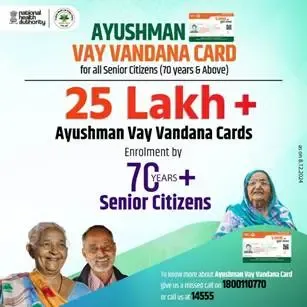
1.38 crore Ayushman Vay Vandana cards have been issued since inception.
23.46 lakh hospitalisation cases have been approved under the scheme in two years.
Hospital treatments worth over ₹5,668 crore have been authorised under the programme.
The scheme provides ₹5 lakh free annual health cover to all citizens aged 70 years and above , regardless of income.
The yojana is an extension of Ayushman Bharat PM-JAY , announced in the Union Budget 2024-25 .
Two years after it quietly reshaped the financial calculus of ageing in India, Ayushman Vay Vandana Yojana has crossed milestones that its architects in the Union Health Ministry are now putting on record. Union Health Minister J. P. Nadda marked the scheme's second anniversary on Thursday, 29 October 2026, citing data that show the programme has moved well beyond a policy promise into measurable hospital coverage for India's elderly.
Nadda wrote in Hindi: 'हमारे बुजुर्गों का सम्मानजनक जीवन, बेहतर स्वास्थ्य और आर्थिक सुरक्षा सुनिश्चित करना... सरकार की प्राथमिकता रही है' — 'Ensuring a dignified life, better health and financial security for our elders has been a priority of the government.' He credited the scheme's design — universal eligibility at 70 years and above, regardless of income — as its defining feature.
What the two-year numbers actually say
The figures Nadda cited are striking in scale. 1.38 crore Ayushman Vay Vandana cards have been issued since the scheme launched on 29 October 2024. 23.46 lakh hospitalisation cases have received approval under it. And the cumulative value of authorised hospital treatment has crossed ₹5,668 crore — underscoring the financial burden that has been absorbed by the state rather than by elderly patients or their families.
Each of those ₹5,668 crore worth of treatments represents a bill that, in the scheme's absence, would likely have landed on a senior citizen or a working-age child. That is the quiet but consequential logic behind the scheme's income-blind design.
From PM-JAY's foundations to a senior-citizen guarantee
Ayushman Bharat PM-JAY, launched in 2018, originally targeted economically weaker families, covering secondary and tertiary hospitalisation up to ₹5 lakh per year. The Union Budget 2024-25 announced a decisive expansion: the same coverage floor, extended to every Indian citizen aged 70 and above, irrespective of their income bracket. That announcement became Ayushman Vay Vandana Yojana.
The policy shift matters structurally. It moves the PM-JAY framework from means-tested targeting toward a demographic entitlement — a model more common in universal health systems. India's elderly population is growing rapidly, and out-of-pocket health expenditure among seniors has historically been among the highest of any age cohort. The scheme directly addresses that vulnerability.
Nadda's anniversary signal and what follows
Prime Minister Narendra Modi's government has used each PM-JAY milestone as a communications moment, and Nadda's post follows that pattern — but the numbers behind it give it weight beyond routine anniversary messaging. With ₹5,668 crore authorised in just two years and card issuance at 1.38 crore, the scheme's utilisation trajectory will be closely watched in the next Union Budget cycle, particularly as states report their own implementation data.
The real test ahead is not cards issued but claims settled — whether the backend hospital network and claims-processing infrastructure can scale to meet the health needs of a demographic that is both growing and, by nature, high-frequency users of healthcare. That question will define the scheme's third year more than any anniversary figure.
Point of View
Signalling a shift in how India's health coverage architecture is being designed. With 1.38 crore cards issued and ₹5,668 crore authorised in two years, the scheme has reached operational scale, but the quality of claims settlement and state-level implementation depth will determine whether it becomes a durable pillar of India's ageing-population policy or a high-card-issuance, low-delivery programme.
NationPress
29 Oct 2026
Frequently Asked Questions
What is Ayushman Vay Vandana Yojana?
Ayushman Vay Vandana Yojana is a central government health scheme launched on 29 October 2024 that provides up to ₹5 lakh per year in free hospitalisation coverage to all Indian citizens aged 70 years and above, irrespective of their income or socioeconomic status.
How many people have received cards under Ayushman Vay Vandana Yojana?
According to Union Health Minister J. P. Nadda's statement on 29 October 2026, 1.38 crore Ayushman Vay Vandana cards have been issued in the two years since the scheme's launch.
What is the difference between Ayushman Bharat PM-JAY and Ayushman Vay Vandana Yojana?
Ayushman Bharat PM-JAY, launched in 2018, originally covered economically weaker families. Ayushman Vay Vandana Yojana, announced in the Union Budget 2024-25 and launched in October 2024, extends the same ₹5 lakh coverage to all citizens aged 70 and above regardless of income — making it a universal entitlement for senior citizens.
How much has the government spent on Ayushman Vay Vandana treatments?
Hospital treatments worth over ₹5,668 crore have been authorised under Ayushman Vay Vandana Yojana in the two years since its launch, according to figures cited by Health Minister J. P. Nadda.
Who is eligible for Ayushman Vay Vandana Yojana?
Every Indian citizen aged 70 years or above is eligible for Ayushman Vay Vandana Yojana, with no income or means-test condition applied — making it one of the broadest age-based health entitlements in India's public health system.