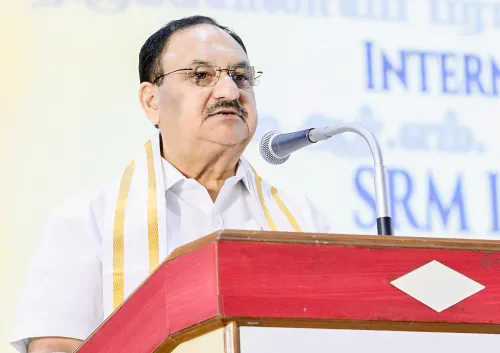
Nadda dares Rahul: file sworn complaint on Mahadevapura bogus votes
Synopsis
Union Health Minister J. P. Nadda challenged Rahul Gandhi and Congress on 29 October 2026, asking why they had not filed a sworn complaint with the Election Commission 470 days after alleging 1 lakh bogus votes in Bengaluru's Mahadevapura constituency.
Key Takeaways
Nadda posted on 29 October 2026 targeting Rahul Gandhi's record as Leader of the Opposition.
Nadda cited the Mahadevapura bogus-vote allegation — involving a claimed 1 lakh fraudulent voter entries — as evidence of Congress raising charges without institutional follow-through.
He noted that 470 days have passed since the allegation without a sworn affidavit being filed with the Election Commission of India .
Nadda said Rahul Gandhi has failed to establish credibility as Leader of Opposition in 10 years .
A formal sworn complaint to the Election Commission would be the procedural next step that BJP argues Congress has avoided.
A pointed accountability challenge is now on the table. Union Health Minister J. P. Nadda, in a post on X on Thursday, 29 October 2026, demanded that Rahul Gandhi and the Indian National Congress explain why — 470 days after alleging 1 lakh bogus votes in the Mahadevapura assembly constituency — they have yet to file a sworn complaint before the Election Commission of India.
Nadda's attack was blunt and two-pronged: Congress needs 'ट्यूशन और स्किल डेवलपमेंट' ('tutoring and skill development') to perform its role as opposition, and Rahul Gandhi — the Leader of Opposition — has in 10 years failed to establish basic political credibility. The Mahadevapura allegation, Nadda argued, is a textbook example: a sensational charge without a single sworn affidavit to back it up.
The Mahadevapura bogus-vote allegation at the centre of the attack
Mahadevapura is a high-stakes urban assembly constituency in Bengaluru's sprawling tech-corridor belt, where voter-roll disputes have long been a flashpoint between the BJP and Congress. The allegation of 1 lakh fraudulent voter entries would, if proven, represent a significant manipulation of an electoral roll — precisely the kind of grievance the Election Commission has formal, binding mechanisms to investigate through sworn affidavits.
The BJP's consistent argument in cases like this is procedural: electoral complaints carry legal weight only when backed by a sworn statement. By counting 470 days of silence, Nadda is not just scoring political points — he is pressing a specific institutional question. Has the opposition actually engaged the Election Commission, or has the allegation served mainly as a campaign talking point?
A pattern of partisan volleys — and why the EC's role matters
This exchange fits into a well-worn groove in Indian electoral politics since 2014: Congress raises irregularity charges; the BJP counters by highlighting the absence of formal filings. The Election Commission of India, as a constitutional authority, remains the only body empowered to adjudicate such complaints — but only when formally approached. Its credibility depends precisely on parties using its processes rather than only its airtime.
Nadda's post stops short of claiming the bogus-vote allegation is false. The sting is sharper than that: he is arguing that Congress itself does not believe its allegation enough to put its name on an affidavit.
Whether Congress files a sworn complaint with the Election Commission — or mounts a parliamentary counter-offensive when the winter session convenes — will determine whether this stays a social-media skirmish or becomes a formal institutional contest.
Point of View
A specific number, and a precise day-count, he converts a broad credibility charge into a testable, verifiable claim — one that will remain a live liability for Congress unless a formal filing materialises. The move also serves a secondary purpose: reinforcing the Election Commission's legitimacy as the proper forum for electoral grievances, pre-empting any opposition narrative that the body is inaccessible or biased. The winter session of Parliament will be the next arena where this exchange is likely to resurface.
NationPress
29 Oct 2026
Frequently Asked Questions
What did J. P. Nadda say about Rahul Gandhi on 29 October 2026?
Nadda said Rahul Gandhi and Congress need 'tutoring and skill development' to play the opposition role effectively, pointing out that Gandhi has failed to establish credibility in 10 years and has not filed a sworn complaint with the Election Commission despite alleging 1 lakh bogus votes in Mahadevapura 470 days ago.
What is the Mahadevapura bogus-vote allegation?
Congress alleged that approximately 1 lakh fraudulent voter entries existed in the Mahadevapura assembly constituency in Bengaluru. Nadda's post notes that no sworn affidavit backing this allegation has been filed with the Election Commission 470 days after the charge was made.
Why does a sworn complaint matter to the Election Commission of India?
The Election Commission can formally investigate electoral irregularities only when a complaint is backed by a sworn affidavit, which carries legal accountability. Without it, the allegation has no official standing before the constitutional body.
What is Rahul Gandhi's current political position?
Rahul Gandhi is the Leader of the Opposition in the Lok Sabha and a senior leader of the Indian National Congress party.
What is Mahadevapura and why is it politically significant?
Mahadevapura is an assembly constituency in Bengaluru Urban district, Karnataka, located in the city's tech-corridor belt. It has been a politically contested seat where voter-roll disputes have repeatedly emerged as a flashpoint between the BJP and Congress.