Nadda fires at Rahul Gandhi over Parliament disruptions
Synopsis
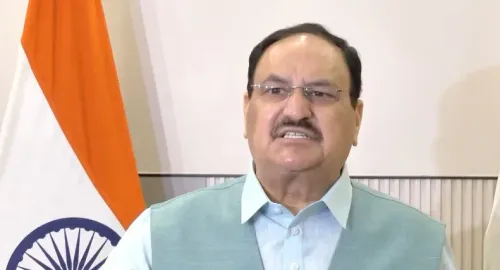
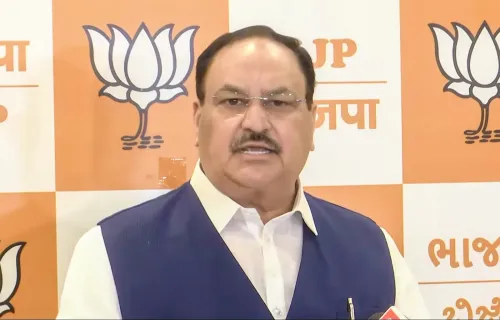
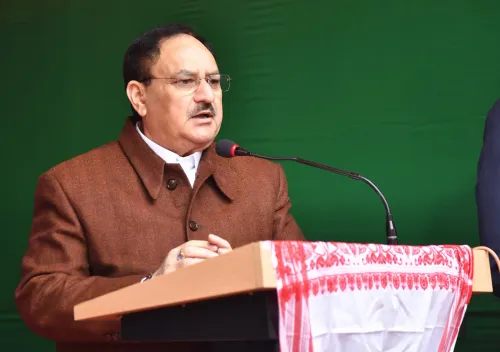
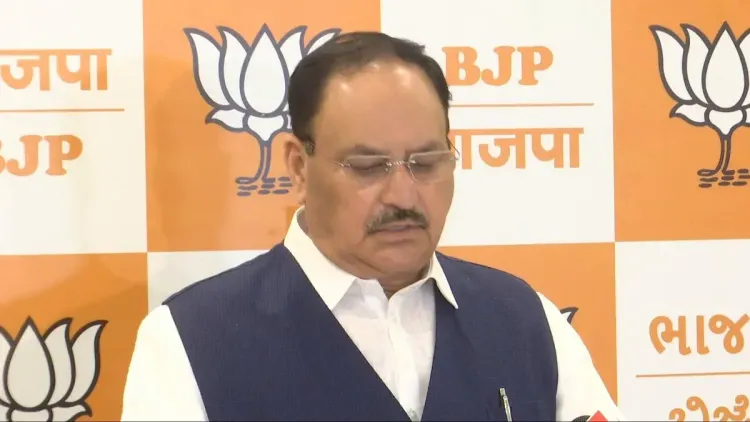
Union Health Minister and BJP president J. P. Nadda publicly accused Rahul Gandhi of deliberately stalling Parliament for 15 days, spreading 'anarchy' instead of engaging in debate, and ignoring student voices in Jharkhand — challenging him to face discussion on the floor of the House.
Key Takeaways
Nadda , BJP national president and Union Health Minister, accused Rahul Gandhi of obstructing Parliament for 15 days on 10 August 2026 .
Nadda alleged Gandhi's goal is to 'spread anarchy' rather than engage in legislative debate.
He issued a direct challenge: 'Do not run from debate — we are ready to discuss every subject inside the House.' Nadda accused Congress of 'double standards,' pointing to alleged silence on student concerns in Jharkhand while disrupting proceedings in Delhi.
BJP framed the disruptions as 'irresponsible opposition' and 'negative politics,' using the hashtag #राहुल_भागना_नहीं to amplify the message.
Parliamentary disruptions have been a recurring pattern across sessions since 2014 , with both sides trading blame.
For fifteen days, according to BJP national president and Union Health Minister J. P. Nadda, India's Parliament has been held hostage — not by legislation, but by obstruction. On Monday, 10 August 2026, Nadda took his sharpest public swipe yet at Rahul Gandhi, accusing the Congress leader of 'changing the goalpost every day' and deliberately preventing the House from functioning.
Posting in Hindi on X, Nadda charged that Gandhi's intent is not dialogue but disorder — 'araajkata failaana' [spreading anarchy]. 'Rahul Gandhi, do not run away from debate,' Nadda wrote. 'Inside the House, we are ready to discuss every subject and you will be given a fitting reply.'
The 'double standard' charge and the Jharkhand question
Nadda's sharpest rhetorical jab was a direct question: can Gandhi not hear the voices of students in Jharkhand? The reference pointed to what the BJP frames as a selective conscience — Congress disrupting Parliament in Delhi while, Nadda alleged, ignoring student grievances in a state where the party's alliance is in government. He tagged the exchange with the hashtag #राहुल_भागना_नहीं [Rahul, don't run].
Nadda called the pattern 'double standard politics' — loud opposition in the well of the House, silence on issues closer to home. He described Congress's role as 'irresponsible opposition' driven by negative politics rather than legislative intent.
A familiar fault line in Indian parliamentary politics
The charge is not new, but the sharpness of the language signals an escalation. Disruptions in both Lok Sabha and Rajya Sabha have been a recurring feature of Indian parliamentary sessions since 2014, with the treasury and opposition benches trading accusations of stonewalling debate. The BJP has consistently argued that Congress uses procedural disruptions as a substitute for substantive opposition; Congress has countered that the government refuses to allow genuine accountability debates.
What makes this moment notable is the personal directness — a cabinet minister and ruling party president addressing the leader of opposition by name, in public, with a challenge to debate rather than disrupt. The hashtag itself is a campaign-style instrument, designed to shape the narrative beyond the chamber walls.
Whether the current session's logjam breaks — and whether Congress responds to the Jharkhand student angle — will be the test of whether this is political theatre or a genuine opening for floor debate.
Point of View
The BJP seeks to shift public perception of who bears responsibility for a stalled session. The Jharkhand student reference is a calculated insertion, designed to expose what the BJP sees as Congress's asymmetric outrage. This fits a broader BJP strategy of personalising opposition critique around Gandhi rather than Congress as an institution, making him the face of legislative dysfunction. The hashtag campaign signals the party is fighting this battle on social media as aggressively as on the floor of the House.
NationPress
25 Sept 2026
Frequently Asked Questions
Why is J. P. Nadda criticising Rahul Gandhi over Parliament?
Nadda accused Rahul Gandhi of deliberately disrupting Parliament for 15 days to spread disorder rather than engage in debate, challenging him to participate in floor discussions instead.
What is the Jharkhand student issue Nadda mentioned?
Nadda referenced student concerns in Jharkhand to allege that Congress applies double standards — disrupting Parliament in Delhi while remaining silent on issues in states where its alliance governs. Specific details of the student matter have not been independently verified.
What does the hashtag #राहुल_भागना_नहीं mean?
The Hindi hashtag translates to 'Rahul, do not run' — a BJP campaign phrase challenging Rahul Gandhi to face debate in Parliament rather than obstruct proceedings.
How common are Parliament disruptions in India?
Parliamentary disruptions have been a recurring feature in both Lok Sabha and Rajya Sabha since 2014, with the ruling party and opposition repeatedly accusing each other of blocking legitimate debate.
What is J. P. Nadda's current position?
J. P. Nadda is the Union Minister of Health and Family Welfare, Minister of Chemicals and Fertilizers, and the national president of the Bharatiya Janata Party (BJP).