Akhilesh Yadav slams BJP over UP school mergers, girls' education

Synopsis
Samajwadi Party chief Akhilesh Yadav accused the BJP government in Uttar Pradesh of deliberately closing schools to limit education, suppress reservation demands, and curb political opposition — warning that teachers and students may launch a statewide protest movement.
Key Takeaways
Akhilesh Yadav argued on 9 November 2026 that a $1 trillion or $5 trillion economy is worthless if a single child is denied schooling due to BJP policy.
He claimed school mergers in Uttar Pradesh are causing parents to stop sending daughters to distant schools, reducing female education in villages.
Yadav alleged the BJP deliberately shrinks school numbers to reduce an educated, questioning electorate that would oppose divisive politics.
He linked reduced education to fewer government jobs, and fewer jobs to avoiding the constitutional obligation to provide reservations.
He invoked the earlier 'online attendance' agitation, saying teachers must be respected for a good generation to emerge, and called the BJP government ' हृदयहीन ' (heartless).
He closed with a direct warning: 'अब शिक्षा विरोधी भाजपा जाएगी, फिर कभी नहीं आएगी!' — framing education as the SP's core electoral issue.
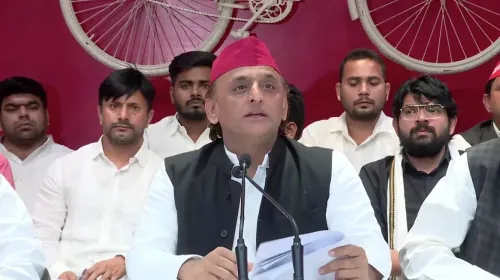
Every trillion dollars added to India's GDP means nothing, Samajwadi Party president Akhilesh Yadav argued on Monday, 9 November 2026, if even a single child is denied schooling — a pointed attack on the BJP government in Uttar Pradesh over its school rationalisation and merger policy.
The merger argument: doors close, girls stay home
At the heart of Yadav's critique is a simple ground-level consequence he says the ruling party refuses to acknowledge. When village schools merge and the nearest option moves kilometres away, families — particularly in areas with no reliable public transport and persistent safety concerns — stop sending their daughters. 'मर्जर के बाद बच्चियाँ दूर के स्कूलों में नहीं भेजी जाएंगी' ('after the merger, girls will not be sent to distant schools'), he wrote, framing the administrative exercise as a direct assault on female education in rural Uttar Pradesh.
The SP chief called the BJP 'anti-education, anti-teacher and anti-student,' and said parents are already withdrawing children from schools — a decision he argued 'only families can truly understand,' not bureaucrats optimising balance sheets.
The political logic Yadav alleges: fewer schools, fewer questions
Yadav went further, attributing the closures to deliberate political calculation. 'An educated person asks questions and opposes divisive politics,' he wrote. 'Fewer schools mean less opposition to the BJP.' The argument extends to jobs and reservations: an educated workforce demands government employment; government employment triggers constitutionally mandated reservations. Because the BJP, in his framing, is 'anti-reservation,' it has no interest in generating the educated job-seekers who would claim those seats.
The logic is combative, but it plugs into a long-running SP–BJP fault-line in Uttar Pradesh — the Samajwadi Party has consistently positioned itself as the defender of social-justice measures, including reservation, against what it describes as upper-caste conservative governance from Lucknow.
Teachers disrespected, trust broken — and a warning
Yadav reserved some of his sharpest language for how the BJP government treats the teaching community. Invoking an earlier 'online attendance' agitation, he said, 'A good generation is born only when teachers are respected and trusted.' Those who use 'abusive language' against teachers, he said, are 'as good as illiterate themselves.' He added: 'अहंकार लोगों को अनपढ़ बना देता है' ('arrogance makes people illiterate') — a barely-veiled jab at the administration.
He closed with a warning and a slogan: if teachers and students are pushed to launch a protest movement that brings 'every sector to a standstill,' the responsibility will rest with BJP. The government, he said, is 'हृदयहीन' — heartless. His parting line was unambiguous: 'अब शिक्षा विरोधी भाजपा जाएगी, फिर कभी नहीं आएगी!' ('The anti-education BJP will go now and never return!')
SP's education record and the road the party is building
Between 2012 and 2017, the Samajwadi Party government in Uttar Pradesh ran flagship education schemes, including free laptop distribution to students — a legacy Yadav routinely invokes to contrast with post-2017 policy under Chief Minister Yogi Adityanath. The school rationalisation drive that followed was framed by the BJP as resource optimisation; the SP frames it as deliberate shrinkage of opportunity. With possible teacher and parent protests building in merger-affected districts, Yadav is signalling he intends to make education the mobilising issue heading into the next electoral cycle in Uttar Pradesh.
Point of View
Not merely a policy complaint. By connecting school mergers to female dropout rates, then to reduced job demand, then to reservation avoidance, he constructs an ideological indictment that positions the SP as the singular defender of social mobility in Uttar Pradesh. The invocation of the 'online attendance' agitation suggests the SP intends to revive teacher-community solidarity as an electoral asset — a constituency that felt alienated under post-2017 surveillance measures. The slogan 'anti-education BJP will go and never return' signals the party is road-testing a unifying campaign line well ahead of the next UP assembly cycle, betting that rural education grievances can cut across caste lines in ways that conventional identity politics cannot.
NationPress
9 Nov 2026
Frequently Asked Questions
What did Akhilesh Yadav say about BJP and school mergers in UP?
Akhilesh Yadav said the BJP government's school merger policy is denying children — especially girls in villages — access to education, calling it evidence that the BJP is anti-education, anti-teacher, and anti-student.
Why does Akhilesh Yadav say BJP closes schools deliberately?
He argued that educated citizens ask questions and oppose divisive politics, so fewer schools mean fewer critics of the BJP. He also linked reduced education to fewer government jobs and therefore less pressure to deliver constitutional reservations.
How do UP school mergers affect girls' education according to Yadav?
Yadav said rural villages lack public transport and have safety concerns, so after mergers parents refuse to send daughters to distant schools, directly reducing female enrolment.
What was the 'online haziri' movement Akhilesh Yadav mentioned?
The 'online haziri' (online attendance) movement was a teachers' agitation against the BJP government's digital attendance surveillance system, which Yadav cited as an example of the government disrespecting teachers.
What is the Samajwadi Party's education record in Uttar Pradesh?
During its government from 2012 to 2017 , the Samajwadi Party ran education schemes including free laptop distribution to students, a legacy the party contrasts with the BJP's post-2017 school rationalisation drive.