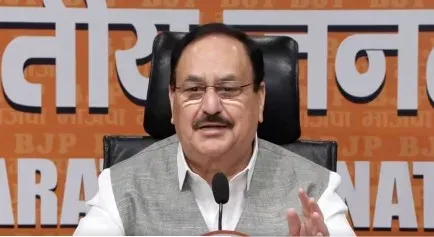
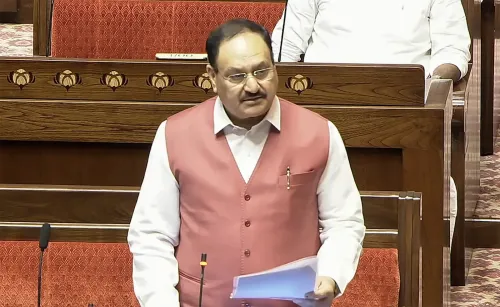
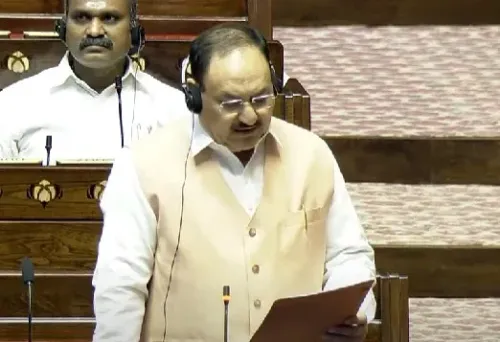
Nadda accuses Rahul Gandhi, opposition of disrupting Parliament
Synopsis
Union Health Minister J. P. Nadda accused Rahul Gandhi and the full opposition of diverting issues and disrupting Parliament, while asserting that Home Minister Amit Shah stood ready to answer every question from the opposition during the ongoing session.
Key Takeaways
Nadda , BJP national president and Union Health Minister, posted on X on August 12, 2026 accusing the opposition of parliamentary disruption.
Nadda specifically named Rahul Gandhi as part of the opposition bloc allegedly derailing the session.
He asserted that Amit Shah , Union Home and Cooperation Minister, was fully prepared to answer every opposition question on the floor.
The charge frames the opposition's conduct as deliberate evasion of responsibility rather than principled protest.
This pattern of mutual obstruction accusations between ruling and opposition parties has recurred across multiple parliamentary terms in India.
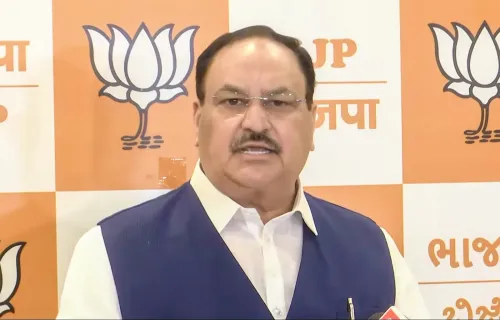
While Union Home Minister Amit Shah stood ready to answer every question the opposition could throw at him, the benches across the aisle chose a different tactic — disruption over debate. That, in sharp terms, is the charge Union Health Minister J. P. Nadda levelled on Wednesday, August 12, 2026, accusing Rahul Gandhi and the entire opposition of deliberately derailing the ongoing parliamentary session.
Posting on X, Nadda wrote in Hindi: 'माननीय केंद्रीय गृह एवं सहकारिता मंत्री श्री Amit Shah जी विपक्ष के हर सवाल पर जवाब देने के लिए तैयार हैं, लेकिन राहुल गांधी समेत पूरा विपक्ष दुर्भाग्यवश सत्र के दौरान केवल मुद्दों को भटकाने और अपनी ज़िम्मेदारी से भागने तथा संसद को बाधित करने के प्रयास कर रहे हैं।' In English: 'The honourable Union Home and Cooperation Minister Shri Amit Shah is ready to answer every question from the opposition, but unfortunately Rahul Gandhi and the entire opposition are only trying to divert issues, run away from their responsibility, and disrupt Parliament during the session.'Shah in the crosshairs — and the government's dare
The post frames Amit Shah as a willing participant in parliamentary accountability — someone prepared to face scrutiny head-on. By naming him explicitly as 'ready to answer every question,' the BJP is effectively issuing a public dare: come to the floor, ask your questions, and get your answers. The implication is unmistakable — the opposition's refusal to engage is a choice, not a compulsion.
Rahul Gandhi, singled out by name, has in recent sessions been a central figure in opposition strategy, leading protests and raising pointed challenges to the government. Nadda's post elevates that into a broader indictment — not just of Gandhi, but of the entire opposition bloc.
A script India's Parliament has seen before
This is not a new argument. Across multiple terms of both Lok Sabha and Rajya Sabha, the cycle has been remarkably consistent: the ruling side accuses the opposition of obstruction; the opposition counters that it is being denied adequate discussion time. Sittings get shortened, legislation stalls, and the public is left with a parliament that produced heat but little light.
What makes the current moment notable is the directness of the call-out. Nadda, as BJP national president and a senior cabinet minister, is not a backbencher venting frustration — this is a coordinated message from the party's top tier, signalling that the government intends to fight the optics battle as aggressively as the legislative one.
The session's ultimate scorecard — bills passed, debates held, questions answered — will determine which side's narrative holds. For now, the government has drawn its line in public, and the opposition's next move on the floor will be watched closely.
Point of View
Not a spontaneous reaction — by positioning Amit Shah as the willing, accountable minister and casting Rahul Gandhi as the one fleeing scrutiny, the BJP is attempting to flip the obstruction narrative on its head ahead of the session's legislative stretch. It fits a broader pattern where the ruling party uses social media to fight battles that stall on the floor of the House. The singling out of Gandhi by name is also deliberate: it personalises the conflict and keeps the Congress leader on the defensive in the court of public opinion, even as formal parliamentary procedures grind on.
NationPress
27 Sept 2026
Frequently Asked Questions
Why did J. P. Nadda criticise the opposition in Parliament?
Nadda accused the opposition, including Rahul Gandhi, of deliberately disrupting the parliamentary session rather than engaging in debate, even as Home Minister Amit Shah was stated to be ready to answer all their questions.
What did Nadda say about Amit Shah in Parliament?
Nadda said Amit Shah was fully prepared to answer every question raised by the opposition during the ongoing session, framing the opposition's disruption as an avoidance of legitimate debate.
Has the Indian Parliament faced opposition disruptions before?
Yes, opposition walkouts, protests, and shortened sittings have been a recurring feature across multiple terms of both Lok Sabha and Rajya Sabha, with governments and oppositions trading obstruction accusations regularly.
What is the BJP's stance on parliamentary disruptions?
The BJP has accused the opposition of diverting issues and evading responsibility by disrupting Parliament, arguing that the government is open to debate and questioning on the floor of the House.