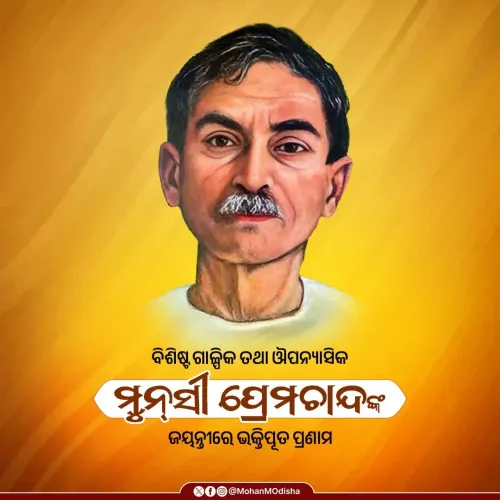
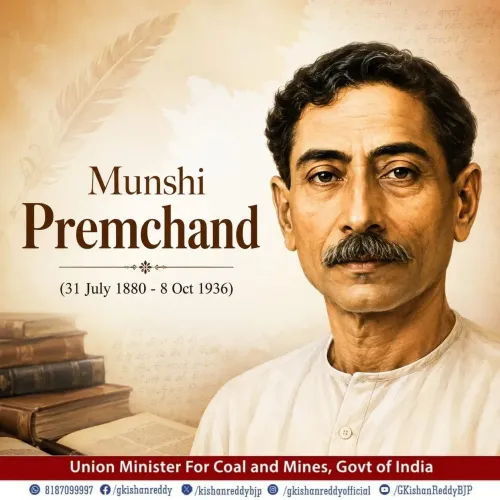
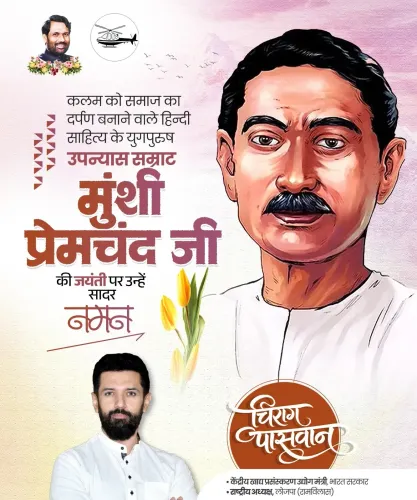
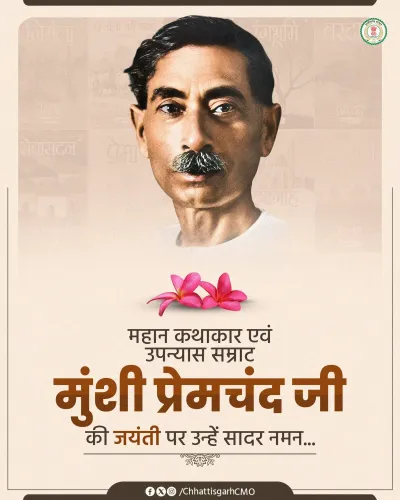
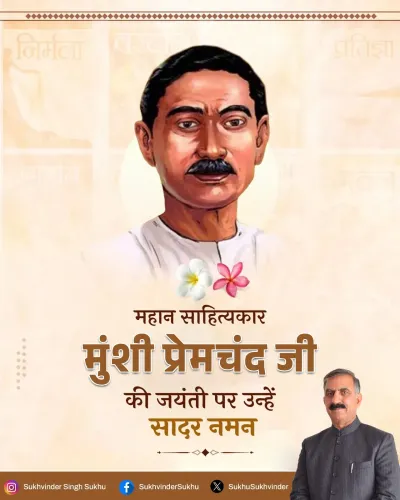
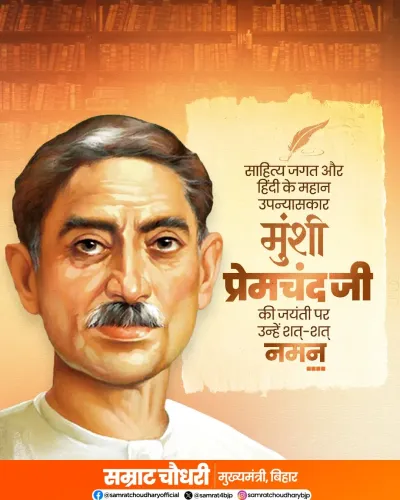
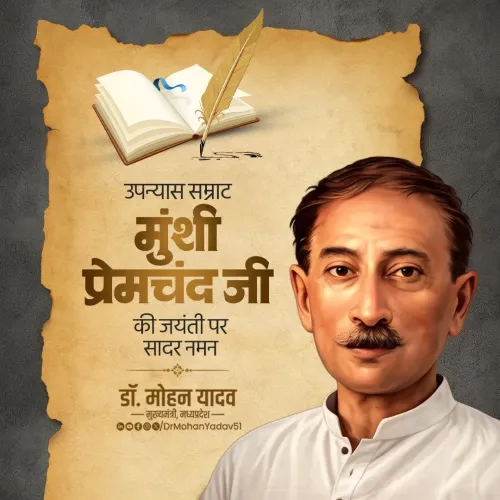
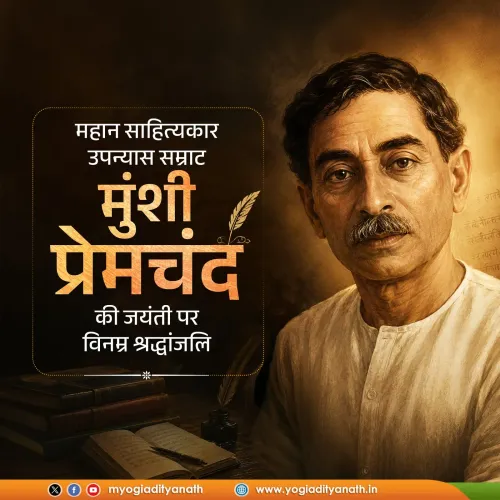
HP CM Office pays tribute to Munshi Premchand on his birth anniversary
Synopsis
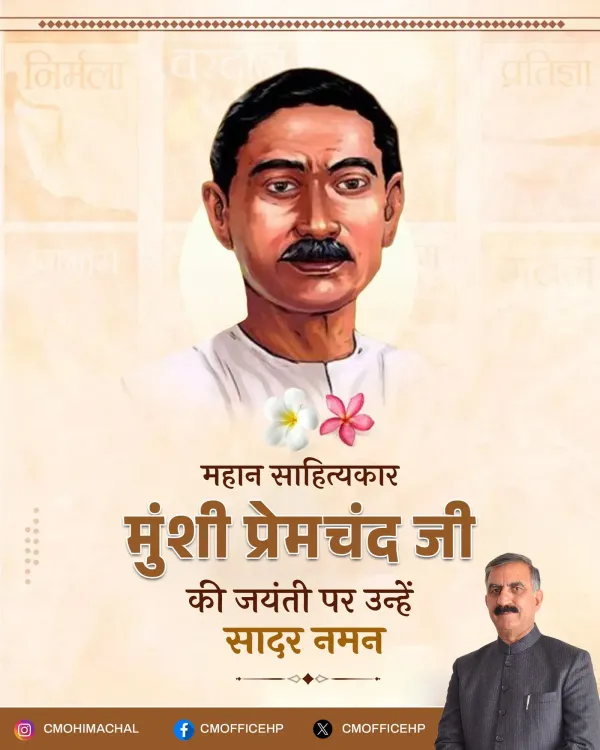
The Chief Minister's Office of Himachal Pradesh honoured Munshi Premchand on his birth anniversary on 31 July 2026, saluting the 'Emperor of Novels' for giving extraordinary literary voice to the lives, struggles, and emotions of India's rural poor and common people.
Key Takeaways
The Chief Minister's Office of Himachal Pradesh posted a tribute to Munshi Premchand on his birth anniversary, 31 July 2026 .
The CMO described Premchand as giving 'extraordinary expression to the ordinary lives of society' through his writing.
Premchand, born 31 July 1880 , is revered as Upanyas Samrat — 'Emperor of Novels' — in Hindi-Urdu literary tradition.
His landmark works include Godan and Gaban , which portrayed caste, poverty, and rural life in pre-independence India.
Indian state governments routinely issue such tributes on literary anniversaries, reinforcing cultural heritage as part of official public messaging.
A writer who gave voice to the voiceless — Munshi Premchand, the towering figure of Hindi-Urdu literature, was remembered on his birth anniversary on Friday, 31 July 2026, as the Chief Minister's Office of Himachal Pradesh paid its respects to the man who made ordinary lives extraordinary through prose.
The CMO's post, shared in Hindi, offered a heartfelt tribute: 'उपन्यास सम्राट मुंशी प्रेमचंद जी की जयंती पर उन्हें सादर नमन' — 'Respectful homage to the Emperor of Novels, Munshi Premchand, on his birth anniversary.' The message noted how Premchand, through his writing, gave 'extraordinary expression to the ordinary lives of society' — the villages, the poor, and the common people whose emotions and struggles he rendered with rare intimacy.
The writer who made rural India the protagonist
Born on 31 July 1880, Dhanpat Rai Srivastava — who wrote under the pen name Munshi Premchand — spent his literary career doing something radical for his era: centring the story of India not on kings or courts, but on the peasant, the widow, the debt-ridden farmer. His novels Godan and Gaban remain foundational texts of South Asian literature, dissecting caste, class, and colonial-era rural despair with surgical empathy. He wrote in both Hindi and Urdu, bridging linguistic communities at a time when such bridges mattered enormously. His title — Upanyas Samrat, 'Emperor of Novels' — was not self-proclaimed. It was bestowed by readers and critics who recognised that no one before or since had mapped the interior life of India's rural poor with such fidelity and feeling.State governments and the ritual of literary memory
The Himachal Pradesh CMO's tribute follows a well-established pattern across Indian state governments: on the birth anniversaries of iconic literary and cultural figures, official handles issue public remembrances that signal an alignment between governance and cultural heritage. For Premchand specifically, whose entire body of work is a meditation on the struggles of the marginalised, such tributes carry an implicit policy resonance — a reminder that the concerns he wrote about a century ago remain live questions in contemporary India. Premchand died on 8 October 1936, leaving behind over a dozen novels, roughly 300 short stories, and a legacy that continues to shape Hindi literature curricula across the country.Point of View
But it arrives within a broader pattern of Indian governments invoking literary icons to signal cultural sensitivity. Premchand's work — rooted in the struggles of the rural poor, caste oppression, and agrarian debt — carries an implicit political resonance that makes such tributes more than merely symbolic. For a hill state like Himachal Pradesh, where rural and agricultural communities remain central to the social fabric, aligning official messaging with Premchand's legacy subtly reinforces a government's claim to understanding ground-level realities. The ritual of literary remembrance, repeated across state capitals on such anniversaries, also reflects how cultural heritage functions as soft political currency in contemporary Indian governance.
NationPress
15 Sept 2026
Frequently Asked Questions
Why is Munshi Premchand's birth anniversary celebrated on 31 July?
Munshi Premchand was born on 31 July 1880 , and his birth anniversary — known as Premchand Jayanti — is observed on this date each year by literary institutions, schools, and governments across India to honour his contributions to Hindi-Urdu literature.
What does 'Upanyas Samrat' mean and why is Premchand called that?
Upanyas Samrat means 'Emperor of Novels' in Hindi. Premchand earned this title because of the unmatched depth, volume, and social impact of his novelistic work, which included over a dozen novels that realistically depicted the lives of India's rural poor and marginalised communities.
What are Munshi Premchand's most famous works?
Premchand's most celebrated novels include Godan — a landmark portrayal of agrarian distress and the life of a poor farmer — and Gaban , which explores middle-class aspirations and moral compromise. He also wrote approximately 300 short stories in Hindi and Urdu.
Why did the Himachal Pradesh CMO pay tribute to Munshi Premchand?
The Chief Minister's Office of Himachal Pradesh posted a tribute on 31 July 2026 to mark Premchand's birth anniversary, honouring his literary legacy of giving voice to the struggles of ordinary, rural, and poor people — a practice common among Indian state governments on major literary anniversaries.
When did Munshi Premchand die?
Munshi Premchand passed away on 8 October 1936 , leaving behind a vast literary legacy that continues to be studied in Hindi literature curricula across India.