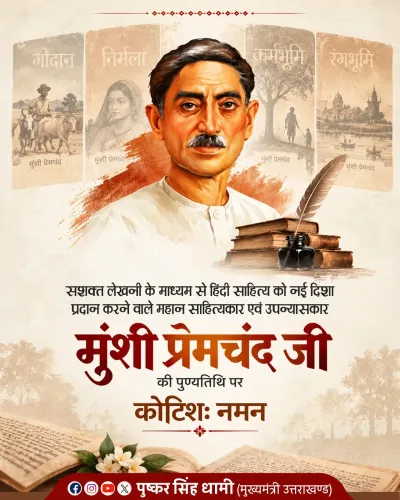
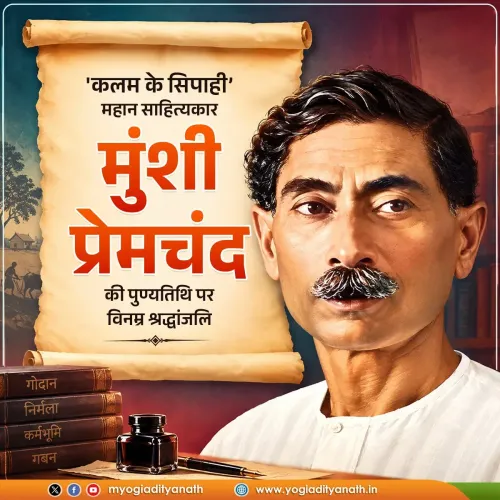
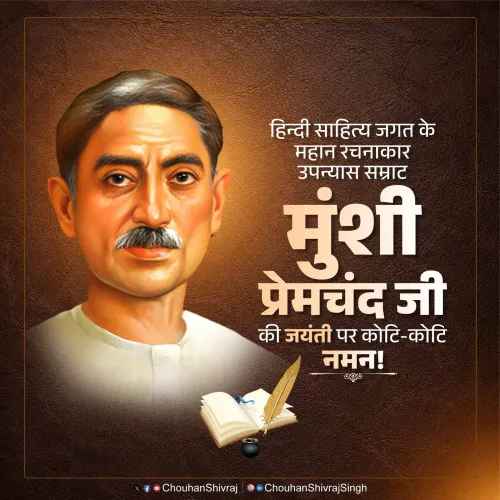
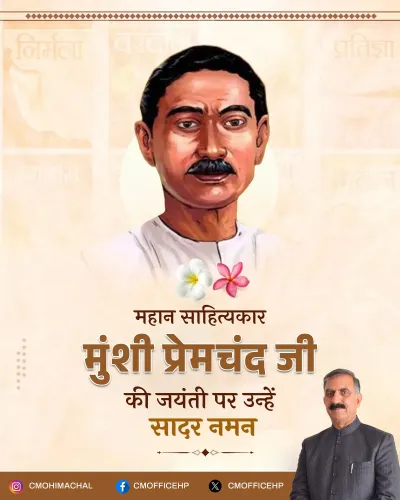
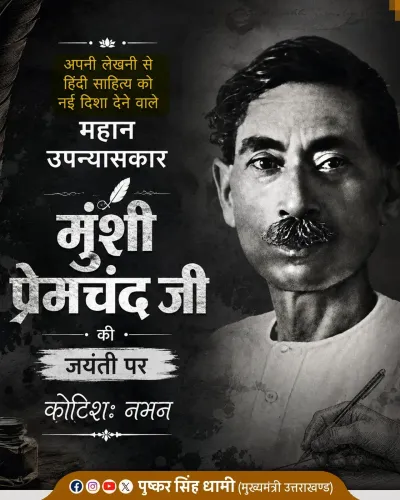
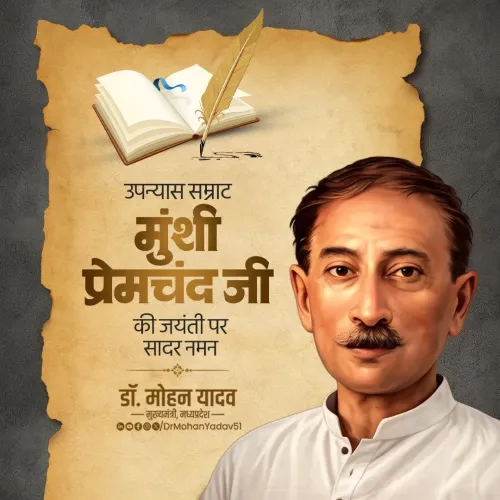
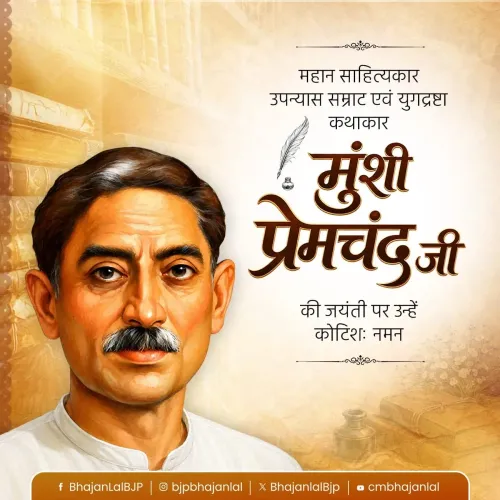
CM Bhajan Lal Sharma pays tribute to Munshi Premchand
Synopsis
Rajasthan Chief Minister Bhajan Lal Sharma on 8 October 2026 honoured Munshi Premchand on his death anniversary, praising the novelist's unparalleled contribution to Hindi literature and his ability to voice the realities of ordinary Indian life.
Key Takeaways
Rajasthan CM Bhajan Lal Sharma paid tribute to Munshi Premchand on his death anniversary, 8 October 2026 .
He described Premchand's contribution to Hindi literature as 'unparalleled' ( atulaniya ).
Premchand was born in 1880 in Lamahi, near Varanasi and passed away on 8 October 1936 .
His major works include the novels 'Godaan' , 'Nirmala' , 'Gaban' , and the short story 'Kafan' .
He authored over a dozen novels and nearly 300 short stories , pioneering social realism in Hindi and Urdu fiction.
On the death anniversary of one of Hindi literature's most towering figures, Rajasthan Chief Minister Bhajan Lal Sharma offered a heartfelt tribute to Munshi Premchand, remembering him as a writer who gave voice to the unspoken truths of ordinary Indian life.
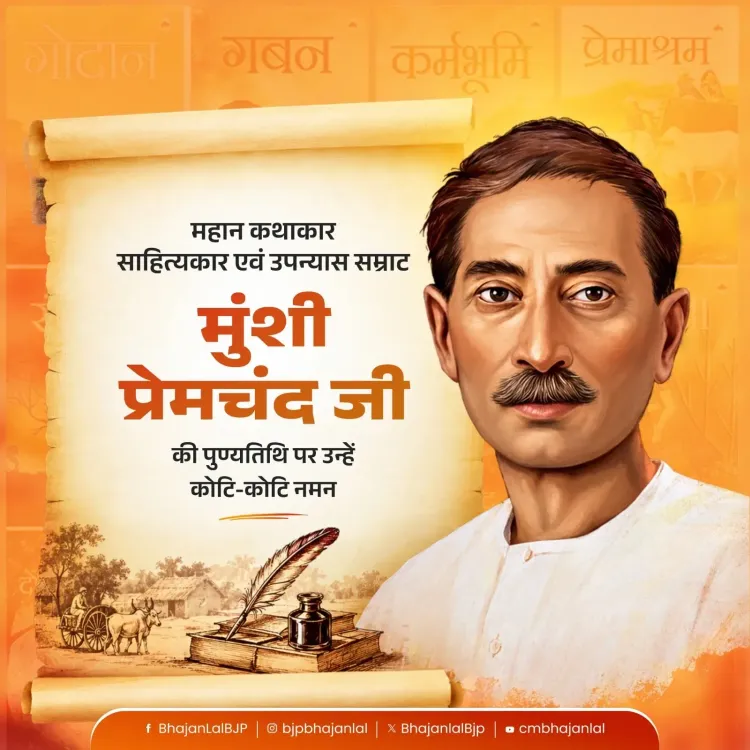
Posting on Thursday, 8 October 2026, CM Sharma wrote in Hindi: 'महान कथाकार, साहित्यकार एवं उपन्यास सम्राट मुंशी प्रेमचंद जी की पुण्यतिथि पर उन्हें कोटि-कोटि नमन!' — 'Heartfelt salutations to the great storyteller, literary giant, and emperor of novels, Munshi Premchand, on his death anniversary.' He praised Premchand's contribution to Hindi literature as 'unparalleled,' noting that his pen gave powerful expression to the realities, emotions, and social conditions of common people.
Munshi Premchand, born Dhanpat Rai Srivastava in 1880 in Lamahi, near Varanasi, remains the most widely read Hindi and Urdu prose writer in the subcontinent's modern literary history. His works — among them 'Godaan', 'Nirmala', 'Gaban', and the celebrated short story 'Kafan' — mapped the inner lives of peasants, widows, moneylenders, and low-caste families with an unflinching clarity that still resonates a century on. He passed away on 8 October 1936, leaving behind a body of work spanning over a dozen novels and close to three hundred short stories.
Premchand is credited with turning Hindi fiction away from fantastical romance and toward social realism — a shift that permanently altered the literary landscape of the subcontinent. His characters were not heroes of myth; they were farmers crushed by debt, women trapped by patriarchy, and children hungry in the shadow of indifference. That choice to look squarely at society, rather than away from it, is what CM Sharma's tribute calls 'atulaniya' — incomparable.
The Chief Minister closed by noting that Premchand's immortal works 'will continue to illuminate the literary world and acquaint readers with the humane side of life' — a line that captures the quiet, enduring power of a writer whose stories are still prescribed in school curricula across India.
Ninety years after his passing, Premchand's pen remains mightier than ever — and the leaders who read him say so publicly because the questions he asked still have no easy answers.
Point of View
A practice that frames the party's political identity around civilisational continuity rather than purely economic governance. CM Sharma's tribute to Premchand — a writer whose work was explicitly critical of caste hierarchy, landlordism, and colonial apathy — is a reminder of Premchand's rare cross-ideological appeal: no single political tradition can claim him. The fact that a sitting Chief Minister quotes a writer whose characters were oppressed peasants and marginalised women signals the enduring political currency of Premchand's moral universe. It also underscores how Hindi literature remains a soft-power resource in the politics of a state where language identity and cultural pride are deeply felt.
NationPress
8 Oct 2026
Frequently Asked Questions
When did Munshi Premchand die?
Munshi Premchand passed away on 8 October 1936 , and his death anniversary is observed annually on this date.
What are Munshi Premchand's most famous works?
His most celebrated works include the novels 'Godaan' , 'Nirmala' , and 'Gaban' , as well as the short story 'Kafan' . He wrote over a dozen novels and nearly 300 short stories in Hindi and Urdu.
Why is Munshi Premchand called 'Upanyas Samrat'?
Premchand is called Upanyas Samrat — 'Emperor of Novels' — because of his unmatched command over the novel form in Hindi and Urdu literature and his prolific, pioneering body of work.
What did Rajasthan CM Bhajan Lal Sharma say about Premchand?
CM Sharma called Premchand's contribution to Hindi literature 'unparalleled,' saying his writing gave powerful voice to the truths, emotions, and social conditions of ordinary people, and that his immortal works will continue to illuminate the literary world.
Where was Munshi Premchand born?
Munshi Premchand was born in 1880 in Lamahi , a village near Varanasi in present-day Uttar Pradesh.